The Citizen barcode printer comes with the free Citizen Bartender UltraLite 2016 printing software.
This version only has some of the functions of the Bartender software, including template editing, serial number printing, and QR code printing.
Citizen Bartender UltraLite 2016 runs on Windows 10, Windows 8, and Windows 7 operating systems, but no longer supports Windows XP and earlier operating systems.
Bartender UltraLite 2016 supports all Citizen barcode printers: CL-S300, CL-S321, CL-S521, CL-S621 , CL-S631 , CL-E720, CL-E720DT, CL-E730, CL-S700 , CL-S700DT, CL-S700R/CL-S703R, CL-S703, CL-S400DT, CL-S6621, CL-S6621XL, etc. Download the driver for Bartender UltraLite here
The Citizen barcode printer comes with the free Citizen Bartender UltraLite 2016 printing software.
This version only has some of the functions of the Bartender software, including template editing, serial number printing, and QR code printing.
Citizen Bartender UltraLite 2016 runs on Windows 10, Windows 8, and Windows 7 operating systems, but no longer supports Windows XP and earlier operating systems. Bartender UltraLite 2016 supports all Citizen barcode printers: CL-S300, CL-S321, CL-S521, CL-S621 , CL-S631 , CL-E720, CL-E720DT, CL-E730, CL-S700 , CL-S700DT, CL-S700R/CL-S703R, CL-S703, CL-S400DT, CL-S6621, CL-S6621XL, etc. Download the driver for Bartender UltraLite here
The Citizen barcode printer comes with the free Citizen Bartender UltraLite 2016 printing software.
This version only has some of the functions of the Bartender software, including template editing, serial number printing, and QR code printing.
Citizen Bartender UltraLite 2016 runs on Windows 10, Windows 8, and Windows 7 operating systems, but no longer supports Windows XP and earlier operating systems.
1.1.1 Power Connection Note: Before connecting the AC power cord or cable to the printer, ensure that the power switch is in the off position.
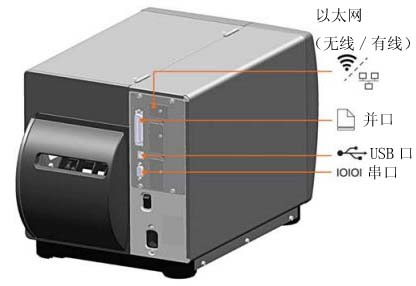
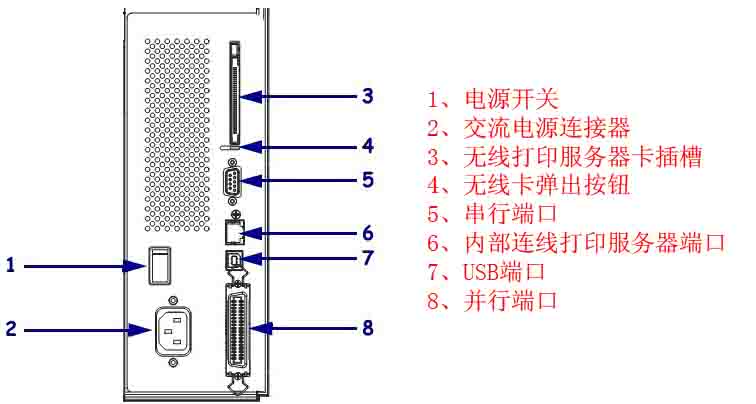
1.1.2 Interface Connection This printer can be connected to the host via a parallel, USB, serial, or optional network interface. The printer will automatically connect to the first port that feeds valid data. Once a connection is established, the printer must be restarted before the interface connection can be changed.
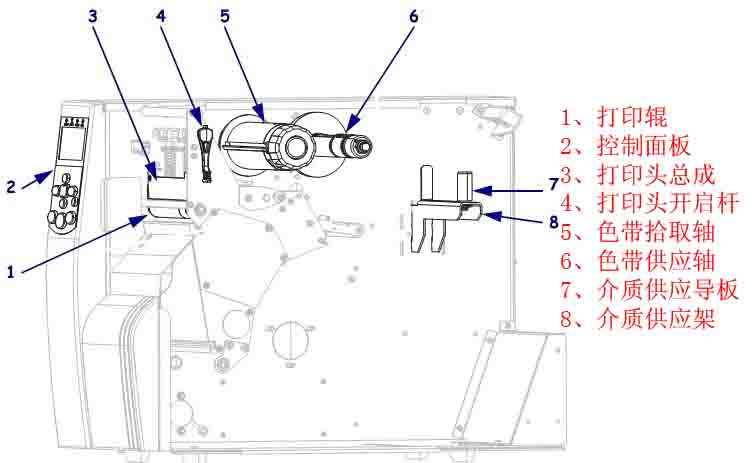
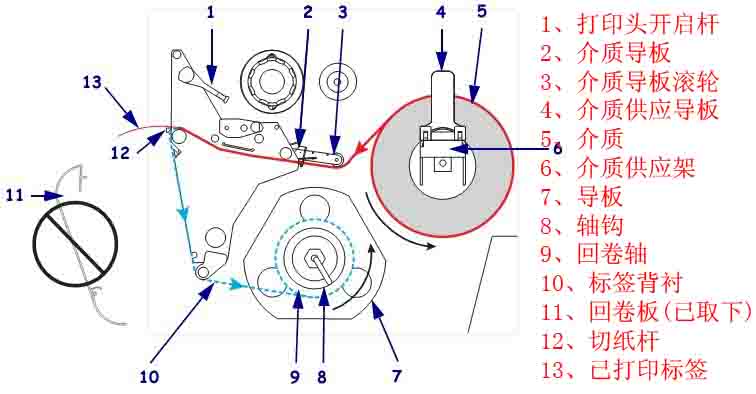
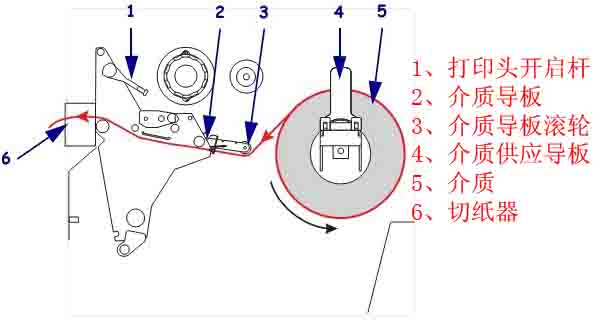
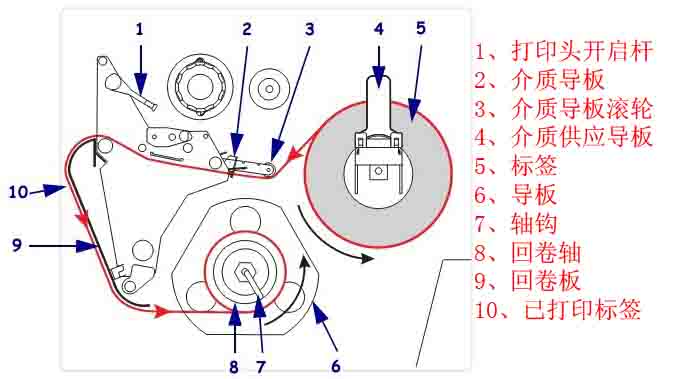
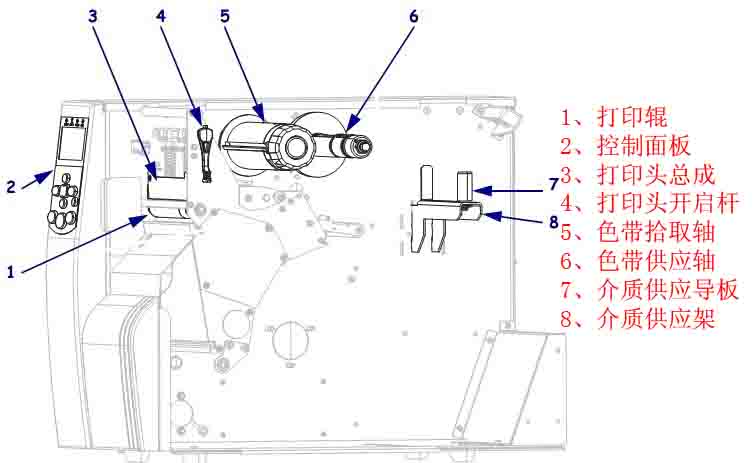
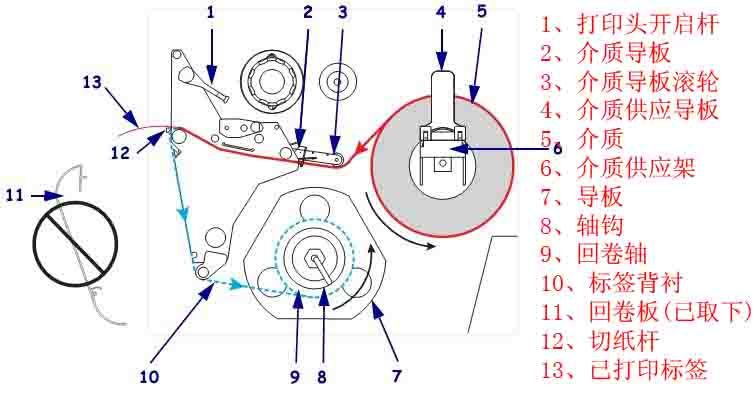
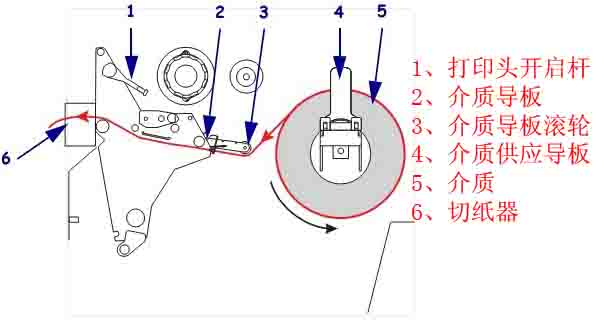
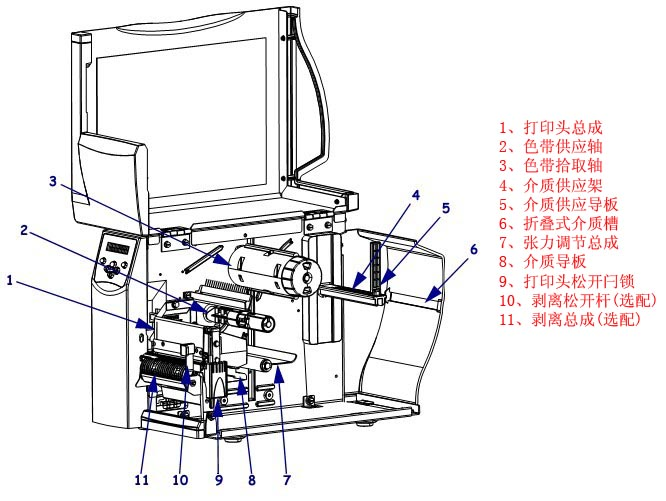
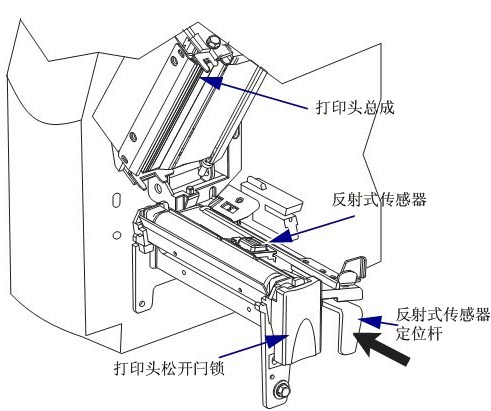
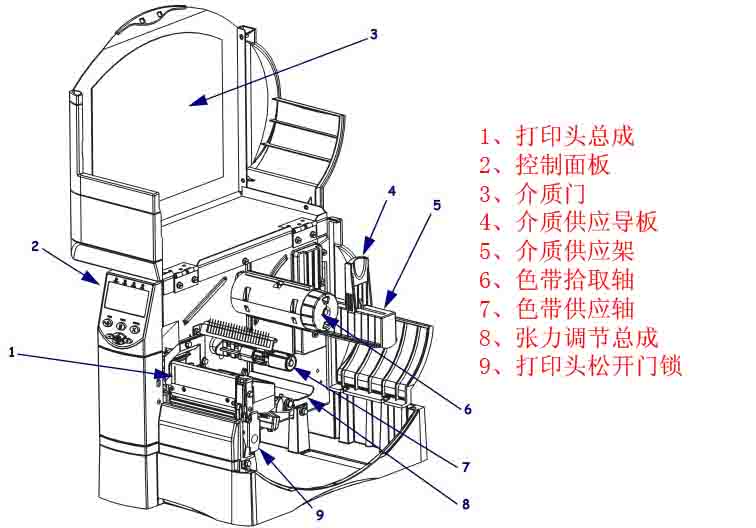
1.2 Installing Label Paper Follow these steps to load label paper into the printer: 1. Open the label paper cover. Turn and release the printhead locking lever to raise the printhead assembly. 2. Turn the label paper guide down. 3. Roll the label paper onto the label spool. 4. Guide the label paper out of the printer as shown in the diagram. Raise the label paper guide. Push the label paper guide inward to the edge of the label paper. 5. Close the printhead assembly and turn the printhead locking lever to the locked position. 6. Close the cover and press the paper feed button several times to feed the label paper to the correct position, ensuring it is correctly tracked. If the top edge of each label is not detected correctly, the printer may need to be calibrated.
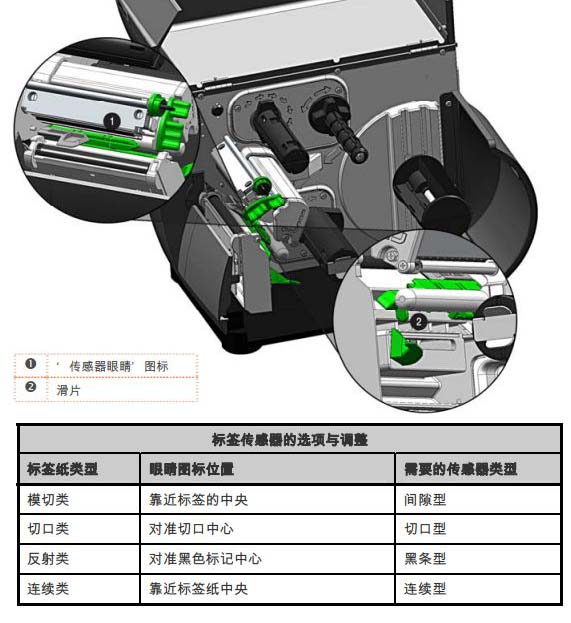
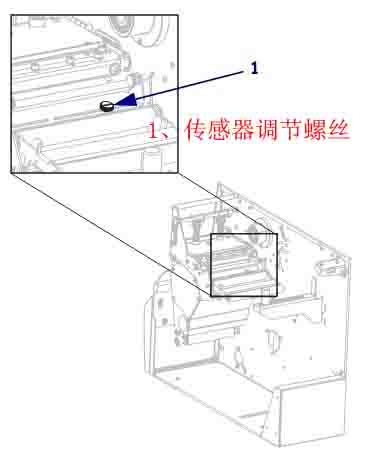
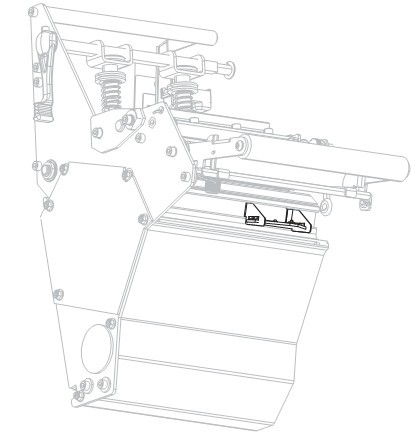
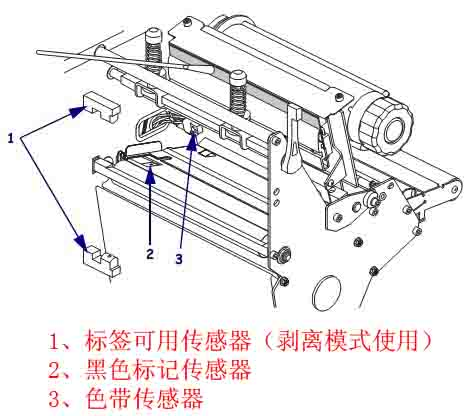
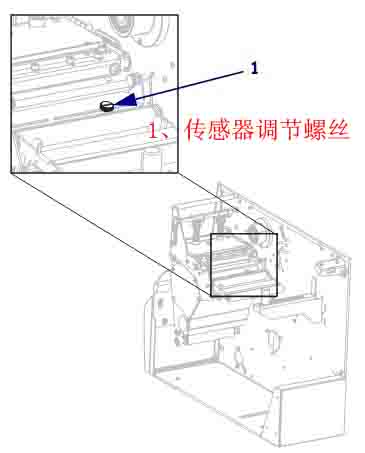
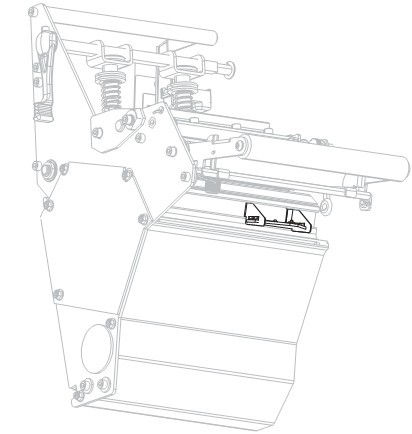
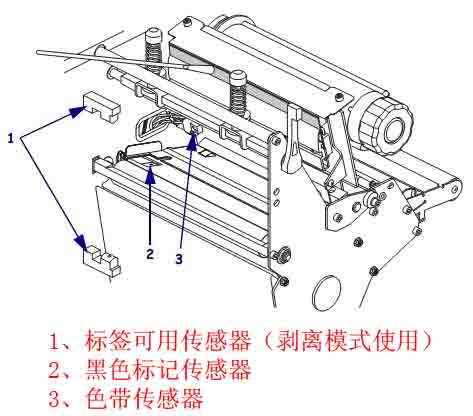
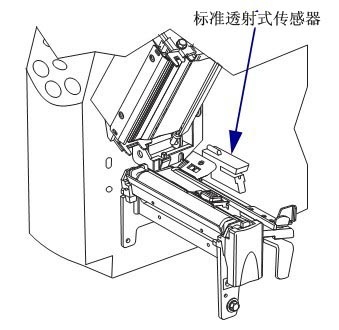
1.3 Label Sensor Adjustment The label sensor position needs to be such that the printer can detect the presence of the label paper and the label header (except for continuous label paper, whose header is set via the front panel). Adjustment steps: 1. Install the label paper, then grip the slider and move the sensor eye icon to the appropriate position above the label paper, as shown in the following figure:
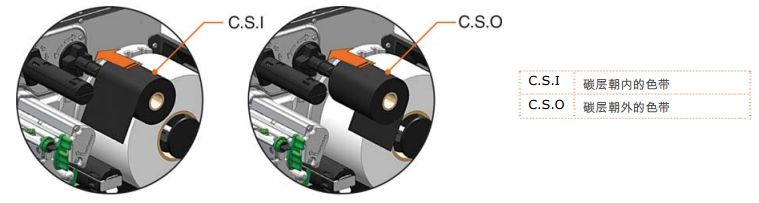
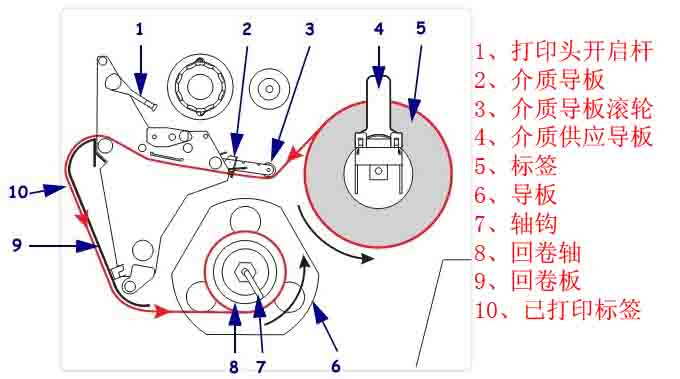
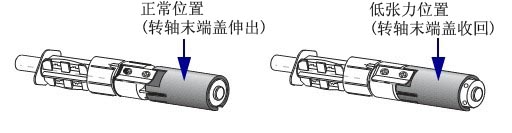
1.4 Installing the Ribbon A ribbon is required for thermal transfer label paper. It is recommended that the ribbon width be slightly wider than the label paper being printed. This printer can use either “internal carbon” or “external carbon” ribbons. The steps for installing the ribbon are as follows: 1. Open the label cover. Turn and release the printhead locking lever to raise the printhead assembly. 2. Attach the ribbon reel to the ribbon mounting shaft, placing it against the flange. Ensure the ribbon is unwound in the correct direction. The diagram below illustrates the correct ribbon installation direction.
3. Wrap the ribbon from under the ribbon roller to the front of the printer, then extend it approximately 12 inches. 4. Close the printhead assembly and turn the printhead locking lever to the locked position. Wind the ribbon upwards onto the ribbon take-up shaft, then turn clockwise several times to secure it in place. 5. Close the cover and press the paper feed button several times to feed the ribbon to the appropriate position, ensuring proper tracking.
1.5 OPTImedia The OPTIMedia function is designed to reduce setup time when using Datamax-O’Neil brand label paper and ribbons. This function automatically adjusts the printer’s heat and speed to optimal levels for best print quality. By using the model prefixes of the label paper and ribbon (printed on the shipping box), users can quickly configure the printer to achieve the best print quality for a specific label paper and ribbon combination. Steps to select OPTIMedia: 1. Press the MENU button. 2. Ensure “MEDIA SETTINGS” is highlighted, then press the ENTER button. 3. Ensure OPTImedia is highlighted, then press the ENTER button. 4. Use the down arrow key to scroll to the model prefix of the label paper being used, then press the ENTER button. 5. Thermal label paper: “OK” is displayed, then press the EXIT button to exit the menu system. Thermal transfer label paper : The printer immediately prompts you to select the ribbon being used. Scroll to the model prefix of the ribbon being used, then press the ENTER button. “OK” is displayed, then press the EXIT button to exit the menu system. The printer is now ready to print using the selected label paper/ribbon. This method will not work if you are using non-Datamax-O’Neil brand supplies.
II. Datamax I-4310e Printer Operation
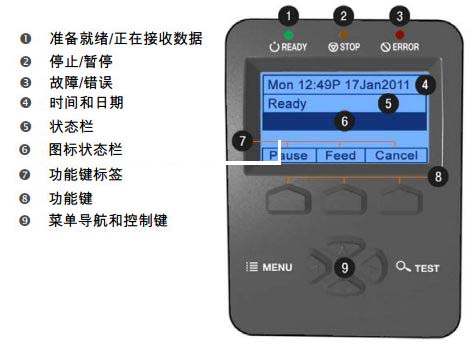
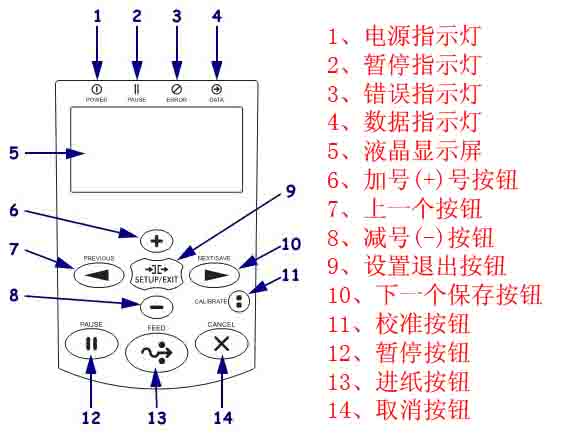
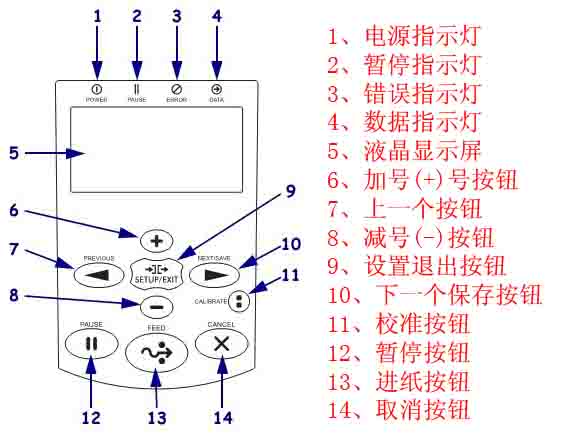
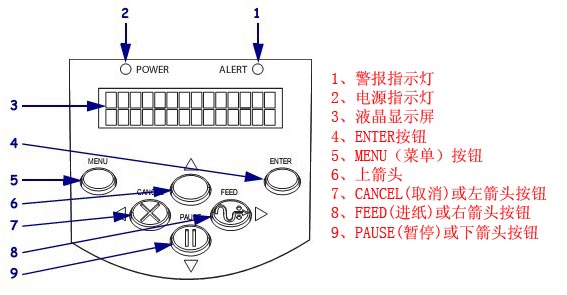
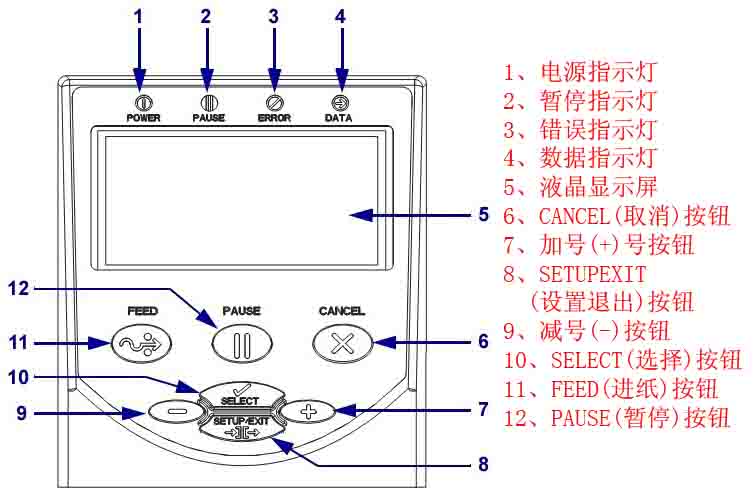
2.1 Front Panel This control panel is an event-driven interface consisting of a graphical display and a keyboard. In addition to providing current printer information, the functions of items and buttons in the main display area can be changed in different modes according to the needs of operational events.
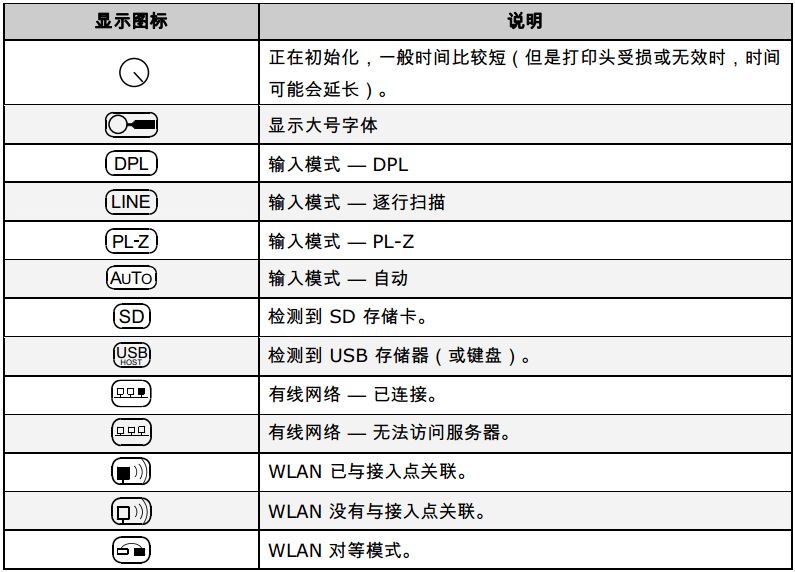
2.1.1 Display Icon
2.2 Windows Driver Datamax I-4606e Driver Download: http://www.chongshang.com.cn/news/view.asp?id=441 Some important settings in the Windows driver require attention: 1. Page Setup tab: Stock . The Stock setting needs to match the size of the label being used. If you cannot find a matching setting, click “New” and then enter the size of the label you are using. 2. Options tab: Print Speed and Printhead Temperature settings have the greatest impact on print quality. Some label papers require higher printing temperatures and slower printing speeds to ensure image print quality.
2.3 Label paper calibration
2.3.1 Quick Calibration A quick calibration should generally be performed during label paper installation to optimize detection parameters. Note: (1) This calibration is not always necessary when using continuous label paper. (2) If the gap between labels is large, the label paper may need to be changed before proceeding to the next step. The steps to calibrate the printer are as follows: 1. Ensure the printer is turned on and idle (i.e., not offline), label paper is installed, the label sensor is adjusted, and the sensor type is selected. 2. Press and hold the paper feed button until at least one full label is output, then release the paper feed button and wait for the printer to process the data. There are two possible results: If the calibration is successful, “CALIBRATION COMPLETE” will be displayed on the screen, and the label paper will feed to the beginning of the next label; if the calibration is unsuccessful, “CALIBRATION FAILED” will be displayed on the screen. In this case, check the following prompts to help resolve the issue: Calibration prompt: “WARNING LOW BACKING” is usually displayed when calibrating die-cut label paper or cut label paper with highly transparent backing. If the first attempt fails, press and hold the paper feed button until two labels are printed consecutively. However, if “CALIBRATION FAILED” appears again, perform the standard calibration routine.
2.3.2 Paper Out Calibration Paper out calibration is used to calibrate the printer’s label sensor so that it can detect a “paper out” status. The calibration steps are as follows: 1. Ensure the printer is turned on and in an idle state (i.e., not offline), and that the label paper has been removed from the printer. 2. Press and hold the pause and paper feed buttons simultaneously. The printer will then complete the calibration and be able to detect a “paper out” status.
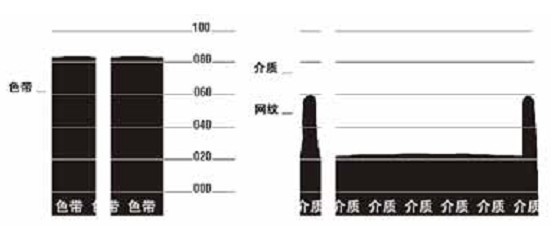
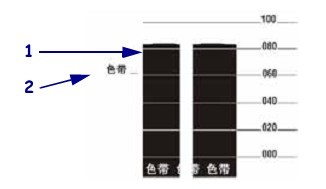
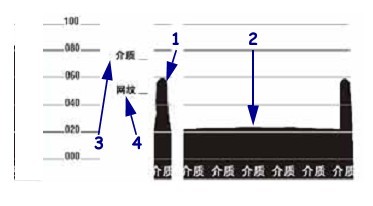
2.3.3 Standard Calibration Standard calibration can be performed using the NETira CT utility or via the printer menu using the front panel buttons. Standard calibration provides dynamic readings, which are useful when there are small cuts or stripes on the label paper that are important for positioning. Three types of calibration samples are required: No paper – no label paper on the sensor; Gap, cut, or stripe – label backing, cut, or stripe placed on top of the sensor; Paper – label (and backing, if present) placed on the sensor. The steps to calibrate the label sensor are as follows: 1. Turn on the printer and wait for the initialization operation to complete and display READY. 2. Press the MENU button. Ensure that MEDIA SETTINGS is highlighted, and then press ENTER. Use the down arrow key to scroll to “SENSOR CALIBRATION”. 3. Press ENTER to enter “SENSOR CALIBRATION”. Use the down arrow key to scroll to “PERFORM CALIBRATION”. Press ENTER again, and then press YES to continue to the next step. Press NO to abort the process. 4. The screen displays “REMOVE LABEL STOCK/PRESS ESC KEY/yyy”. Remove the label paper. Press ESC if no label paper is installed. (yyy indicates the current sensor reading.) 5. Continue according to the label paper type: ◆ For die-cut labels, the screen displays “SCAN BACKING/PRESS ESC KEY/yyy”. Tear one or two labels from the backing and install the label paper. Place the label sensor under the backing area and press ESC. ◆ For cut/reflective labels, the screen displays “SCAN MARK/PRESS ESC KEY/yyy”. Install the label paper. Place the label sensor under the cut (or black stripe) and press ESC. ◆ For continuous labels, “REMOVE LABEL STOCK/PRESS ESC KEY/yyy”, press ESC, and then proceed to the next step. 6. Screen display: SCAN PAPER/PRESS ESC KEY/yyy. Continue execution according to the label paper type: ◆ For all label papers except continuous ones, place the label material (and backing, if any) above the sensor, and then press the ESC key. ◆ Continuous label paper—Install the label paper. Place the label sensor below the label paper and press the ESC key. 7. Observe the calibration result. The screen displays CALIBRATION COMPLETE, indicating successful calibration. 8. Press the ESC key, and then press EXIT to exit the ready state. When calibrating gap or reflective label paper, press and hold the “Paper Feed” key until at least one label is output.
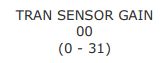
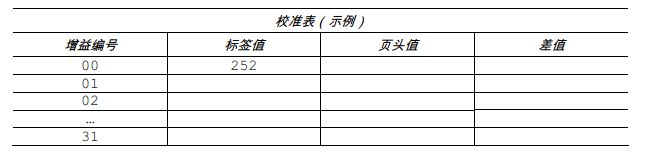
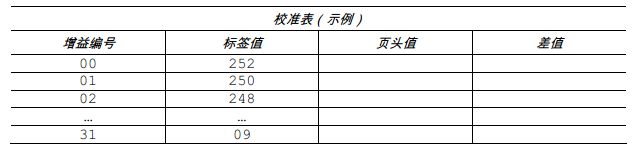
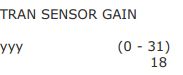
2.3.4 Advanced Input Calibration Advanced input calibration is an alternative calibration method for special label paper types. It uses different sampling algorithms to acquire sensor readings and selects the optimal algorithm from these readings, which is then manually entered into the database. Note: Advanced input calibration should only be used after standard calibration has proven unsuccessful. The steps to calibrate the label sensor are as follows: 1. Turn on the printer and wait for the initialization operation to complete and display READY. 2. Press the MENU button. Ensure MEDIA SETTINGS is highlighted, and then press ENTER. Use the down arrow key to scroll to “SENSOR CALIBRATION”. 3. Use the down arrow key to highlight “ADVANCED ENTRY”, and then press ENTER. 4. Scroll to “TRAN SENSOR GAIN” (or REFL SENSOR GAIN, if using reflective label paper), and then press ENTER. 5. Install the label paper. Place the label paper within the coverage area of the label sensor, then lower and lock the printhead assembly. Note: Do not align the aperture with the label sensor; if using pre-printed label paper, ensure that the label area above the sensor is free of text, images, or lines. 6. Use the up and down keys to set the gain number to 00. Record the sensor reading as the label value corresponding to gain number 00 in the table (32 rows x 4 columns, headers similar to the table below).
7. Use the up and down keys to increment the gain number by 1, and then record the label value. Repeat this process for each gain number.
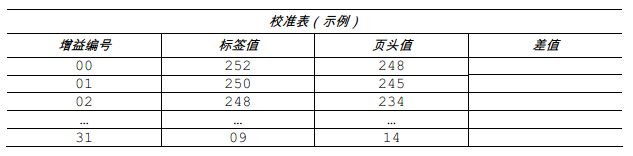
8. Raise the printhead assembly, and then continue according to the label paper type: ◆ Die-cut label paper— Tear one or two labels from the backing and place the backing within the coverage area of the label sensor. Adjust the label sensor as needed. ◆ Cut label paper— Place the cut edge of the label paper within the coverage area of the label sensor. ◆ Reflective label paper— Place the black stripe of the label paper within the coverage area of the label sensor. 9. Lower and lock the printhead assembly. Use the up and down keys to set the gain number to 00. In the table, record this reading as the header (TOF) value corresponding to gain number 00. 10. Use these keys to increment the gain number by 1. Record the header value. Repeat this process for each gain number.
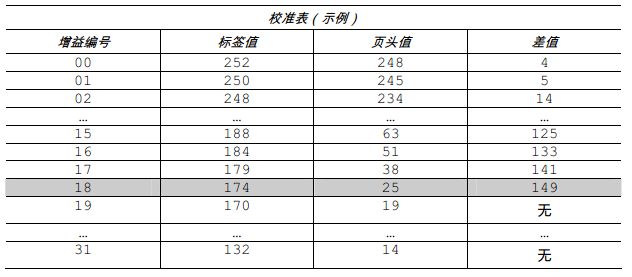
11. In the example calibration table, the label value and header value are at least 20. Subtract the two numbers and record the result as the difference (see below). Find the largest difference and its corresponding gain number. This gain number will be used to resample the label paper.
In this example, gain number 18 is selected because both readings are at least 20 and their difference is the largest. 12. Use these keys to set the gain number determined in the previous step. Press ENTER to enable the setting.
13. Fill in the table with the new measurement value (see the example below), as follows:
(A) Raise the printhead assembly. Place the label above the label sensor, then lower and lock the printhead assembly. Record the sensor reading as “Paper”. (B) Raise the printhead assembly. Place the backing, notch, or stripe over the label sensor, then lower and lock the printhead assembly. Record the sensor reading as “Gap or Stripe”. (C) Raise the printhead assembly. Remove all label paper from the label sensor, then lower and lock the printhead assembly. Record the sensor reading as “Paper Out”. Note: Resampled values may differ from previously recorded values. This is normal; no readjustment of the label sensor is required. 14. Press the ESC key. Use these buttons to scroll to “PAPER SENSOR LEVEL” (or REFL PAPER LEVEL, if using reflective label paper), then press ENTER. Use these keys to set the paper value determined in step 13, then press ENTER. 15. Press the ESC key. Scroll to “GAP SENSOR LEVEL” (or MARK SENSOR LEVEL, if using reflective label paper), then press ENTER. Set the gap (or stripe) value determined in step 13, then press ENTER. 16. Press the ESC key. Scroll to “EMPTY SENSOR LEVEL” and press ENTER. Set the paper shortage value determined in step 13 and press ENTER. 17. Press the EXIT key, and then press “YES” when prompted in the “SAVE CHANGES” prompt box. The operation steps are complete, and the entire process is about to end. 18. Press and hold the “Feed” key until at least one label is printed. The printer is now ready. Note: If the calibration attempt fails, reduce the sensor sensitivity as follows: Re-enter the ADVANCED MENU. Go to MEDIA SETTINGS/SENSOR CALIBRATION/ADVANCED ENTRY/TRAN (or REFL) SENSOR GAIN, and then decrease the corresponding gain setting in increments of 1. Exit the menu and save the changes. Test label paper with the new settings. Repeat if necessary until a usable gain setting is obtained.
III. Datamax I-4606e Printer System Menu
3.1 Overview of the Menu System The menu system consists of three primary branches, each with different secondary menus or function access levels: ● User menu provides access to basic printer settings and functions; ● Advanced menu provides access to all operating settings, functions, and diagnostics; ● Test menu provides access to test, user-defined, and previous label printing functions. Note: (1) A prompt may appear before granting menu access and changes take effect; see “Security” for details. (2) The display contrast is adjustable: Press and hold the MENU button to cycle through the contrast range (this may take several seconds), and release the button when the desired appearance is achieved.
3.2 User Menu The user menu consists of the following basic options: ● Label Paper Settings ● Print Control ● Printer Options ● System Settings Note: (1) Some setting changes will only take effect (and be saved) when “Save Changes” is prompted and “YES” is selected. (2) Label software may override printer menu settings in some cases; please refer to the Advanced Menu for details.
3.3 Advanced Menu The Advanced Menu consists of all the settings, controls, and function options in the following menus: ● Label Paper Settings ● Print Controls ● Printer Options ● System Settings ● Communications ● Diagnostics After selecting the Advanced Menu, simply press the MENU button to open it. The steps to enable the Advanced Menu are as follows: 1. Press the MENU button. 2. Use the up or down arrow keys to scroll to “SYSTEM SETTINGS” and then press ENTER. 3. Scroll to “MENU MODE” and then press ENTER. 4. Scroll to “ADVANCED MENU” and then press ENTER. (When finished, “OK” will be displayed on the screen, and the printer will exit the menu system.) Note: (1) Some setting changes will only take effect (and be saved) when “Save Changes” is selected. (2) Label software may override printer menu settings in some cases; please refer to “Advanced Menu/Communications/Host Settings” to avoid potential conflicts. (3) To return to the user menu, select the menu again, or restore its factory default value.
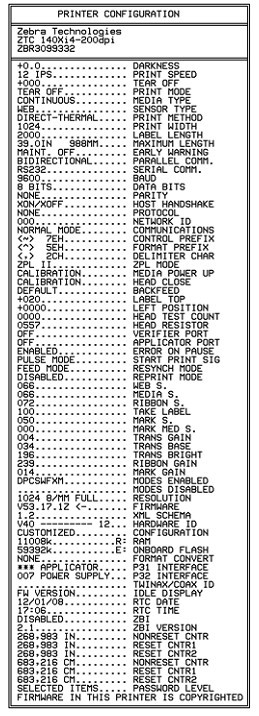
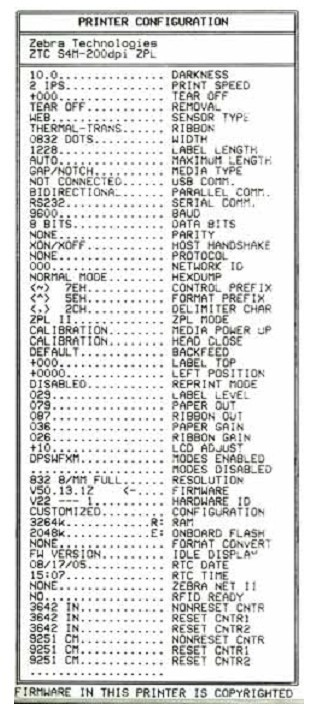
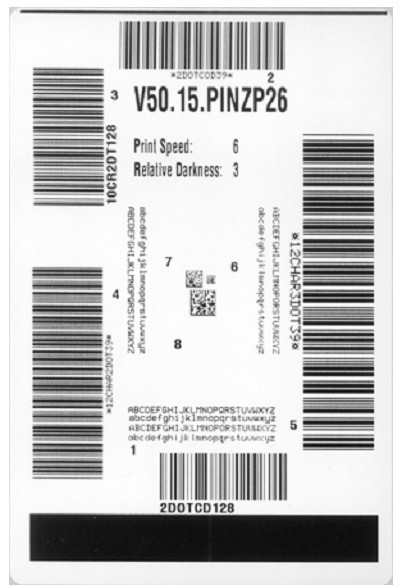
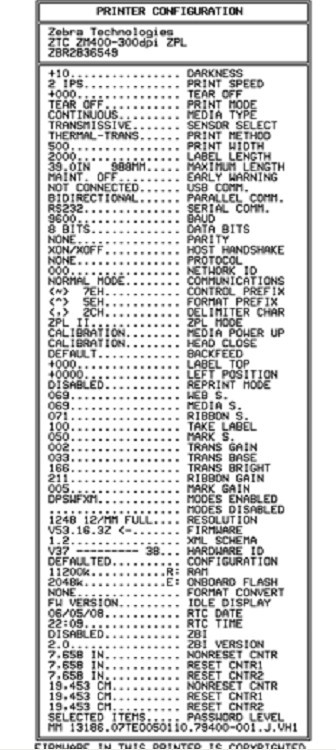
3.4 Test Menu The test menu consists of test options and information label options: ● Print Quality Label ● Print Configuration ● Ribbon Test Label ● Test Label ● Verification Label ● Print Previous Label ● User-defined Label These labels are generated internally by the system and printed according to the pre-selected label paper type, print speed, and heat settings. These print settings can be changed via the menu system or host commands. Print the entire layout using full-width label paper; otherwise, adjust the printer and set the “Label Width” menu settings. Note: (1) Press the CANCEL button to stop printing. (2) A print delay can be set; see “Print Test Speed” (Diagnostics section).
3.5 Menu Details
3.5.1 Label Paper Settings The label paper settings menu includes label/ribbon detection and selection functions, as well as printhead cleaning options (items marked with an asterisk are only accessible through the advanced menu): ● OPTimedia ● Label Paper Type ● Label Paper Index Type ● Label Length ● Maximum Label Length* ● Out of Paper Distance* ● Label Width ● Ribbon Shortage Options* ● Sensor Calibration* ● Printhead Cleaning* Menu options are defined on the following pages: ■ OPTimedia automatically configures various print settings based on the label paper/ribbon combination. ■ MEDIA TYPE: Selects the method used to print labels. This should be set according to the type of label paper used, where: DIRECT THERMAL: Sets to use label paper that generates images through a heat reaction. THERMAL TRANSFER: Sets to use label paper that requires a ribbon to generate images. ■ MEDIA INDEX TYPE: Selects the “To-the-Front” (TOF) detection method to determine the label’s guide edge, where: GAP: Identifies the header by detecting gaps in the label paper. (Default Settings) NOTCH: Identifies the header by detecting cuts in the label paper. HOLE: Identifies the header by detecting holes in the label paper. BLACK MARK: Identifies the header by detecting reflective (black) stripes on the bottom of the label paper. CONTINUOUS: Does not use header identification; instead, it determines the header based on the label length (set in the label paper settings). ■ LABEL LENGTH: Determines the label length (0 – 99.99 in.) when “SENSOR TYPE” is set to “CONTINUOUS”, where: 04.00: Default setting. ■ MAXIMUM LABEL LENGTH: Sets the label paper length (0 – 99.99 in.) fed when the printer detects a header error before reporting it. In this case, “Sensor Type” is set to “GAP” or “REFLECTIVE”, where: 8.00: Default setting. The maximum label length is typically 2.5 to 3 times the physical label length. ■ PAPER EMPTY DISTANCE: Sets the length of label paper the printer attempts to feed before reporting a paper out error (0 – 99.99 in.), where: 0.25: Default setting. When using transparent or semi-transparent label paper, this setting should be greater than the actual label length. ■ LABEL WIDTH: Sets the maximum printable width. Content exceeding this setting will not be printed, where: 4.65: Default setting. ■ RIBBON LOW OPTIONS: Defines the printer’s response when the ribbon is running low when thermal transfer mode is selected, where: RIBBON LOW DIAMETER: Sets the critical diameter of the ribbon roll (1.00 – 2.00 in.) that triggers the “Low Ribbon Warning” message, where: 0.50 is the default setting. PAUSE ON RIBBON LOW: Enables the printer to pause when the “Insufficient Ribbon Diameter” condition is met. ENABLE: Pauses operation when the “Insufficient Ribbon Diameter” condition is detected; the PAUSE button must be pressed to continue printing. DISABLE: No operator intervention is required; printing continues even when a ribbon error is reported. (Default setting) ■ SENSOR CALIBRATION: Selects the label sensor calibration method. PERFORM CALIBRATION: Sets these values through the printer’s internal calculations, as described in the “Standard Calibration” program. ADVANCED ENTRY: Sets these values manually (typically used for label papers that are difficult to calibrate), as described in “Advanced Input Calibration.” PAPER SENSOR LEVEL: Sets a threshold value (0-255) for paper, with a default setting of 170. REFL PAPER LEVEL: Sets a threshold value (0-255) for reflective label paper, with a default setting of 170. GAP SENSOR LEVEL: Sets the threshold value (0-255) for gap labels, with a default value of 040. MARK SENSOR LEVEL: Sets the threshold value (0-255) for striped labels, with a default value of 040. EMPTY SENSOR LEVEL: Sets the threshold value (0-255) for paper shortages, with a default value of 000. TRAN SENSOR GAIN: Sets the sensitivity (0-31) for transmissive sensors, with a default value of 15. REFL SENSOR GAIN: Sets the sensitivity (0-31) for reflective sensors, with a default value of 15. ■ PRINTHEAD CLEANING: Controls automatic cleaning alarms and functions, including: CLEAN HEAD SCHEDULE: Specifies the length of print (in inches or centimeters) required before the printhead must be cleaned. A printhead cleaning error will be reported when the printhead length exceeds three times that length. (Note that specifying a value [0 – 200 in.] will multiply by 1000; 0 [default setting] will disable this function.) CLEAN HEAD COUNTER: Indicates the length printed (in inches or centimeters) since the last cleaning program was started. RESET COUNTER: Resets the printhead cleaning counter to restart the printhead cleaning schedule. CLEAN HEAD NOW: Starts the cleaning process and resets the printhead cleaning counter.
3.5.2 Print Control The print control menu includes print handling capacity, offset, and custom settings: (Items marked with an asterisk are only accessible through the advanced menu.) ● Heat ● Print Speed ● Paper Feed Speed ● Paper Ejection Speed* ● Conversion Speed* ● Row Offset ● Column Offset ● Output Length ● Header Priority* ● Custom Adjustment* ● Motor Throttling* The menu options are defined as follows: ■ HEAT: Controls the printhead heating time (0 – 30), equivalent to the heating setting in many label software programs, where: 10: Default setting. ■ PRINT SPEED: Controls the label movement speed during printing, where: xx in/sec ■ FEED SPEED: Controls the label movement speed between print zones, where: xx in/sec ■ REVERSE SPEED: Controls the label movement speed during paper ejection positioning (2.0 – 5.0 in./sec.), where: 4.0 in/sec is the default setting. ■ SLEW SPEED: Controls the label movement speed between print areas when using GPIO functions (2.0 – 16.0 in./sec.), where: xx in/sec. ■ ROW OFFSET: Moves the vertical coordinate of the print start position (0 – 99.99 in.). 00.00 in is the default setting. ■ COLUMN OFFSET: Shifts the horizontal coordinate of the left-aligned print start position to the right (0 – 99.99 in.), but does not shift the label width endpoint to the right, where: 00.00 in is the default setting. ■ PRESENT DISTANCE: Sets the length from the print start position to the end of label printing (0 – 4.00 in.). When receiving subsequent label layouts, the printer automatically retracts the label and positions it at the print start position, where: 0.00 in is the default setting. ■ TOF PRECEDENCE: Enables overwriting label layout data when exceeding page length, where: DISABLE: Prints the label layout without truncating data exceeding the page header. ENABLE: Ends the label at the next page header, truncating any printed data exceeding this stripe. ■ CUSTOM ADJUSTMENTS: Changes factory adjustment parameters to uniformly and independently compensate for occasional noticeable minor mechanical differences when multiple printers share label layouts. These settings can also be used for special label layout adjustments, where: DARKNESS: Controls the filtering time (1-64), configuring rated heat settings for printhead-related thermal characteristics, where: 32 is the default setting. CONTRAST: Refines grayscale adjustment (1-64) to improve print quality, where: 32 is the default setting. ROW ADJUST: Moves the vertical coordinate of the print start position (xxx point) to refine the “ROW OFFSET” setting, where: +0000. To move “Row Adjust” in the negative direction of the coordinates, modify the “PRESENT ADJUST” setting (see below) by the same amount. COLUMN ADJUST: Moves the horizontal coordinate of the print start position and the label width end position to the right (xxx point) to refine the “COLUMN OFFSET” setting, where: +000 (-100 –100 DOTS) is the default setting. PRESENT ADJUST: Adjusts the label stop position (xxx point) to optimize the “PRESENT DISTANCE” setting, where: +000 (-100 –100 DOTS) is the default setting. ■ MOTOR THROTTLING: If printing continuously within a specified time period, the printer will use a delay mode to adjust the printing of each label. ENABLE: Enables “Motor Throttling”; Default setting DISABLE: Disables Motor Throttling
3.5.3 Printer Options The printer options menu includes file handling, modules, and optional device settings: ● Modules ● Paper Output Sensor ● Cutter ● GPIO Ports The menu options are defined as follows: ■ MODULES: Controls memory handling functions, where: DIRECTORY: Views and prints free space and file types (including plug-in files) on a module. Only detected modules are listed; selecting “ALL” will display all results. (For information on memory allocation, please refer to the Programmer’s Manual.) PRINT FILE: Prints the selected file type in storage: DBM—Font sample. DCM—Configuration commands contained in the file. DIM—Image. DLB—Stored tag. DLN—Language name. DMS—RFID database contained in the file. DPL—Label layout, if detected. DTT —Font sample. PLU—File name contained in the plug-in directory. PRN—Treat as a DPL file. TXT—Treat as a DPL file. FORMAT MODULE: Selects from the list of printer-formattable modules. Selecting “FORMAT MODULE” will clear all data in the selected module. DELETE FILE: Select from the list of files that can be deleted; see Section 6.3 “File Processing Messages”. COPY FILE: Select from the list of files that can be copied; you will be prompted to select the target module before execution. UNPROTECT MODULE: Select from the list of modules that can be unprotected; you will be prompted for the result after execution. ■ PRESENT SENSOR: Controls “On-Demand” labeling, where: MODE: Sets the printer’s detection method and response: AUTO is the default setting. Automatic detection, enables the paper output sensor (or tear-and-go mechanism), sets the label stop position; if no detection is detected, the operation will be ignored. ENABLED: Enables the paper output sensor (or tear-and-go mechanism), sets the label stop position; if no detection is detected, an error will occur. DISABLED: Disables this option. RETRACT DELAY: Edits the delay time for retracting the next label during printing, where: (1 – 255 x 10 ms) 070 delay time range (in 10 milliseconds); the default setting is 70 (multiplied by 10). ■ CUTTER: Controls the cutter operation, where: MODE: Sets the printer’s detection method and response: AUTO is the default setting; automatically detects whether the cutter is present. If the cutter is detected, the cutter is enabled; otherwise, it is ignored. ENABLED: Enables the cutter. If the cutter is not detected, an error will occur. DISABLED: Disables the cutter. CUT BEHIND: Allows small labels to queue before cutting to improve processing capacity. (1) In the absence of a cutter, this mode displays an extra label that retracts when the next job or paper feed operation begins. (2) In case of an error or uncertainty about the label position, the guide edge will be cut to ensure that there is no excess at the front of the first label; otherwise, the cutter will only cut when necessary. (0 – 2) The setting for the number of labels allowed to queue for cutting is 0, 1, or 2; 0 is the default setting. ■ GPIO PORT: Controls the GPIO functions of the labeler adapter option, where: GPIO DEVICE: Sets the specific device types that can be used for this option, where: DISABLED: Disables this option. APPLICATOR: Parameters that enable labeler-related functions: * Completes when the previous print starts, deactivating the Data Ready state (DRDY); * Allows paper feeding at any time; * Displays Data Ready when paused. APPLICATOR2: Parameters that enable labeler standby functions: * Completes when Data Ready (DRDY) and Print End (EOP) overlap by 1 millisecond; * Disables paper feeding when the Data Ready signal is issued; * Deactivates the Data Ready state when paused or an error occurs. BARCODE VERIFIER: Enables GPIO port usage with barcode verifiers. START OF PRINT: Selects the type of input signal required to initiate the print start (SOP), where: LOW PULSE: Triggers the print job with a low pulse. HIGH PULSE: Triggers the print job with a high pulse. ACTIVE LOW: Triggers the print job with a logic low signal. ACTIVE HIGH: Triggers the print job with a logic high signal. EDGE: Triggers the print job via a signal edge transition. END OF PRINT: Sets the type of output signal generated to indicate the end of print (EOP), where: LOW PULSE: Outputs a low pulse upon completion. HIGH PULSE: Outputs a high pulse upon completion. ACTIVE LOW: Inputs a logic low signal upon completion. ACTIVE HIGH: Inputs a logic high signal upon completion. RIBBON LOW: Sets the type of output signal generated to indicate insufficient ribbon, where: ACTIVE LOW: Inputs a logic low signal when this condition occurs. ACTIVE HIGH: Inputs a logic high signal when this condition occurs. SLEW ENABLE: Selects the type of input signal required to initiate label over-pitch feeding, where: STANDARD: Triggers over-pitch feeding via a logic low signal. LOW PULSE: Triggers over-pitch feeding via a low pulse. HIGH PULSE: Triggers over-pitch feeding via a high pulse. ACTIVE LOW: Triggers over-pitch feeding via a logic low signal. ACTIVE HIGH: Triggers over-pitch feeding via a logic high signal. Err On Pause (App2): Sets the output signal when maintenance is required due to an error (only for labeler adapter type 2). Where: ENABLED: Enables the output signal. DISABLED: Disables the output signal.
3.5.4 System Settings The system settings menu includes label layout, operation, and control functions: (Items marked with an asterisk can only be accessed through the advanced menu) ● Menu Mode ● Configuration File ● Internal Module* ● Default Module * ● Scalar Font Cache* ● Single-Byte Symbol * ● Double-Byte Symbol* ● Time and Date ● Label Counter* ● Print Configuration* ● Configuration Level* ● Set Factory Defaults* ● Layout Attributes* ● Label Rotation ● Mirror Mode * ● Pause Mode * ● Peel Mode* ● Security* ● Unit of Measurement* ● Input Mode* ● DPL Simulation* ● Column Simulation* ● Row Simulation* ● SOP Simulation* ● Print Back Paper* ● Font Simulation* ● Label Storage* ● Menu Language ● Display Settings* ● Error Handling* ● SCL Font Bold Factor* The menu options are defined as follows: ■ CONFIGURATION FILE: Controls the creation, storage, and retrieval of printer configuration files, where: RESTORE AS CURRENT: Restores the printer’s last saved configuration. SAVE SETTING AS: Creates a file based on the current printer configuration, as described in this document. DELETE FILE: Deletes the selected configuration file from memory. (Cannot delete the current file.) FACTORY SETTING FILE: A list of configuration files that can be used to restore the printer configuration after a primary reset or when “YES” is selected in the “SET FACTORY DEFAULTS” menu. (None is set to the default file.) ■ INTERNAL MODULE: Sets the number of 1KB blocks allocated for the internal DRAM “D” module (100 – 5120), where: 1024 is the default setting. ■ DEFAULT MODULE: Specifies the storage module used to store files when no explicit instruction is given, where: D: Default setting (DRAM module). G: Flash memory module. ■ SCALEABLE FONT CACHE: Configures the number of 1KB blocks allocated for the scalar font engine (128 – 512), where: 384 KBytes is the default setting. ■ SINGLE BYTE SYMBOLS: Select the code page to use for printing single-byte fonts. ■ DSOUBLE BYTE SYMBOLS: Select the optional ILPC code page to use for printing double-byte fonts, where: JIS – Japanese Industrial Standard ; SHIFT JIS – Variant Japanese Industrial Standard ; EUC – Extended UNIX Code ; UNICODE – Unicode (including Korean). Default setting. GB – Chinese Government Industrial Standard. BIG 5 – Taiwan encoding . ■ TIME AND DATE: Set the printer’s time and date. ■ MEDIA COUNTERS: Display and control various internal counters, where: ABSOLUTE COUNTER: Displays the printed length (in inches) and the date the counter was set (cannot be reset). PRINTHEAD COUNTER: Displays the total printed length in inches (cannot be reset by the user). RESETTABLE COUNTER: Displays the length printed since the last reset in inches (cannot be reset by the user). RESET COUNTER: Resets the “Resettable Counter”. ■ PRINT CONFIGURATION: Creates a configuration label using the printer’s current database information. ■ CONFIGURATION LEVEL: Displays the printer’s hard drive and software levels, where: PRINTER KEY: A unique index number identifying the printer, in the following format: vvvv-cwxx-yyyyyy-zzz, where: vvvv — represents the printer model. cwxx — represents the hardware and software feature levels, where: c — represents the printer level. w — represents the motherboard’s hardware feature level. xx — represents the software feature level (10 = standard DPL, 20 = internal CG Times font). This is the acceptable feature level; exceeding this range will require an authorization code. yyyyyy — is the manufacturing date code. zzz — is a unique timestamp. APPLICATION VERSION: Displays the firmware level, version number, and date. BOOT LOADER: Displays the bootloader version level and date. UPGRADE PRINTER CODE: Upgrades the printer’s software feature level. UNLOCK FEATURE: Enables additional optional features in the printer. (Authorization code required.) ■ SET FACTORY DEFAULTS: Restores printer settings to factory defaults (excluding “CUSTOM ADJUSTMENTS” and calibration settings); if selected, it restores to the factory settings file, where selecting “YES” on the prompt box will restore the configuration. ■ FORMAT ATTRIBUTES: Defines the printing effect of overlapping text and graphics, where: TRANSPARENT: Prints the intersections of text, images, and barcodes, for example:
XOR: Do not print the intersections of text, images, and barcodes (default setting). For example:
OPAQUE: Print the intersections of text, images, and barcodes, but will overwrite the first layer of the layout. For example:
■ LABEL ROTATION: Allows the label format to be flipped 180 degrees before printing, where: ENABLED: Flips the layout. DISABLED: Does not flip the layout. (Default setting) ■ IMAGING MODE: Determines the label processing procedure, where: MULTIPLE LABEL: Mirrors multiple labels for maximum processing speed, provided storage space allows. For timestamped labels, the indicated time reflects the mirroring time, not the actual printing time. (Default setting) SINGLE LABEL: Mirrors the next label only after the previous label has been printed; while providing the most accurate timestamps, processing speed is reduced. ■ PAUSE MODE: Enables controlled interactive printing, where: ENABLED: Requires pressing the PAUSE key to print each label. DISABLED: There is no pause between labels during printing. (Default Settings) ■ PEEL MODE: Enables the printer to wait for a print start signal (via an optional GPIO port) before feeding labels, where: ENABLED: Disables paper feeding until a print start signal is received. DISABLED: Feeds labels regardless of whether a print start signal is received. (Default Settings) ■ SECURITY: Allows setting password protection for all or some user interfaces, and changing that password: SELECT SECURITY: Allows setting a password for specific user interface areas, where: DISABLED: No password is required to access menus. (Default Settings) SECURE MENU: Requires a password to access user and advanced menus. MENU AND TEST: Requires a password to access any menu. ADVANCED MENU: Requires a password to access the advanced menu. (Enabling this option takes effect by reverting the menu mode to user mode; see above.) MODIFY PASSWORD: Changes the four-digit password required when security is enabled. During the modification process, you must re-enter this password as prompted for confirmation. To enable, the password must first be set to a value other than the default setting (0000). ■ UNITS OF MEASURE: Sets the measurement standard used, where: IMPERIAL is in inches. (Default setting) METRIC is in millimeters and centimeters. ■ INPUT MODE: Defines the processing method when data is received, where: PL-Z: Uses an alternative programming language for processing, except for the following DPL-specific parameters: DPL simulation; SOP simulation; Tag storage. AUTO: Identifies and activates the simulation parser suitable for the data. ■ BACK AFTER PRINT: Defines the movement of the label paper when the cutter, paper output sensor, peel and paper output, or GPIO is activated, where: MODE: Repositions the label paper, where: DISABLED: Moves only when the next label is ready to print to minimize curling. (Default setting) ENABLED: Moves according to the backup delay time after paper cutting, sensor clearing, or printing start to maximize output speed. BACKUP DELAY (1/50s): Instructs the printer to retract the extended label after a specified time (0-255, in 1/50-second increments), where: 000: Retracts when the next label is received and processed. (Default setting) ■ FONT EMULATION: Allows font replacement for all internal fonts, where: STANDARD FONTS: Prints using standard (internal) fonts. (Default setting) CG TIMES: Prints using CG Times fonts. USER ID S50: Prints using downloaded fonts. ■ LABEL STORE: Determines the command invocation level used when retrieving stored label layouts, where: STATE & FIELDS: Invokes printer status (i.e., heat, speed settings, etc.) and stored label formatting commands. (Default setting) FIELDS ONLY: Invokes label formatting commands for stored labels. ■ MENU LANGUAGE: Selects menus and configures label language. Only display the resident language, where: ENGLISH: Enables English (default setting) ■ DISPLAY SETTINGS: Determines the appearance of items on the display screen, where: GRAPHIC DISPLAY MODE: Determines the magnification of displayed items, where: STANDARD: Standard setting. ENHANCED: Magnified setting. DISPLAY UNITS: Determines the display type of length information, where: STANDARD: Displays information according to “UNITS OF MEASURE” (see above). IMPERIAL: Displays information in inches. METRIC: Displays information in millimeters and centimeters. DISPLAY CONTRAST: Adjusts the display contrast (0-100), where: 35 is the default setting.
3.5.5 Communication The communication menu includes interface and host control functions (items marked with an asterisk can only be accessed through the advanced menu): ● Serial Port A* ● Parallel Port A* ● USB Port* ● Network Interface* ● Host Settings* The menu options are defined as follows: ■ SERIAL PORT A: Controls the RS-232 communication settings of Serial Port A, where: BAUD RATE: Sets the serial communication rate, where: (1200 – 115000 BPS): Range in bits per second; 9600 BPS is the default setting. PROTOCOL: Sets the data flow control (handshake) method, where: BOTH: Uses XON/XOFF and CTS/DTR. (Default setting) SOFTWARE: Uses XON/XOFF. HARDWARE: Uses CTS/DTR. NONE: Does not use flow control. PARITY: Sets the parity word, where: NONE: Does not use parity. (Default settings) ODD: Use odd parity. EVEN: Use even parity. DATA BITS: Set word length, where: (7 – 8): Select seven or eight bits; 8 is the default setting. STOP BITS: Set the number of stop bits, where: (1 – 2): Select one or two stop bits; 1 is the default setting. ■ PARALLEL PORT A: Controls the parallel port communication settings, where: PORT DIRECTION: Determines whether to return data from the printer, where: UNI-DIRECTIONAL: No data returned; unidirectional communication. BI-DIRECTIONAL: Returns data via the IEEE 1284 reverse channel. (Default setting), requires an IEEE 1284 full-duplex cable. ■ USB PORT: Controls the communication settings of the USB port. USB DEVICE CLASS: Defines the type of the USB port, where: PRINTER: Sets the printer to a typical Windows printer. CDC: Sets the printer to be used with a handheld PC and similar devices. Composite: Combines the printer and CDC level. (Default setting) ■ NETWORK INTERFACE: Controls the communication settings of the network interface, where: QUICK SETUP: Controls the communication settings of the network interface, where: WIRED DHCP: Configures the network card for wired connections. SET FACTORY DEFAULTS: Resets the NIC adapter parameters to factory defaults. GENERIC SETTINGS: Controls global communication settings for wired and wireless LAN sharing. ACTIVE INTERFACE: Selects the network interface currently used by the printer, where: NONE: Disables both interfaces. WIRED ETHERNET: Selects the wired Ethernet interface. WIRELESS ETHERNET: Selects the wireless Ethernet interface. SNMP ENABLE: Sets SNMP NO to (default setting). TELNET ENABLE: Enables/disables Telnet protocol NO to (default setting). FTP SERVER ENABLE: Enables/disables FTP protocol NO to (default setting). HTTP SERVER ENABLE: Enables/disables FTP protocol YES to (default setting). LPD PRINT ENABLE YES to (default setting). TCP PRINT ENABLE YES to (default setting). NETCENTER ENABLE NO to (default setting) . GRATUITOUS ARP: Sets the ARP packet transfer interval, where: (0-100 minutes); default value is 0. NETWORK REPORT: Prints or displays a report listing the printer’s network settings. WIRED ETHERNET: Controls the communication settings of the wired Ethernet network interface. IP DISCOVERY: Sets the address detection method, where: USE STATIC ADDRESSES: Uses the stored static IP address, subnet mask, and/or gateway address. USE DHCP: The network card uses the DHCP protocol to broadcast on the network and receive an address from a responsible server at startup. Manual modification of the IP address, subnet mask, or gateway address is not allowed; if no server is found, the specified static address value will be used. (Default setting), server-assigned addresses take precedence over any static addresses stored in the interface. USE BOOTP: The network card uses the BOOTP protocol to broadcast on the network and receive an address from a responsible server at startup. Manual modification of the IP address, subnet mask, or gateway address is not allowed; if no server is found, the specified static address value will be used. (Default setting), server-assigned addresses take precedence over any static addresses stored in the interface. IP ADDRESS: Specifies the static IP address of the interface in standard octet format. SUBNET MASK: Specifies the static subnet mask assigned to the interface, for example: 255.255.255.000. DEFAULT GATEWAY: Specifies the gateway address to be used by the interface, for example: 192.168.10.1. DUPLEX CAPABILITY: Specifies the transmission speed for the wired Ethernet connection: * Auto-negotiation (default); * 100 BaseT Full-duplex; * 00 BaseT Half-duplex; * 10 BaseT Full-duplex; * 10 BaseT Half-duplex PRIMARY WINS SERVER: The IP address of the primary WINS server. SECONDARY WINS SERVER: The IP address of the secondary WINS server. PRIMARY DNS SERVER: The IP address of the primary DNS server. SECONDARY DNS SERVER: The IP address of the secondary DNS server. SNMP TRAP DESTINATION ADDRESS: A standard octet address where an SNMP trap will be sent when the SNMP service is installed on the receiver. When zeroed, no trap is sent. SNMP SERVER ADDRESS: The server address set for the SNMP service in standard octet format. NETBIOS ENABLE: Enables or disables NET BIOS SERVICES. NO: (Default setting) TCP PRINT PORT: Selects the port used for all TCP network communication; default setting is 9100. INACTIVITY TIME: Sets the time (in seconds) the current port remains open when there is no activity. LPD PRINT PORT: Selects the port used for all LPD network communication; default setting is 515. WIRELESS ETHERNET: Controls the communication settings of the wireless Ethernet network interface, where: IP DISCOVERY: Sets the address detection method, where: USE STATIC ADDRESSES: Uses stored static IP, subnet mask, and/or gateway address. USE DHCP: The network card uses the DHCP protocol to broadcast on the network and receive addresses from a responsible server at startup. Manual modification of IP address, subnet mask, or gateway address is not allowed; if no server is found, the specified static address value will be used. (Default setting), addresses assigned by the server take precedence over any static addresses stored in the interface. USE BOOTP: The network card uses the BOOTP protocol to broadcast on the network and receives an address from a responsible server at startup. Manual modification of the IP address, subnet mask, or gateway address is not allowed; if no server is found, the specified static address value will be used. (Default setting). The address assigned by the server takes precedence over any static address stored in the interface. IP ADDRESS: Specifies the static IP address of the interface in standard octet format. SUBNET MASK: Specifies the static subnet mask assigned to the interface, for example: 255.255.255.000. DEFAULT GATEWAY: Specifies the gateway address to be used by the interface, for example: 192.168.10.1. ■ HOST SETTINGS: Controls communication with the host device, where: HOST TIMEOUT: Sets the time (1-60 seconds) that a communication port established must remain idle before data is received through the spare port, where: 10 is the default setting. CONTROL CODES: Allows changing the prefix of software commands interpreted by the printer, where: STANDARD CODES: Uses the following characters: hexadecimal 01 = SOH command; hexadecimal 02 = STX command; counter = ^; hexadecimal 1B = ESC; hexadecimal 0x0D = carriage return. (Default setting) ALTERNATE CODES: Uses the following characters: hexadecimal 5E = SOH command; hexadecimal 7E = STX command; counter = @; hexadecimal 1B = ESC; hexadecimal 0x0D = carriage return. ALTERNATE CODES 2: Uses the following characters: hexadecimal 5E = SOH command; hexadecimal 7E = STX command; counter = @; hexadecimal 1B = ESC; hexadecimal 0x7C = carriage return. CUSTOM CODES: Enter the required hexadecimal code to select each DPL command (SOH, STX, CR, and count-by). FEEDBACK CHARACTERS: Allows the printer to return hexadecimal 1E (RS) after successfully printing each label and hexadecimal 1F (US) after successfully printing each batch of documents. ENABLED: Sends feedback characters to the host. DISABLED: Does not send feedback characters to the host. (Default setting) ESC SEQUENCES: Allows processing of data containing invalid ESC control code sequences, where: ENABLED: Normal command processing. (Default setting) DISABLED: Ignores ESC sequences during processing (some systems send a “banner” to the printer). Bitmap font download is disabled in this mode. HEAT COMMAND: Determines how DPL heating commands are processed, where: ENABLED: Normal command processing. (Default setting) DISABLED: Ignores DPL heating commands; heat values are controlled via menu settings. SPEED COMMANDS: Determines the handling method for DPL printing, paper feeding, over-pitch paper feed, and paper eject commands. ENABLED: Normal handling of commands. (Default setting) DISABLED: Ignores DPL speed commands; speed is controlled via menu settings. TOF SENSING COMMANDS: Defines the handling method for DPL gap, continuous, and reflective commands. ENABLED: Normal handling of commands. (Default setting) DISABLED: Ignores DPL TOF commands; TOF is controlled via menu settings. SYMBOL SET COMMAND: Defines the processing method for DPL single-byte and double-byte character set commands, where: ENABLED: Normal command processing. (Default setting) DISABLED: Ignores DPL character set commands; control character set options are set via the menu. CNTRL-CODES (DATA): Defines the processing method for DPL SOH, STX, CR, ESC, and ^ codes, where: ENABLED: Normal command processing. (Default setting) DISABLED: Ignores DPL control codes; control code functionality is determined via the menu. STX-V SW SETTINGS: Determines the processing method for DPL <STX>V commands, where: ENABLED: Normal command processing. (Default setting) DISABLED: Ignores option enable commands; control option selection is set via the menu. MAX LENGTH COMMAND: Determines the processing method for DPL <STX>M commands, where: ENABLED: Normal command processing. (Default setting) DISABLED: Ignores the maximum label length command; the maximum label length is controlled via menu settings. PROCESS SOH (DATA): Defines how the printer responds to immediate commands (such as status retrieval, module storage, etc.), where: ENABLED: Interrupts the operation upon receipt to process the command. DISABLED: Processes the command normally. (Default setting)
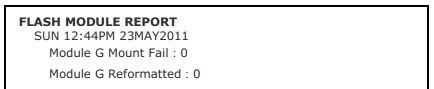
3.5.6 Diagnostics The diagnostic menu includes test functions and printhead report options (items marked with an asterisk are only accessible through the advanced menu): ● Hex Dump Mode * Optional Test * Print Test Speed (minutes) * Sensor Reading * Ribbon Sensor Limit * iPH Report * Flash Module Report * Menu options are defined as follows: ■ HEX DUMP MODE: Defines how the printer processes data received from the host, where: ENABLE: The printer outputs the raw ASCII data it receives without interpretation; the data is not processed. DISABLE: Processes the data normally. (Default setting) FILE CAPTURE: Saves incoming data to module H (USB flash drive, if available); otherwise, the file is saved to module G. Specify the filename in the format [dmx_xxx_yyy.dpl], where the count is automatically incremented for each acquisition, and a unique printer timestamp (xxx) is provided. ■ OPTIONS TESTING: Performs printer option diagnostics, or monitors and outputs test results, including: TEST PRESENT SENSOR: Performs a functional test on the paper output sensor by indicating “LABEL PRESENTED” (when the sensor is covered by a label) and “LABEL NOT PRESENTED” (when the sensor is not covered by a label). (Note that this test can also be used to check the sensor functionality of the “Tear and Play” option.) TEST CUTTER: Performs a functional test on the cutter, including: PERFORM TEST 001 TIMES: Cycles the cutter blades a selected number of times (0-999), giving a pass/fail result for each attempt. TEST GPIO: Performs a functional test on the GPIO ports, including: MONITOR GPIO INPUT: Displays the logic value of the input signal for Start of Print (SOP). If not connected, it may display zero or one. TEST GPIO OUTPUT: Displays the logic value of the output signal for End of Print (EP) and Service Request (SR). To change the output signal status, place the cursor on the displayed status to select it, and then use the up or down arrow keys to toggle. PRINT SIGNAL INFO: Prints a reference label containing the GPIO signal name, pin assignment, settings, and current signal status. ■ PRINT TEST RATE (MIN): Sets the delay interval (0 to 120 minutes) between labels when batch printing test labels, where 000 is the default setting. ■ SENSOR READINGS: Displays values from the printer’s sensors (0 – 255), where:
THR
TRAN
RIBM
24V
103
091
009
171
PS
HD
RANK
003
255
050
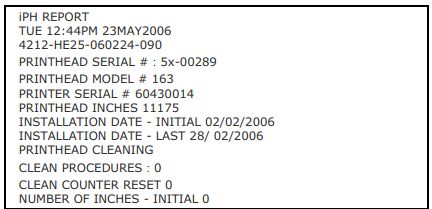
THR = Printhead thermistor sensor; TRAN = Gap label paper sensor (REFL when set to reflective); RIBM = Ribbon sensor; 24V = 24-volt power sensor; PS = Paper output sensor; HD = Printhead position sensor; RANK = Printhead sorting resistor. ■ RIBBON SENSOR LIMITS: Displays ribbon sensor readings for printers equipped with thermal transfer printheads (see example below), where: RIBBON ADC LOW: 111; RIBBON ADC HIGH: 249 ■ iPH REPORT: Displays IntelliSEAQ printhead report data, where: VIEW: Display data; PRINT: Print reference label.
IV. Datamax I-4606e Printer Maintenance and Adjustment
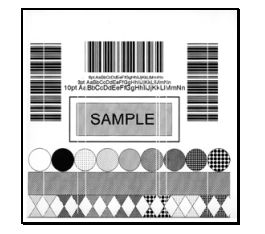
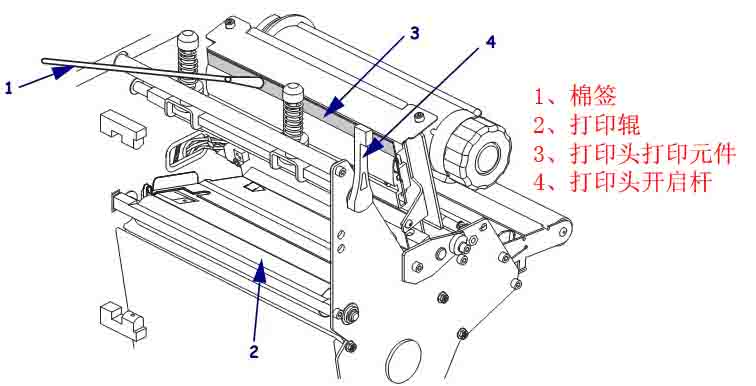
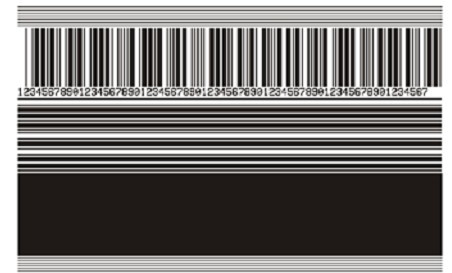
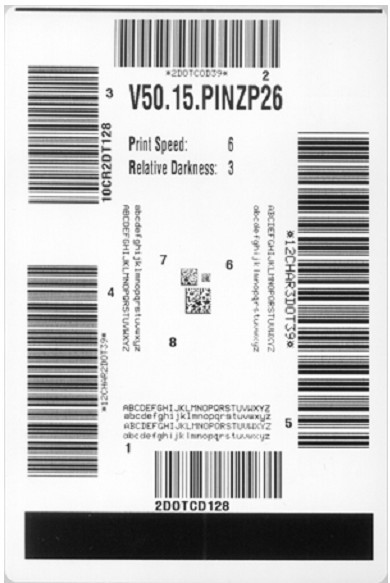
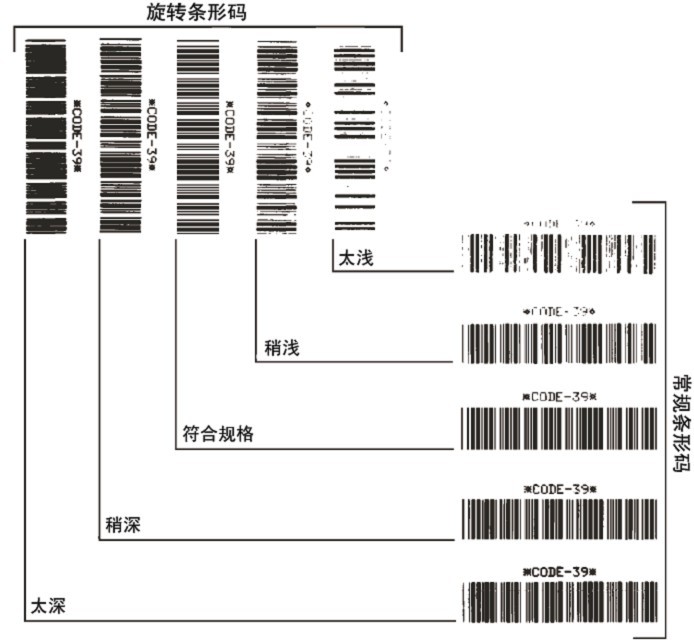
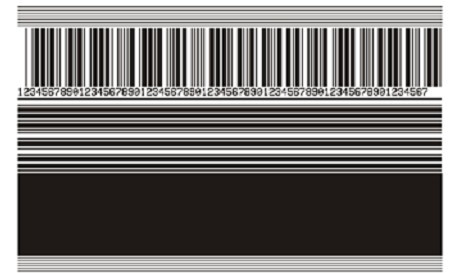
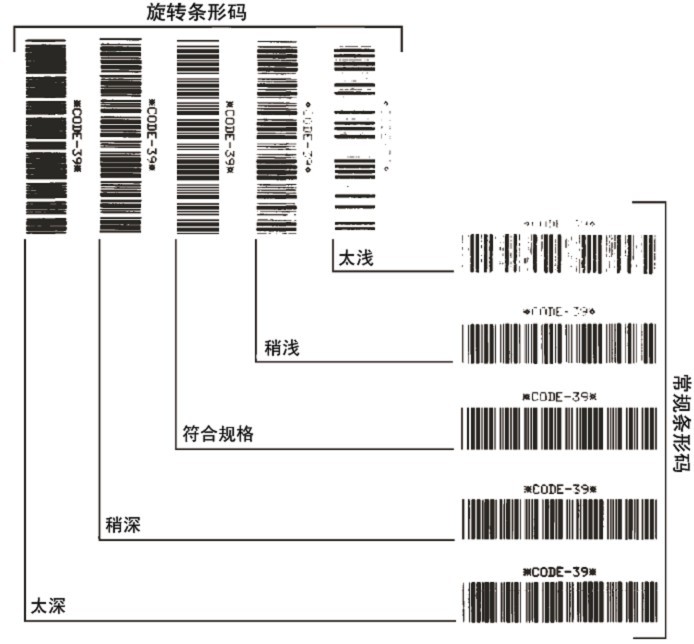
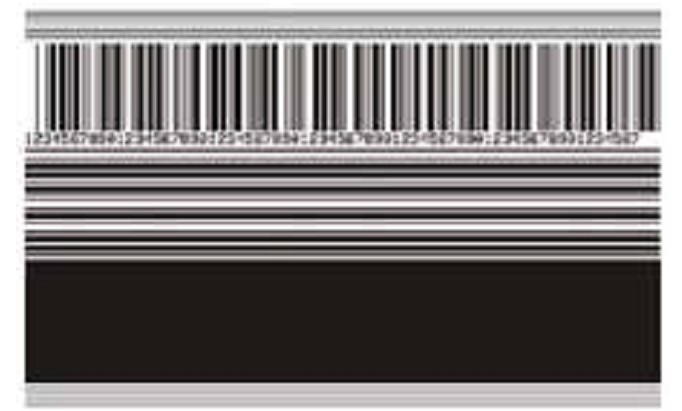
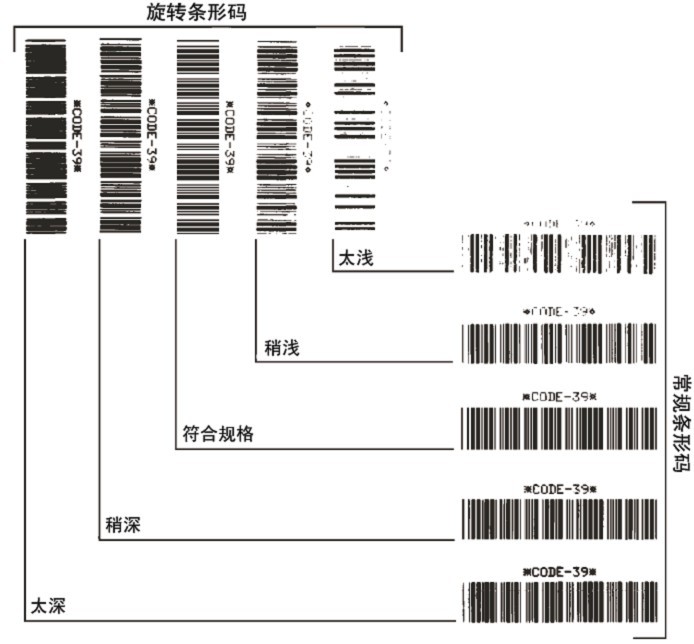
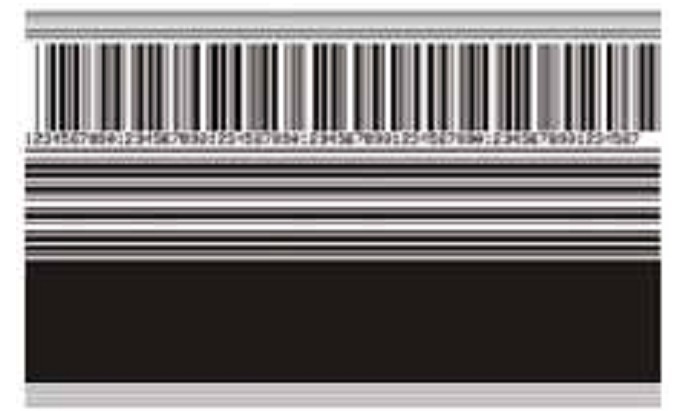
4.1 Cleaning the Printhead If print quality deteriorates (symptoms include non-standard barcodes, out-of-bounds printing, and striped lines; see sample labels below), a common cause is dirt buildup on the printhead. Furthermore, failing to remove this buildup can lead to component failure and significantly shorten the printhead’s service life.
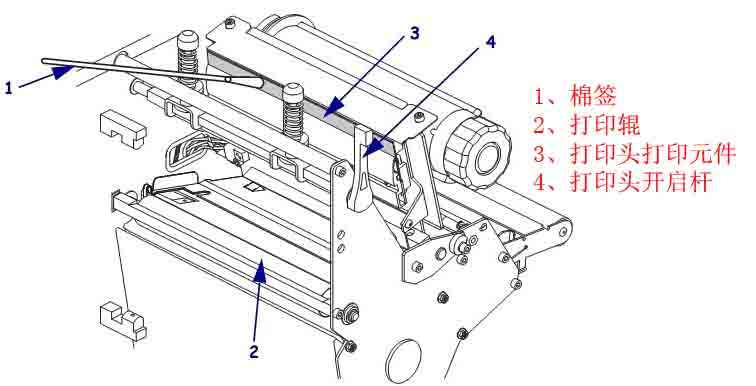
Steps to clean the printhead: 1. Turn off the printer and unplug the power cord. 2. Open the access cover. Open the printhead locking lever and raise the printhead assembly. Allow the printhead to cool before proceeding. 3. If necessary, separate the label paper and ribbon from the printhead. 4. Use a cotton swab moistened with isopropyl alcohol (do not saturate) to wipe away any dirt buildup on the printhead surface, being careful to control the wetted area. Allow the printhead to dry. 5. Reinstall the ribbon and label paper. Lower the printhead assembly back to the locked position. 6. Close the access cover. Plug in the power cord and turn on the printer. Feed a few labels to normalize information tracking.
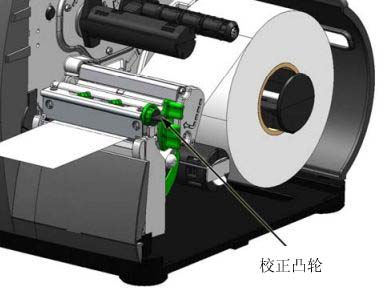
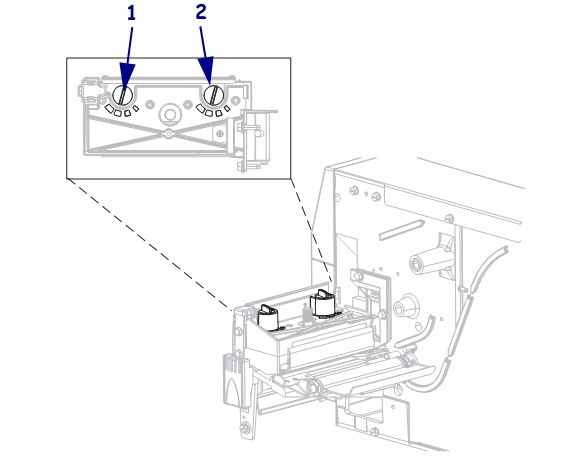
4.2 Label Paper Width Adjustment When using narrow label paper (smaller than the printhead width), adjust the leveling cam to distribute pressure evenly. The steps to adjust the printhead leveling cam are as follows:
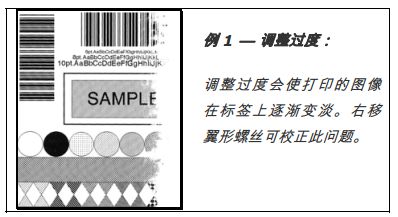
1. After loading the label paper, download the label template (or use the test menu format), and then begin printing a small number of labels. 2. While observing the print output, rotate the leveling cam counterclockwise until the image gradually fades on the label, as shown in Example 1.
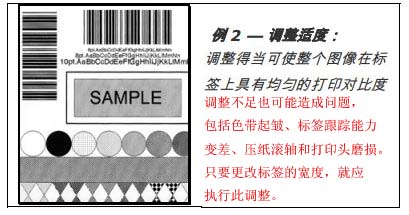
3. While observing the print output, rotate the leveling cam clockwise until the image is fully printed or even shows increased contrast, as shown in Example 2.
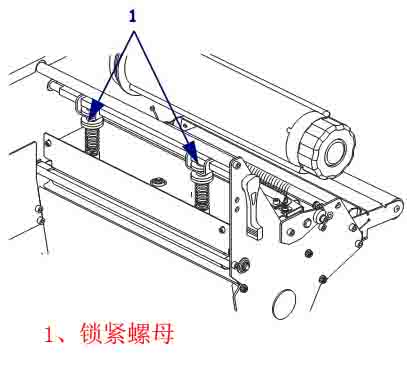
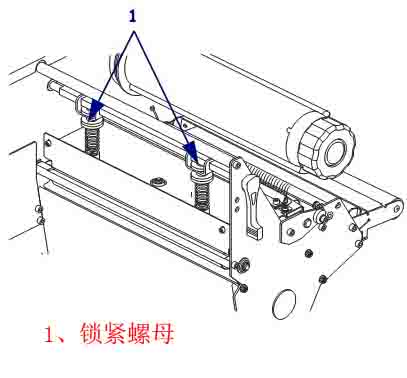
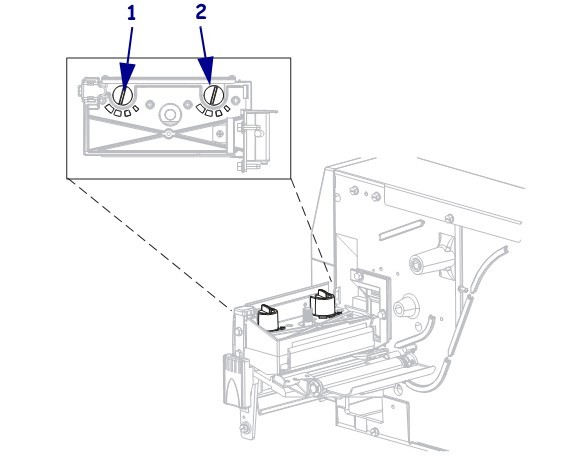
4.3 Printhead Pressure Adjustment Printhead pressure adjustment should be performed after attempting to improve print quality through other print quality controls. A. After loading label paper, download the label template (or use the test menu format), and then begin printing a small number of labels. B. Observe the print output, rotating each pressure adjustment screw (using a small coin or screwdriver) by the same amount until the image is fully printed and the contrast becomes uniform:
* Counterclockwise rotation (+) increases the applied pressure; * Clockwise rotation (-) decreases the applied pressure. Note: Ensure each arrow points in the same direction.
4.4 Replacing the Printhead Note: The printhead is fragile, so handle with extreme care and never poke its surface with sharp objects. If you have any questions, contact a qualified technician or MinYong Digital Support before proceeding. To replace a damaged printhead, follow these steps: 1. Touch any exposed metal parts on the printer housing to discharge any static electricity from your body. 2. Turn off the printer and unplug the power cord. Open the cover; if a ribbon is installed, remove it. 3. With the printhead locked in the down position, loosen the printhead mounting screws (leave them in the printhead assembly). 4. Loosen the printhead assembly. Hold the printhead and lift it. Disconnect both cables and remove the old printhead. 5. Carefully hold the new printhead and connect the two cables. 6. Place the printhead onto the locating pin in the printhead assembly and secure it with the printhead mounting screws (do not overtighten). 7. Clean the printhead (see Section 4.1). 8. Reinstall the ribbon (if it was previously removed), lower the printhead assembly, and rotate the printhead locking lever backward to the locked position.
4.5 Printer Reset Soft Reset—Steps to reset the printer and clear all temporary host settings: 1. With the printer in the “On” position, press and hold the Pause and Cancel buttons for approximately 4 seconds.
V. Troubleshooting Datamax I-4606e Printer This section provides information to help users resolve issues when they occur. The table below lists a series of problems that may not necessarily result in an error status.
question
Solution
Unable to communicate via parallel port:
When sending the layout to the printer, observe the “Ready” indicator light. If the light does not flash, check the parallel cable type. Also check the protocol and port settings between the printer and the host computer.
Unable to load label paper using the optional cutter:
Warning: Exercise extreme caution. Turn off the printer and unplug the power cord before proceeding. Ensure the cutter is installed correctly. Plug in the power cord and turn on the printer. You should hear the cutter blades rotating and self-adjusting. If the problem persists, call for support.
The LCD screen is black, but the ready indicator light is on.
The display contrast setting may be too low. Press and hold the MENU button for 3 seconds, then use the up and down arrow keys to adjust until the display reappears.
Uneven paper feeding:
The printer may require calibration; see Section 2.3.
The printing is garbled (it prints gibberish instead of the label layout):
The printer may be in hexadecimal dump mode; if serial communication is used, check the host and printer port settings; the printer setting may be eight data bits, while the host setting may be seven data bits (or vice versa).
Unable to print Intellifont fonts:
Intellifont format is closely related to Little/Big Endian. Printers use Big Endian. For more information, please consult your font supplier.
The printed text on the right side of the label (facing the printer) is faint:
The “Media Width Adjustment” setting may be incorrect; please refer to Section 4.2. The printhead or pressure rollers may be dirty or worn; clean them or call for repair.
The printed labels contained incomplete information:
Check the label layout; ensure character positions do not exceed the label size. All row/column values must be large enough to accommodate the characters and barcode. The label layout’s storage requirements may exceed available storage space. Try reducing the storage space allocated to internal modules or the scalar font cache. If using serial communication, ensure the connection cable meets requirements.
No printing marks on the left or right side of the label:
The layout may exceed the label size. Please check the label size in your software. For printers with a display screen, also check the values in the Print Control/Column Offset and Print Control/Custom Adjustments/Column Offset menus.
No power (all indicator lights are off):
Verify that both the outlet and printer are connected to the AC power cord; also ensure the power switch is in the “ON” position. Verify that the AC outlet is working properly, or try connecting the printer to a different AC circuit. The AC power cord may be damaged; please replace it. The power fuse may be blown; please call a repair service.
No content is printed (the label moves forward normally, but no image is printed):
Check the ribbon used to print the image: If there is an image on the ribbon: * Verify that the ribbon is installed correctly. * If installed correctly, the incorrect carbon layer configuration is used. (To check the carbon layer, press the adhesive backing of the label onto the ribbon surface. Only the carbon layer of the ribbon will release ink.) Clean the printhead; then replace the ribbon with the correct type suitable for the printer. If there is no image on the ribbon: Print any internal test labels. If an image is printed, check the printer and host protocol and port settings. Their settings must match. The thermal setting may be too low. Adjust it in the software program or via the menu. The label paper/ribbon combination may be inappropriate. Contact MinYong Digital. The printhead or printhead cable may be loose; turn off the printer and then reconnect it.
No action was taken when attempting to print using the software program:
Ensure the printer is ready. Observe the front panel; if the “Ready” indicator light does not flash when sending the layout, check the protocol and port settings between the printer and the host computer. Ensure the connection cable is compatible.
Poor print quality:
The printhead may need cleaning; adjust the heat and print speed settings via the front panel or host commands. The label paper/ribbon combination may be incompatible; please contact MinYong Digital. The “Media Width Adjustment” setting may be incorrect; the pressure roller may be dirty or worn; clean the pressure roller or call for service.
Labels missing during printing:
A label paper calibration process may be required; the label sensor may be mispositioned; readjust the position; the layout may be less than 1/8 inch from the label’s tail edge. Try reducing the size or slightly moving the layout.
Unable to print rotated text:
Character formatting may exceed the label size. Ensure that row/column values provide sufficient space for printing characters or barcodes. See the Programmer’s Manual for details.
1.1.1 Power Connection Note: Before connecting the AC power cord or cable to the printer, ensure that the power switch is in the off position.
1.1.2 Interface Connection This printer can be connected to the host via a parallel, USB, serial, or optional network interface. The printer will automatically connect to the first port that feeds valid data. Once a connection is established, the printer must be restarted before the interface connection can be changed.
1.2 Installing Label Paper Follow these steps to load label paper into the printer: 1. Open the label paper cover. Turn and release the printhead locking lever to raise the printhead assembly. 2. Turn the label paper guide down. 3. Roll the label paper onto the label spool. 4. Guide the label paper out of the printer as shown in the diagram. Raise the label paper guide. Push the label paper guide inward to the edge of the label paper. 5. Close the printhead assembly and turn the printhead locking lever to the locked position. 6. Close the cover and press the paper feed button several times to feed the label paper to the correct position, ensuring it is correctly tracked. If the top edge of each label is not detected correctly, the printer may need to be calibrated.
1.3 Label Sensor Adjustment The label sensor position needs to be such that the printer can detect the presence of the label paper and the label header (except for continuous label paper, whose header is set via the front panel). Adjustment steps: 1. Install the label paper, then grip the slider and move the sensor eye icon to the appropriate position above the label paper, as shown in the following figure:
1.4 Installing the Ribbon A ribbon is required for thermal transfer label paper. It is recommended that the ribbon width be slightly wider than the label paper being printed. This printer can use either “internal carbon” or “external carbon” ribbons. The steps for installing the ribbon are as follows: 1. Open the label cover. Turn and release the printhead locking lever to raise the printhead assembly. 2. Attach the ribbon reel to the ribbon mounting shaft, placing it against the flange. Ensure the ribbon is unwound in the correct direction. The diagram below illustrates the correct ribbon installation direction.
3. Wrap the ribbon from under the ribbon roller to the front of the printer, then extend it approximately 12 inches. 4. Close the printhead assembly and turn the printhead locking lever to the locked position. Wind the ribbon upwards onto the ribbon take-up shaft, then turn clockwise several times to secure it in place. 5. Close the cover and press the paper feed button several times to feed the ribbon to the appropriate position, ensuring proper tracking.
1.5 OPTImedia The OPTIMedia function is designed to reduce setup time when using Datamax-O’Neil brand label paper and ribbons. This function automatically adjusts the printer’s heat and speed to optimal levels for best print quality. By using the model prefixes of the label paper and ribbon (printed on the shipping box), users can quickly configure the printer to achieve the best print quality for a specific label paper and ribbon combination. Steps to select OPTIMedia: 1. Press the MENU button. 2. Ensure “MEDIA SETTINGS” is highlighted, then press the ENTER button. 3. Ensure OPTImedia is highlighted, then press the ENTER button. 4. Use the down arrow key to scroll to the model prefix of the label paper being used, then press the ENTER button. 5. Thermal label paper: “OK” is displayed, then press the EXIT button to exit the menu system. Thermal transfer label paper : The printer immediately prompts you to select the ribbon being used. Scroll to the model prefix of the ribbon being used, then press the ENTER button. “OK” is displayed, then press the EXIT button to exit the menu system. The printer is now ready to print using the selected label paper/ribbon. This method will not work if you are using non-Datamax-O’Neil brand supplies.
II. Datamax I-4310e Printer Operation
2.1 Front Panel This control panel is an event-driven interface consisting of a graphical display and a keyboard. In addition to providing current printer information, the functions of items and buttons in the main display area can be changed in different modes according to the needs of operational events.
2.1.1 Display Icon
2.2 Windows Driver Datamax I-4310e Driver Download: http://www.chongshang.com.cn/news/view.asp?id=441 Some important settings in the Windows driver require attention: 1. Page Setup tab: Stock . The Stock setting needs to match the size of the label being used. If you cannot find a matching setting, click “New” and then enter the size of the label you are using. 2. Options tab: Print Speed and Printhead Temperature settings have the greatest impact on print quality. Some label papers require higher printing temperatures and slower printing speeds to ensure image print quality.
2.3 Label paper calibration
2.3.1 Quick Calibration A quick calibration should generally be performed during label paper installation to optimize detection parameters. Note: (1) This calibration is not always necessary when using continuous label paper. (2) If the gap between labels is large, the label paper may need to be changed before proceeding to the next step. The steps to calibrate the printer are as follows: 1. Ensure the printer is turned on and idle (i.e., not offline), label paper is installed, the label sensor is adjusted, and the sensor type is selected. 2. Press and hold the paper feed button until at least one full label is output, then release the paper feed button and wait for the printer to process the data. There are two possible results: If the calibration is successful, “CALIBRATION COMPLETE” will be displayed on the screen, and the label paper will feed to the beginning of the next label; if the calibration is unsuccessful, “CALIBRATION FAILED” will be displayed on the screen. In this case, check the following prompts to help resolve the issue: Calibration prompt: “WARNING LOW BACKING” is usually displayed when calibrating die-cut label paper or cut label paper with highly transparent backing. If the first attempt fails, press and hold the paper feed button until two labels are printed consecutively. However, if “CALIBRATION FAILED” appears again, perform the standard calibration routine.
2.3.2 Paper Out Calibration Paper out calibration is used to calibrate the printer’s label sensor so that it can detect a “paper out” status. The calibration steps are as follows: 1. Ensure the printer is turned on and in an idle state (i.e., not offline), and that the label paper has been removed from the printer. 2. Press and hold the pause and paper feed buttons simultaneously. The printer will then complete the calibration and be able to detect a “paper out” status.
2.3.3 Standard Calibration Standard calibration can be performed using the NETira CT utility or via the printer menu using the front panel buttons. Standard calibration provides dynamic readings, which are useful when there are small cuts or stripes on the label paper that are important for positioning. Three types of calibration samples are required: No paper – no label paper on the sensor; Gap, cut, or stripe – label backing, cut, or stripe placed on top of the sensor; Paper – label (and backing, if present) placed on the sensor. The steps to calibrate the label sensor are as follows: 1. Turn on the printer and wait for the initialization operation to complete and display READY. 2. Press the MENU button. Ensure that MEDIA SETTINGS is highlighted, and then press ENTER. Use the down arrow key to scroll to “SENSOR CALIBRATION”. 3. Press ENTER to enter “SENSOR CALIBRATION”. Use the down arrow key to scroll to “PERFORM CALIBRATION”. Press ENTER again, and then press YES to continue to the next step. Press NO to abort the process. 4. The screen displays “REMOVE LABEL STOCK/PRESS ESC KEY/yyy”. Remove the label paper. Press ESC if no label paper is installed. (yyy indicates the current sensor reading.) 5. Continue according to the label paper type: ◆ For die-cut labels, the screen displays “SCAN BACKING/PRESS ESC KEY/yyy”. Tear one or two labels from the backing and install the label paper. Place the label sensor under the backing area and press ESC. ◆ For cut/reflective labels, the screen displays “SCAN MARK/PRESS ESC KEY/yyy”. Install the label paper. Place the label sensor under the cut (or black stripe) and press ESC. ◆ For continuous labels, “REMOVE LABEL STOCK/PRESS ESC KEY/yyy”, press ESC, and then proceed to the next step. 6. Screen display: SCAN PAPER/PRESS ESC KEY/yyy. Continue execution according to the label paper type: ◆ For all label papers except continuous ones, place the label material (and backing, if any) above the sensor, and then press the ESC key. ◆ Continuous label paper—Install the label paper. Place the label sensor below the label paper and press the ESC key. 7. Observe the calibration result. The screen displays CALIBRATION COMPLETE, indicating successful calibration. 8. Press the ESC key, and then press EXIT to exit the ready state. When calibrating gap or reflective label paper, press and hold the “Paper Feed” key until at least one label is output.
2.3.4 Advanced Input Calibration Advanced input calibration is an alternative calibration method for special label paper types. It uses different sampling algorithms to acquire sensor readings and selects the optimal algorithm from these readings, which is then manually entered into the database. Note: Advanced input calibration should only be used after standard calibration has proven unsuccessful. The steps to calibrate the label sensor are as follows: 1. Turn on the printer and wait for the initialization operation to complete and display READY. 2. Press the MENU button. Ensure MEDIA SETTINGS is highlighted, and then press ENTER. Use the down arrow key to scroll to “SENSOR CALIBRATION”. 3. Use the down arrow key to highlight “ADVANCED ENTRY”, and then press ENTER. 4. Scroll to “TRAN SENSOR GAIN” (or REFL SENSOR GAIN, if using reflective label paper), and then press ENTER. 5. Install the label paper. Place the label paper within the coverage area of the label sensor, then lower and lock the printhead assembly. Note: Do not align the aperture with the label sensor; if using pre-printed label paper, ensure that the label area above the sensor is free of text, images, or lines. 6. Use the up and down keys to set the gain number to 00. Record the sensor reading as the label value corresponding to gain number 00 in the table (32 rows x 4 columns, headers similar to the table below).
7. Use the up and down keys to increment the gain number by 1, and then record the label value. Repeat this process for each gain number.
8. Raise the printhead assembly, and then continue according to the label paper type: ◆ Die-cut label paper— Tear one or two labels from the backing and place the backing within the coverage area of the label sensor. Adjust the label sensor as needed. ◆ Cut label paper— Place the cut edge of the label paper within the coverage area of the label sensor. ◆ Reflective label paper— Place the black stripe of the label paper within the coverage area of the label sensor. 9. Lower and lock the printhead assembly. Use the up and down keys to set the gain number to 00. In the table, record this reading as the header (TOF) value corresponding to gain number 00. 10. Use these keys to increment the gain number by 1. Record the header value. Repeat this process for each gain number.
11. In the example calibration table, the label value and header value are at least 20. Subtract the two numbers and record the result as the difference (see below). Find the largest difference and its corresponding gain number. This gain number will be used to resample the label paper.
In this example, gain number 18 is selected because both readings are at least 20 and their difference is the largest. 12. Use these keys to set the gain number determined in the previous step. Press ENTER to enable the setting.
13. Fill in the table with the new measurement value (see the example below), as follows:
(A) Raise the printhead assembly. Place the label above the label sensor, then lower and lock the printhead assembly. Record the sensor reading as “Paper”. (B) Raise the printhead assembly. Place the backing, notch, or stripe over the label sensor, then lower and lock the printhead assembly. Record the sensor reading as “Gap or Stripe”. (C) Raise the printhead assembly. Remove all label paper from the label sensor, then lower and lock the printhead assembly. Record the sensor reading as “Paper Out”. Note: Resampled values may differ from previously recorded values. This is normal; no readjustment of the label sensor is required. 14. Press the ESC key. Use these buttons to scroll to “PAPER SENSOR LEVEL” (or REFL PAPER LEVEL, if using reflective label paper), then press ENTER. Use these keys to set the paper value determined in step 13, then press ENTER. 15. Press the ESC key. Scroll to “GAP SENSOR LEVEL” (or MARK SENSOR LEVEL, if using reflective label paper), then press ENTER. Set the gap (or stripe) value determined in step 13, then press ENTER. 16. Press the ESC key. Scroll to “EMPTY SENSOR LEVEL” and press ENTER. Set the paper shortage value determined in step 13 and press ENTER. 17. Press the EXIT key, and then press “YES” when prompted in the “SAVE CHANGES” prompt box. The operation steps are complete, and the entire process is about to end. 18. Press and hold the “Feed” key until at least one label is printed. The printer is now ready. Note: If the calibration attempt fails, reduce the sensor sensitivity as follows: Re-enter the ADVANCED MENU. Go to MEDIA SETTINGS/SENSOR CALIBRATION/ADVANCED ENTRY/TRAN (or REFL) SENSOR GAIN, and then decrease the corresponding gain setting in increments of 1. Exit the menu and save the changes. Test label paper with the new settings. Repeat if necessary until a usable gain setting is obtained.
III. Datamax I-4310e Printer System Menu
3.1 Overview of the Menu System The menu system consists of three primary branches, each with different secondary menus or function access levels: ● User menu provides access to basic printer settings and functions; ● Advanced menu provides access to all operating settings, functions, and diagnostics; ● Test menu provides access to test, user-defined, and previous label printing functions. Note: (1) A prompt may appear before granting menu access and changes take effect; see “Security” for details. (2) The display contrast is adjustable: Press and hold the MENU button to cycle through the contrast range (this may take several seconds), and release the button when the desired appearance is achieved.
3.2 User Menu The user menu consists of the following basic options: ● Label Paper Settings ● Print Control ● Printer Options ● System Settings Note: (1) Some setting changes will only take effect (and be saved) when “Save Changes” is prompted and “YES” is selected. (2) Label software may override printer menu settings in some cases; please refer to the Advanced Menu for details.
3.3 Advanced Menu The Advanced Menu consists of all the settings, controls, and function options in the following menus: ● Label Paper Settings ● Print Controls ● Printer Options ● System Settings ● Communications ● Diagnostics After selecting the Advanced Menu, simply press the MENU button to open it. The steps to enable the Advanced Menu are as follows: 1. Press the MENU button. 2. Use the up or down arrow keys to scroll to “SYSTEM SETTINGS” and then press ENTER. 3. Scroll to “MENU MODE” and then press ENTER. 4. Scroll to “ADVANCED MENU” and then press ENTER. (When finished, “OK” will be displayed on the screen, and the printer will exit the menu system.) Note: (1) Some setting changes will only take effect (and be saved) when “Save Changes” is selected. (2) Label software may override printer menu settings in some cases; please refer to “Advanced Menu/Communications/Host Settings” to avoid potential conflicts. (3) To return to the user menu, select the menu again, or restore its factory default value.
3.4 Test Menu The test menu consists of test options and information label options: ● Print Quality Label ● Print Configuration ● Ribbon Test Label ● Test Label ● Verification Label ● Print Previous Label ● User-defined Label These labels are generated internally by the system and printed according to the pre-selected label paper type, print speed, and heat settings. These print settings can be changed via the menu system or host commands. Print the entire layout using full-width label paper; otherwise, adjust the printer and set the “Label Width” menu settings. Note: (1) Press the CANCEL button to stop printing. (2) A print delay can be set; see “Print Test Speed” (Diagnostics section).
3.5 Menu Details
3.5.1 Label Paper Settings The label paper settings menu includes label/ribbon detection and selection functions, as well as printhead cleaning options (items marked with an asterisk are only accessible through the advanced menu): ● OPTimedia ● Label Paper Type ● Label Paper Index Type ● Label Length ● Maximum Label Length* ● Out of Paper Distance* ● Label Width ● Ribbon Shortage Options* ● Sensor Calibration* ● Printhead Cleaning* Menu options are defined on the following pages: ■ OPTimedia automatically configures various print settings based on the label paper/ribbon combination. ■ MEDIA TYPE: Selects the method used to print labels. This should be set according to the type of label paper used, where: DIRECT THERMAL: Sets to use label paper that generates images through a heat reaction. THERMAL TRANSFER: Sets to use label paper that requires a ribbon to generate images. ■ MEDIA INDEX TYPE: Selects the “To-the-Front” (TOF) detection method to determine the label’s guide edge, where: GAP: Identifies the header by detecting gaps in the label paper. (Default Settings) NOTCH: Identifies the header by detecting cuts in the label paper. HOLE: Identifies the header by detecting holes in the label paper. BLACK MARK: Identifies the header by detecting reflective (black) stripes on the bottom of the label paper. CONTINUOUS: Does not use header identification; instead, it determines the header based on the label length (set in the label paper settings). ■ LABEL LENGTH: Determines the label length (0 – 99.99 in.) when “SENSOR TYPE” is set to “CONTINUOUS”, where: 04.00: Default setting. ■ MAXIMUM LABEL LENGTH: Sets the label paper length (0 – 99.99 in.) fed when the printer detects a header error before reporting it. In this case, “Sensor Type” is set to “GAP” or “REFLECTIVE”, where: 8.00: Default setting. The maximum label length is typically 2.5 to 3 times the physical label length. ■ PAPER EMPTY DISTANCE: Sets the length of label paper the printer attempts to feed before reporting a paper out error (0 – 99.99 in.), where: 0.25: Default setting. When using transparent or semi-transparent label paper, this setting should be greater than the actual label length. ■ LABEL WIDTH: Sets the maximum printable width. Content exceeding this setting will not be printed, where: 4.65: Default setting. ■ RIBBON LOW OPTIONS: Defines the printer’s response when the ribbon is running low when thermal transfer mode is selected, where: RIBBON LOW DIAMETER: Sets the critical diameter of the ribbon roll (1.00 – 2.00 in.) that triggers the “Low Ribbon Warning” message, where: 0.50 is the default setting. PAUSE ON RIBBON LOW: Enables the printer to pause when the “Insufficient Ribbon Diameter” condition is met. ENABLE: Pauses operation when the “Insufficient Ribbon Diameter” condition is detected; the PAUSE button must be pressed to continue printing. DISABLE: No operator intervention is required; printing continues even when a ribbon error is reported. (Default setting) ■ SENSOR CALIBRATION: Selects the label sensor calibration method. PERFORM CALIBRATION: Sets these values through the printer’s internal calculations, as described in the “Standard Calibration” program. ADVANCED ENTRY: Sets these values manually (typically used for label papers that are difficult to calibrate), as described in “Advanced Input Calibration.” PAPER SENSOR LEVEL: Sets a threshold value (0-255) for paper, with a default setting of 170. REFL PAPER LEVEL: Sets a threshold value (0-255) for reflective label paper, with a default setting of 170. GAP SENSOR LEVEL: Sets the threshold value (0-255) for gap labels, with a default value of 040. MARK SENSOR LEVEL: Sets the threshold value (0-255) for striped labels, with a default value of 040. EMPTY SENSOR LEVEL: Sets the threshold value (0-255) for paper shortages, with a default value of 000. TRAN SENSOR GAIN: Sets the sensitivity (0-31) for transmissive sensors, with a default value of 15. REFL SENSOR GAIN: Sets the sensitivity (0-31) for reflective sensors, with a default value of 15. ■ PRINTHEAD CLEANING: Controls automatic cleaning alarms and functions, including: CLEAN HEAD SCHEDULE: Specifies the length of print (in inches or centimeters) required before the printhead must be cleaned. A printhead cleaning error will be reported when the printhead length exceeds three times that length. (Note that specifying a value [0 – 200 in.] will multiply by 1000; 0 [default setting] will disable this function.) CLEAN HEAD COUNTER: Indicates the length printed (in inches or centimeters) since the last cleaning program was started. RESET COUNTER: Resets the printhead cleaning counter to restart the printhead cleaning schedule. CLEAN HEAD NOW: Starts the cleaning process and resets the printhead cleaning counter.
3.5.2 Print Control The print control menu includes print handling capacity, offset, and custom settings: (Items marked with an asterisk are only accessible through the advanced menu.) ● Heat ● Print Speed ● Paper Feed Speed ● Paper Ejection Speed* ● Conversion Speed* ● Row Offset ● Column Offset ● Output Length ● Header Priority* ● Custom Adjustment* ● Motor Throttling* The menu options are defined as follows: ■ HEAT: Controls the printhead heating time (0 – 30), equivalent to the heating setting in many label software programs, where: 10: Default setting. ■ PRINT SPEED: Controls the label movement speed during printing, where: xx in/sec ■ FEED SPEED: Controls the label movement speed between print zones, where: xx in/sec ■ REVERSE SPEED: Controls the label movement speed during paper ejection positioning (2.0 – 5.0 in./sec.), where: 4.0 in/sec is the default setting. ■ SLEW SPEED: Controls the label movement speed between print areas when using GPIO functions (2.0 – 16.0 in./sec.), where: xx in/sec. ■ ROW OFFSET: Moves the vertical coordinate of the print start position (0 – 99.99 in.). 00.00 in is the default setting. ■ COLUMN OFFSET: Shifts the horizontal coordinate of the left-aligned print start position to the right (0 – 99.99 in.), but does not shift the label width endpoint to the right, where: 00.00 in is the default setting. ■ PRESENT DISTANCE: Sets the length from the print start position to the end of label printing (0 – 4.00 in.). When receiving subsequent label layouts, the printer automatically retracts the label and positions it at the print start position, where: 0.00 in is the default setting. ■ TOF PRECEDENCE: Enables overwriting label layout data when exceeding page length, where: DISABLE: Prints the label layout without truncating data exceeding the page header. ENABLE: Ends the label at the next page header, truncating any printed data exceeding this stripe. ■ CUSTOM ADJUSTMENTS: Changes factory adjustment parameters to uniformly and independently compensate for occasional noticeable minor mechanical differences when multiple printers share label layouts. These settings can also be used for special label layout adjustments, where: DARKNESS: Controls the filtering time (1-64), configuring rated heat settings for printhead-related thermal characteristics, where: 32 is the default setting. CONTRAST: Refines grayscale adjustment (1-64) to improve print quality, where: 32 is the default setting. ROW ADJUST: Moves the vertical coordinate of the print start position (xxx point) to refine the “ROW OFFSET” setting, where: +0000. To move “Row Adjust” in the negative direction of the coordinates, modify the “PRESENT ADJUST” setting (see below) by the same amount. COLUMN ADJUST: Moves the horizontal coordinate of the print start position and the label width end position to the right (xxx point) to refine the “COLUMN OFFSET” setting, where: +000 (-100 –100 DOTS) is the default setting. PRESENT ADJUST: Adjusts the label stop position (xxx point) to optimize the “PRESENT DISTANCE” setting, where: +000 (-100 –100 DOTS) is the default setting. ■ MOTOR THROTTLING: If printing continuously within a specified time period, the printer will use a delay mode to adjust the printing of each label. ENABLE: Enables “Motor Throttling”; Default setting DISABLE: Disables Motor Throttling
3.5.3 Printer Options The printer options menu includes file handling, modules, and optional device settings: ● Modules ● Paper Output Sensor ● Cutter ● GPIO Ports The menu options are defined as follows: ■ MODULES: Controls memory handling functions, where: DIRECTORY: Views and prints free space and file types (including plug-in files) on a module. Only detected modules are listed; selecting “ALL” will display all results. (For information on memory allocation, please refer to the Programmer’s Manual.) PRINT FILE: Prints the selected file type in storage: DBM—Font sample. DCM—Configuration commands contained in the file. DIM—Image. DLB—Stored tag. DLN—Language name. DMS—RFID database contained in the file. DPL—Label layout, if detected. DTT —Font sample. PLU—File name contained in the plug-in directory. PRN—Treat as a DPL file. TXT—Treat as a DPL file. FORMAT MODULE: Selects from the list of printer-formattable modules. Selecting “FORMAT MODULE” will clear all data in the selected module. DELETE FILE: Select from the list of files that can be deleted; see Section 6.3 “File Processing Messages”. COPY FILE: Select from the list of files that can be copied; you will be prompted to select the target module before execution. UNPROTECT MODULE: Select from the list of modules that can be unprotected; you will be prompted for the result after execution. ■ PRESENT SENSOR: Controls “On-Demand” labeling, where: MODE: Sets the printer’s detection method and response: AUTO is the default setting. Automatic detection, enables the paper output sensor (or tear-and-go mechanism), sets the label stop position; if no detection is detected, the operation will be ignored. ENABLED: Enables the paper output sensor (or tear-and-go mechanism), sets the label stop position; if no detection is detected, an error will occur. DISABLED: Disables this option. RETRACT DELAY: Edits the delay time for retracting the next label during printing, where: (1 – 255 x 10 ms) 070 delay time range (in 10 milliseconds); the default setting is 70 (multiplied by 10). ■ CUTTER: Controls the cutter operation, where: MODE: Sets the printer’s detection method and response: AUTO is the default setting; automatically detects whether the cutter is present. If the cutter is detected, the cutter is enabled; otherwise, it is ignored. ENABLED: Enables the cutter. If the cutter is not detected, an error will occur. DISABLED: Disables the cutter. CUT BEHIND: Allows small labels to queue before cutting to improve processing capacity. (1) In the absence of a cutter, this mode displays an extra label that retracts when the next job or paper feed operation begins. (2) In case of an error or uncertainty about the label position, the guide edge will be cut to ensure that there is no excess at the front of the first label; otherwise, the cutter will only cut when necessary. (0 – 2) The setting for the number of labels allowed to queue for cutting is 0, 1, or 2; 0 is the default setting. ■ GPIO PORT: Controls the GPIO functions of the labeler adapter option, where: GPIO DEVICE: Sets the specific device types that can be used for this option, where: DISABLED: Disables this option. APPLICATOR: Parameters that enable labeler-related functions: * Completes when the previous print starts, deactivating the Data Ready state (DRDY); * Allows paper feeding at any time; * Displays Data Ready when paused. APPLICATOR2: Parameters that enable labeler standby functions: * Completes when Data Ready (DRDY) and Print End (EOP) overlap by 1 millisecond; * Disables paper feeding when the Data Ready signal is issued; * Deactivates the Data Ready state when paused or an error occurs. BARCODE VERIFIER: Enables GPIO port usage with barcode verifiers. START OF PRINT: Selects the type of input signal required to initiate the print start (SOP), where: LOW PULSE: Triggers the print job with a low pulse. HIGH PULSE: Triggers the print job with a high pulse. ACTIVE LOW: Triggers the print job with a logic low signal. ACTIVE HIGH: Triggers the print job with a logic high signal. EDGE: Triggers the print job via a signal edge transition. END OF PRINT: Sets the type of output signal generated to indicate the end of print (EOP), where: LOW PULSE: Outputs a low pulse upon completion. HIGH PULSE: Outputs a high pulse upon completion. ACTIVE LOW: Inputs a logic low signal upon completion. ACTIVE HIGH: Inputs a logic high signal upon completion. RIBBON LOW: Sets the type of output signal generated to indicate insufficient ribbon, where: ACTIVE LOW: Inputs a logic low signal when this condition occurs. ACTIVE HIGH: Inputs a logic high signal when this condition occurs. SLEW ENABLE: Selects the type of input signal required to initiate label over-pitch feeding, where: STANDARD: Triggers over-pitch feeding via a logic low signal. LOW PULSE: Triggers over-pitch feeding via a low pulse. HIGH PULSE: Triggers over-pitch feeding via a high pulse. ACTIVE LOW: Triggers over-pitch feeding via a logic low signal. ACTIVE HIGH: Triggers over-pitch feeding via a logic high signal. Err On Pause (App2): Sets the output signal when maintenance is required due to an error (only for labeler adapter type 2). Where: ENABLED: Enables the output signal. DISABLED: Disables the output signal.
3.5.4 System Settings The system settings menu includes label layout, operation, and control functions: (Items marked with an asterisk can only be accessed through the advanced menu) ● Menu Mode ● Configuration File ● Internal Module* ● Default Module * ● Scalar Font Cache* ● Single-Byte Symbol * ● Double-Byte Symbol* ● Time and Date ● Label Counter* ● Print Configuration* ● Configuration Level* ● Set Factory Defaults* ● Layout Attributes* ● Label Rotation ● Mirror Mode * ● Pause Mode * ● Peel Mode* ● Security* ● Unit of Measurement* ● Input Mode* ● DPL Simulation* ● Column Simulation* ● Row Simulation* ● SOP Simulation* ● Print Back Paper* ● Font Simulation* ● Label Storage* ● Menu Language ● Display Settings* ● Error Handling* ● SCL Font Bold Factor* The menu options are defined as follows: ■ CONFIGURATION FILE: Controls the creation, storage, and retrieval of printer configuration files, where: RESTORE AS CURRENT: Restores the printer’s last saved configuration. SAVE SETTING AS: Creates a file based on the current printer configuration, as described in this document. DELETE FILE: Deletes the selected configuration file from memory. (Cannot delete the current file.) FACTORY SETTING FILE: A list of configuration files that can be used to restore the printer configuration after a primary reset or when “YES” is selected in the “SET FACTORY DEFAULTS” menu. (None is set to the default file.) ■ INTERNAL MODULE: Sets the number of 1KB blocks allocated for the internal DRAM “D” module (100 – 5120), where: 1024 is the default setting. ■ DEFAULT MODULE: Specifies the storage module used to store files when no explicit instruction is given, where: D: Default setting (DRAM module). G: Flash memory module. ■ SCALEABLE FONT CACHE: Configures the number of 1KB blocks allocated for the scalar font engine (128 – 512), where: 384 KBytes is the default setting. ■ SINGLE BYTE SYMBOLS: Select the code page to use for printing single-byte fonts. ■ DSOUBLE BYTE SYMBOLS: Select the optional ILPC code page to use for printing double-byte fonts, where: JIS – Japanese Industrial Standard ; SHIFT JIS – Variant Japanese Industrial Standard ; EUC – Extended UNIX Code ; UNICODE – Unicode (including Korean). Default setting. GB – Chinese Government Industrial Standard. BIG 5 – Taiwan encoding . ■ TIME AND DATE: Set the printer’s time and date. ■ MEDIA COUNTERS: Display and control various internal counters, where: ABSOLUTE COUNTER: Displays the printed length (in inches) and the date the counter was set (cannot be reset). PRINTHEAD COUNTER: Displays the total printed length in inches (cannot be reset by the user). RESETTABLE COUNTER: Displays the length printed since the last reset in inches (cannot be reset by the user). RESET COUNTER: Resets the “Resettable Counter”. ■ PRINT CONFIGURATION: Creates a configuration label using the printer’s current database information. ■ CONFIGURATION LEVEL: Displays the printer’s hard drive and software levels, where: PRINTER KEY: A unique index number identifying the printer, in the following format: vvvv-cwxx-yyyyyy-zzz, where: vvvv — represents the printer model. cwxx — represents the hardware and software feature levels, where: c — represents the printer level. w — represents the motherboard’s hardware feature level. xx — represents the software feature level (10 = standard DPL, 20 = internal CG Times font). This is the acceptable feature level; exceeding this range will require an authorization code. yyyyyy — is the manufacturing date code. zzz — is a unique timestamp. APPLICATION VERSION: Displays the firmware level, version number, and date. BOOT LOADER: Displays the bootloader version level and date. UPGRADE PRINTER CODE: Upgrades the printer’s software feature level. UNLOCK FEATURE: Enables additional optional features in the printer. (Authorization code required.) ■ SET FACTORY DEFAULTS: Restores printer settings to factory defaults (excluding “CUSTOM ADJUSTMENTS” and calibration settings); if selected, it restores to the factory settings file, where selecting “YES” on the prompt box will restore the configuration. ■ FORMAT ATTRIBUTES: Defines the printing effect of overlapping text and graphics, where: TRANSPARENT: Prints the intersections of text, images, and barcodes, for example:
XOR: Do not print the intersections of text, images, and barcodes (default setting). For example:
OPAQUE: Print the intersections of text, images, and barcodes, but will overwrite the first layer of the layout. For example:
■ LABEL ROTATION: Allows the label format to be flipped 180 degrees before printing, where: ENABLED: Flips the layout. DISABLED: Does not flip the layout. (Default setting) ■ IMAGING MODE: Determines the label processing procedure, where: MULTIPLE LABEL: Mirrors multiple labels for maximum processing speed, provided storage space allows. For timestamped labels, the indicated time reflects the mirroring time, not the actual printing time. (Default setting) SINGLE LABEL: Mirrors the next label only after the previous label has been printed; while providing the most accurate timestamps, processing speed is reduced. ■ PAUSE MODE: Enables controlled interactive printing, where: ENABLED: Requires pressing the PAUSE key to print each label. DISABLED: There is no pause between labels during printing. (Default Settings) ■ PEEL MODE: Enables the printer to wait for a print start signal (via an optional GPIO port) before feeding labels, where: ENABLED: Disables paper feeding until a print start signal is received. DISABLED: Feeds labels regardless of whether a print start signal is received. (Default Settings) ■ SECURITY: Allows setting password protection for all or some user interfaces, and changing that password: SELECT SECURITY: Allows setting a password for specific user interface areas, where: DISABLED: No password is required to access menus. (Default Settings) SECURE MENU: Requires a password to access user and advanced menus. MENU AND TEST: Requires a password to access any menu. ADVANCED MENU: Requires a password to access the advanced menu. (Enabling this option takes effect by reverting the menu mode to user mode; see above.) MODIFY PASSWORD: Changes the four-digit password required when security is enabled. During the modification process, you must re-enter this password as prompted for confirmation. To enable, the password must first be set to a value other than the default setting (0000). ■ UNITS OF MEASURE: Sets the measurement standard used, where: IMPERIAL is in inches. (Default setting) METRIC is in millimeters and centimeters. ■ INPUT MODE: Defines the processing method when data is received, where: PL-Z: Uses an alternative programming language for processing, except for the following DPL-specific parameters: DPL simulation; SOP simulation; Tag storage. AUTO: Identifies and activates the simulation parser suitable for the data. ■ BACK AFTER PRINT: Defines the movement of the label paper when the cutter, paper output sensor, peel and paper output, or GPIO is activated, where: MODE: Repositions the label paper, where: DISABLED: Moves only when the next label is ready to print to minimize curling. (Default setting) ENABLED: Moves according to the backup delay time after paper cutting, sensor clearing, or printing start to maximize output speed. BACKUP DELAY (1/50s): Instructs the printer to retract the extended label after a specified time (0-255, in 1/50-second increments), where: 000: Retracts when the next label is received and processed. (Default setting) ■ FONT EMULATION: Allows font replacement for all internal fonts, where: STANDARD FONTS: Prints using standard (internal) fonts. (Default setting) CG TIMES: Prints using CG Times fonts. USER ID S50: Prints using downloaded fonts. ■ LABEL STORE: Determines the command invocation level used when retrieving stored label layouts, where: STATE & FIELDS: Invokes printer status (i.e., heat, speed settings, etc.) and stored label formatting commands. (Default setting) FIELDS ONLY: Invokes label formatting commands for stored labels. ■ MENU LANGUAGE: Selects menus and configures label language. Only display the resident language, where: ENGLISH: Enables English (default setting) ■ DISPLAY SETTINGS: Determines the appearance of items on the display screen, where: GRAPHIC DISPLAY MODE: Determines the magnification of displayed items, where: STANDARD: Standard setting. ENHANCED: Magnified setting. DISPLAY UNITS: Determines the display type of length information, where: STANDARD: Displays information according to “UNITS OF MEASURE” (see above). IMPERIAL: Displays information in inches. METRIC: Displays information in millimeters and centimeters. DISPLAY CONTRAST: Adjusts the display contrast (0-100), where: 35 is the default setting.
3.5.5 Communication The communication menu includes interface and host control functions (items marked with an asterisk can only be accessed through the advanced menu): ● Serial Port A* ● Parallel Port A* ● USB Port* ● Network Interface* ● Host Settings* The menu options are defined as follows: ■ SERIAL PORT A: Controls the RS-232 communication settings of Serial Port A, where: BAUD RATE: Sets the serial communication rate, where: (1200 – 115000 BPS): Range in bits per second; 9600 BPS is the default setting. PROTOCOL: Sets the data flow control (handshake) method, where: BOTH: Uses XON/XOFF and CTS/DTR. (Default setting) SOFTWARE: Uses XON/XOFF. HARDWARE: Uses CTS/DTR. NONE: Does not use flow control. PARITY: Sets the parity word, where: NONE: Does not use parity. (Default settings) ODD: Use odd parity. EVEN: Use even parity. DATA BITS: Set word length, where: (7 – 8): Select seven or eight bits; 8 is the default setting. STOP BITS: Set the number of stop bits, where: (1 – 2): Select one or two stop bits; 1 is the default setting. ■ PARALLEL PORT A: Controls the parallel port communication settings, where: PORT DIRECTION: Determines whether to return data from the printer, where: UNI-DIRECTIONAL: No data returned; unidirectional communication. BI-DIRECTIONAL: Returns data via the IEEE 1284 reverse channel. (Default setting), requires an IEEE 1284 full-duplex cable. ■ USB PORT: Controls the communication settings of the USB port. USB DEVICE CLASS: Defines the type of the USB port, where: PRINTER: Sets the printer to a typical Windows printer. CDC: Sets the printer to be used with a handheld PC and similar devices. Composite: Combines the printer and CDC level. (Default setting) ■ NETWORK INTERFACE: Controls the communication settings of the network interface, where: QUICK SETUP: Controls the communication settings of the network interface, where: WIRED DHCP: Configures the network card for wired connections. SET FACTORY DEFAULTS: Resets the NIC adapter parameters to factory defaults. GENERIC SETTINGS: Controls global communication settings for wired and wireless LAN sharing. ACTIVE INTERFACE: Selects the network interface currently used by the printer, where: NONE: Disables both interfaces. WIRED ETHERNET: Selects the wired Ethernet interface. WIRELESS ETHERNET: Selects the wireless Ethernet interface. SNMP ENABLE: Sets SNMP NO to (default setting). TELNET ENABLE: Enables/disables Telnet protocol NO to (default setting). FTP SERVER ENABLE: Enables/disables FTP protocol NO to (default setting). HTTP SERVER ENABLE: Enables/disables FTP protocol YES to (default setting). LPD PRINT ENABLE YES to (default setting). TCP PRINT ENABLE YES to (default setting). NETCENTER ENABLE NO to (default setting) . GRATUITOUS ARP: Sets the ARP packet transfer interval, where: (0-100 minutes); default value is 0. NETWORK REPORT: Prints or displays a report listing the printer’s network settings. WIRED ETHERNET: Controls the communication settings of the wired Ethernet network interface. IP DISCOVERY: Sets the address detection method, where: USE STATIC ADDRESSES: Uses the stored static IP address, subnet mask, and/or gateway address. USE DHCP: The network card uses the DHCP protocol to broadcast on the network and receive an address from a responsible server at startup. Manual modification of the IP address, subnet mask, or gateway address is not allowed; if no server is found, the specified static address value will be used. (Default setting), server-assigned addresses take precedence over any static addresses stored in the interface. USE BOOTP: The network card uses the BOOTP protocol to broadcast on the network and receive an address from a responsible server at startup. Manual modification of the IP address, subnet mask, or gateway address is not allowed; if no server is found, the specified static address value will be used. (Default setting), server-assigned addresses take precedence over any static addresses stored in the interface. IP ADDRESS: Specifies the static IP address of the interface in standard octet format. SUBNET MASK: Specifies the static subnet mask assigned to the interface, for example: 255.255.255.000. DEFAULT GATEWAY: Specifies the gateway address to be used by the interface, for example: 192.168.10.1. DUPLEX CAPABILITY: Specifies the transmission speed for the wired Ethernet connection: * Auto-negotiation (default); * 100 BaseT Full-duplex; * 00 BaseT Half-duplex; * 10 BaseT Full-duplex; * 10 BaseT Half-duplex PRIMARY WINS SERVER: The IP address of the primary WINS server. SECONDARY WINS SERVER: The IP address of the secondary WINS server. PRIMARY DNS SERVER: The IP address of the primary DNS server. SECONDARY DNS SERVER: The IP address of the secondary DNS server. SNMP TRAP DESTINATION ADDRESS: A standard octet address where an SNMP trap will be sent when the SNMP service is installed on the receiver. When zeroed, no trap is sent. SNMP SERVER ADDRESS: The server address set for the SNMP service in standard octet format. NETBIOS ENABLE: Enables or disables NET BIOS SERVICES. NO: (Default setting) TCP PRINT PORT: Selects the port used for all TCP network communication; default setting is 9100. INACTIVITY TIME: Sets the time (in seconds) the current port remains open when there is no activity. LPD PRINT PORT: Selects the port used for all LPD network communication; default setting is 515. WIRELESS ETHERNET: Controls the communication settings of the wireless Ethernet network interface, where: IP DISCOVERY: Sets the address detection method, where: USE STATIC ADDRESSES: Uses stored static IP, subnet mask, and/or gateway address. USE DHCP: The network card uses the DHCP protocol to broadcast on the network and receive addresses from a responsible server at startup. Manual modification of IP address, subnet mask, or gateway address is not allowed; if no server is found, the specified static address value will be used. (Default setting), addresses assigned by the server take precedence over any static addresses stored in the interface. USE BOOTP: The network card uses the BOOTP protocol to broadcast on the network and receives an address from a responsible server at startup. Manual modification of the IP address, subnet mask, or gateway address is not allowed; if no server is found, the specified static address value will be used. (Default setting). The address assigned by the server takes precedence over any static address stored in the interface. IP ADDRESS: Specifies the static IP address of the interface in standard octet format. SUBNET MASK: Specifies the static subnet mask assigned to the interface, for example: 255.255.255.000. DEFAULT GATEWAY: Specifies the gateway address to be used by the interface, for example: 192.168.10.1. ■ HOST SETTINGS: Controls communication with the host device, where: HOST TIMEOUT: Sets the time (1-60 seconds) that a communication port established must remain idle before data is received through the spare port, where: 10 is the default setting. CONTROL CODES: Allows changing the prefix of software commands interpreted by the printer, where: STANDARD CODES: Uses the following characters: hexadecimal 01 = SOH command; hexadecimal 02 = STX command; counter = ^; hexadecimal 1B = ESC; hexadecimal 0x0D = carriage return. (Default setting) ALTERNATE CODES: Uses the following characters: hexadecimal 5E = SOH command; hexadecimal 7E = STX command; counter = @; hexadecimal 1B = ESC; hexadecimal 0x0D = carriage return. ALTERNATE CODES 2: Uses the following characters: hexadecimal 5E = SOH command; hexadecimal 7E = STX command; counter = @; hexadecimal 1B = ESC; hexadecimal 0x7C = carriage return. CUSTOM CODES: Enter the required hexadecimal code to select each DPL command (SOH, STX, CR, and count-by). FEEDBACK CHARACTERS: Allows the printer to return hexadecimal 1E (RS) after successfully printing each label and hexadecimal 1F (US) after successfully printing each batch of documents. ENABLED: Sends feedback characters to the host. DISABLED: Does not send feedback characters to the host. (Default setting) ESC SEQUENCES: Allows processing of data containing invalid ESC control code sequences, where: ENABLED: Normal command processing. (Default setting) DISABLED: Ignores ESC sequences during processing (some systems send a “banner” to the printer). Bitmap font download is disabled in this mode. HEAT COMMAND: Determines how DPL heating commands are processed, where: ENABLED: Normal command processing. (Default setting) DISABLED: Ignores DPL heating commands; heat values are controlled via menu settings. SPEED COMMANDS: Determines the handling method for DPL printing, paper feeding, over-pitch paper feed, and paper eject commands. ENABLED: Normal handling of commands. (Default setting) DISABLED: Ignores DPL speed commands; speed is controlled via menu settings. TOF SENSING COMMANDS: Defines the handling method for DPL gap, continuous, and reflective commands. ENABLED: Normal handling of commands. (Default setting) DISABLED: Ignores DPL TOF commands; TOF is controlled via menu settings. SYMBOL SET COMMAND: Defines the processing method for DPL single-byte and double-byte character set commands, where: ENABLED: Normal command processing. (Default setting) DISABLED: Ignores DPL character set commands; control character set options are set via the menu. CNTRL-CODES (DATA): Defines the processing method for DPL SOH, STX, CR, ESC, and ^ codes, where: ENABLED: Normal command processing. (Default setting) DISABLED: Ignores DPL control codes; control code functionality is determined via the menu. STX-V SW SETTINGS: Determines the processing method for DPL <STX>V commands, where: ENABLED: Normal command processing. (Default setting) DISABLED: Ignores option enable commands; control option selection is set via the menu. MAX LENGTH COMMAND: Determines the processing method for DPL <STX>M commands, where: ENABLED: Normal command processing. (Default setting) DISABLED: Ignores the maximum label length command; the maximum label length is controlled via menu settings. PROCESS SOH (DATA): Defines how the printer responds to immediate commands (such as status retrieval, module storage, etc.), where: ENABLED: Interrupts the operation upon receipt to process the command. DISABLED: Processes the command normally. (Default setting)
3.5.6 Diagnostics The diagnostic menu includes test functions and printhead report options (items marked with an asterisk are only accessible through the advanced menu): ● Hex Dump Mode * Optional Test * Print Test Speed (minutes) * Sensor Reading * Ribbon Sensor Limit * iPH Report * Flash Module Report * Menu options are defined as follows: ■ HEX DUMP MODE: Defines how the printer processes data received from the host, where: ENABLE: The printer outputs the raw ASCII data it receives without interpretation; the data is not processed. DISABLE: Processes the data normally. (Default setting) FILE CAPTURE: Saves incoming data to module H (USB flash drive, if available); otherwise, the file is saved to module G. Specify the filename in the format [dmx_xxx_yyy.dpl], where the count is automatically incremented for each acquisition, and a unique printer timestamp (xxx) is provided. ■ OPTIONS TESTING: Performs printer option diagnostics, or monitors and outputs test results, including: TEST PRESENT SENSOR: Performs a functional test on the paper output sensor by indicating “LABEL PRESENTED” (when the sensor is covered by a label) and “LABEL NOT PRESENTED” (when the sensor is not covered by a label). (Note that this test can also be used to check the sensor functionality of the “Tear and Play” option.) TEST CUTTER: Performs a functional test on the cutter, including: PERFORM TEST 001 TIMES: Cycles the cutter blades a selected number of times (0-999), giving a pass/fail result for each attempt. TEST GPIO: Performs a functional test on the GPIO ports, including: MONITOR GPIO INPUT: Displays the logic value of the input signal for Start of Print (SOP). If not connected, it may display zero or one. TEST GPIO OUTPUT: Displays the logic value of the output signal for End of Print (EP) and Service Request (SR). To change the output signal status, place the cursor on the displayed status to select it, and then use the up or down arrow keys to toggle. PRINT SIGNAL INFO: Prints a reference label containing the GPIO signal name, pin assignment, settings, and current signal status. ■ PRINT TEST RATE (MIN): Sets the delay interval (0 to 120 minutes) between labels when batch printing test labels, where 000 is the default setting. ■ SENSOR READINGS: Displays values from the printer’s sensors (0 – 255), where:
THR
TRAN
RIBM
24V
103
091
009
171
PS
HD
RANK
003
255
050
THR = Printhead thermistor sensor; TRAN = Gap label paper sensor (REFL when set to reflective); RIBM = Ribbon sensor; 24V = 24-volt power sensor; PS = Paper output sensor; HD = Printhead position sensor; RANK = Printhead sorting resistor. ■ RIBBON SENSOR LIMITS: Displays ribbon sensor readings for printers equipped with thermal transfer printheads (see example below), where: RIBBON ADC LOW: 111; RIBBON ADC HIGH: 249 ■ iPH REPORT: Displays IntelliSEAQ printhead report data, where: VIEW: Display data; PRINT: Print reference label.
IV. Datamax I-4310e Printer Maintenance and Adjustment
4.1 Cleaning the Printhead If print quality deteriorates (symptoms include non-standard barcodes, out-of-bounds printing, and striped lines; see sample labels below), a common cause is dirt buildup on the printhead. Furthermore, failing to remove this buildup can lead to component failure and significantly shorten the printhead’s service life.
Steps to clean the printhead: 1. Turn off the printer and unplug the power cord. 2. Open the access cover. Open the printhead locking lever and raise the printhead assembly. Allow the printhead to cool before proceeding. 3. If necessary, separate the label paper and ribbon from the printhead. 4. Use a cotton swab moistened with isopropyl alcohol (do not saturate) to wipe away any dirt buildup on the printhead surface, being careful to control the wetted area. Allow the printhead to dry. 5. Reinstall the ribbon and label paper. Lower the printhead assembly back to the locked position. 6. Close the access cover. Plug in the power cord and turn on the printer. Feed a few labels to normalize information tracking.
4.2 Label Paper Width Adjustment When using narrow label paper (smaller than the printhead width), adjust the leveling cam to distribute pressure evenly. The steps to adjust the printhead leveling cam are as follows:
1. After loading the label paper, download the label template (or use the test menu format), and then begin printing a small number of labels. 2. While observing the print output, rotate the leveling cam counterclockwise until the image gradually fades on the label, as shown in Example 1.
3. While observing the print output, rotate the leveling cam clockwise until the image is fully printed or even shows increased contrast, as shown in Example 2.
4.3 Printhead Pressure Adjustment Printhead pressure adjustment should be performed after attempting to improve print quality through other print quality controls. A. After loading label paper, download the label template (or use the test menu format), and then begin printing a small number of labels. B. Observe the print output, rotating each pressure adjustment screw (using a small coin or screwdriver) by the same amount until the image is fully printed and the contrast becomes uniform:
* Counterclockwise rotation (+) increases the applied pressure; * Clockwise rotation (-) decreases the applied pressure. Note: Ensure each arrow points in the same direction.
4.4 Replacing the Printhead Note: The printhead is fragile, so handle with extreme care and never poke its surface with sharp objects. If you have any questions, contact a qualified technician or MinYong Digital Support before proceeding. To replace a damaged printhead, follow these steps: 1. Touch any exposed metal parts on the printer housing to discharge any static electricity from your body. 2. Turn off the printer and unplug the power cord. Open the cover; if a ribbon is installed, remove it. 3. With the printhead locked in the down position, loosen the printhead mounting screws (leave them in the printhead assembly). 4. Loosen the printhead assembly. Hold the printhead and lift it. Disconnect both cables and remove the old printhead. 5. Carefully hold the new printhead and connect the two cables. 6. Place the printhead onto the locating pin in the printhead assembly and secure it with the printhead mounting screws (do not overtighten). 7. Clean the printhead (see Section 4.1). 8. Reinstall the ribbon (if it was previously removed), lower the printhead assembly, and rotate the printhead locking lever backward to the locked position.
4.5 Printer Reset Soft Reset—Steps to reset the printer and clear all temporary host settings: 1. With the printer in the “On” position, press and hold the Pause and Cancel buttons for approximately 4 seconds.
V. Troubleshooting Datamax I-4310e Printer This section provides information to help users resolve issues when they occur. The table below lists a series of problems that may not necessarily result in an error status.
question
Solution
Unable to communicate via parallel port:
When sending the layout to the printer, observe the “Ready” indicator light. If the light does not flash, check the parallel cable type. Also check the protocol and port settings between the printer and the host computer.
Unable to load label paper using the optional cutter:
Warning: Exercise extreme caution. Turn off the printer and unplug the power cord before proceeding. Ensure the cutter is installed correctly. Plug in the power cord and turn on the printer. You should hear the cutter blades rotating and self-adjusting. If the problem persists, call for support.
The LCD screen is black, but the ready indicator light is on.
The display contrast setting may be too low. Press and hold the MENU button for 3 seconds, then use the up and down arrow keys to adjust until the display reappears.
Uneven paper feeding:
The printer may require calibration; see Section 2.3.
The printing is garbled (it prints gibberish instead of the label layout):
The printer may be in hexadecimal dump mode; if serial communication is used, check the host and printer port settings; the printer setting may be eight data bits, while the host setting may be seven data bits (or vice versa).
Unable to print Intellifont fonts:
Intellifont format is closely related to Little/Big Endian. Printers use Big Endian. For more information, please consult your font supplier.
The printed text on the right side of the label (facing the printer) is faint:
The “Media Width Adjustment” setting may be incorrect; please refer to Section 4.2. The printhead or pressure rollers may be dirty or worn; clean them or call for repair.
The printed labels contained incomplete information:
Check the label layout; ensure character positions do not exceed the label size. All row/column values must be large enough to accommodate the characters and barcode. The label layout’s storage requirements may exceed available storage space. Try reducing the storage space allocated to internal modules or the scalar font cache. If using serial communication, ensure the connection cable meets requirements.
No printing marks on the left or right side of the label:
The layout may exceed the label size. Please check the label size in your software. For printers with a display screen, also check the values in the Print Control/Column Offset and Print Control/Custom Adjustments/Column Offset menus.
No power (all indicator lights are off):
Verify that both the outlet and printer are connected to the AC power cord; also ensure the power switch is in the “ON” position. Verify that the AC outlet is working properly, or try connecting the printer to a different AC circuit. The AC power cord may be damaged; please replace it. The power fuse may be blown; please call a repair service.
No content is printed (the label moves forward normally, but no image is printed):
Check the ribbon used to print the image: If there is an image on the ribbon: * Verify that the ribbon is installed correctly. * If installed correctly, the incorrect carbon layer configuration is used. (To check the carbon layer, press the adhesive backing of the label onto the ribbon surface. Only the carbon layer of the ribbon will release ink.) Clean the printhead; then replace the ribbon with the correct type suitable for the printer. If there is no image on the ribbon: Print any internal test labels. If an image is printed, check the printer and host protocol and port settings. Their settings must match. The thermal setting may be too low. Adjust it in the software program or via the menu. The label paper/ribbon combination may be inappropriate. Contact MinYong Digital. The printhead or printhead cable may be loose; turn off the printer and then reconnect it.
No action was taken when attempting to print using the software program:
Ensure the printer is ready. Observe the front panel; if the “Ready” indicator light does not flash when sending the layout, check the protocol and port settings between the printer and the host computer. Ensure the connection cable is compatible.
Poor print quality:
The printhead may need cleaning; adjust the heat and print speed settings via the front panel or host commands. The label paper/ribbon combination may be incompatible; please contact MinYong Digital. The “Media Width Adjustment” setting may be incorrect; the pressure roller may be dirty or worn; clean the pressure roller or call for service.
Labels missing during printing:
A label paper calibration process may be required; the label sensor may be mispositioned; readjust the position; the layout may be less than 1/8 inch from the label’s tail edge. Try reducing the size or slightly moving the layout.
Unable to print rotated text:
Character formatting may exceed the label size. Ensure that row/column values provide sufficient space for printing characters or barcodes. See the Programmer’s Manual for details.
1.1.1 Power Connection Note: Before connecting the AC power cord or cable to the printer, ensure that the power switch is in the off position.
1.1.2 Interface Connection This printer can be connected to the host via a parallel, USB, serial, or optional network interface. The printer will automatically connect to the first port that feeds valid data. Once a connection is established, the printer must be restarted before the interface connection can be changed.
1.2 Installing Label Paper Follow these steps to load label paper into the printer: 1. Open the label paper cover. Turn and release the printhead locking lever to raise the printhead assembly. 2. Turn the label paper guide down. 3. Roll the label paper onto the label spool. 4. Guide the label paper out of the printer as shown in the diagram. Raise the label paper guide. Push the label paper guide inward to the edge of the label paper. 5. Close the printhead assembly and turn the printhead locking lever to the locked position. 6. Close the cover and press the paper feed button several times to feed the label paper to the correct position, ensuring it is correctly tracked. If the top edge of each label is not detected correctly, the printer may need to be calibrated.
1.3 Label Sensor Adjustment The label sensor position needs to be such that the printer can detect the presence of the label paper and the label header (except for continuous label paper, whose header is set via the front panel). Adjustment steps: 1. Install the label paper, then grip the slider and move the sensor eye icon to the appropriate position above the label paper, as shown in the following figure:
1.4 Installing the Ribbon A ribbon is required for thermal transfer label paper. It is recommended that the ribbon width be slightly wider than the label paper being used. This printer can use either “internal carbon” or “external carbon” ribbons. The steps for installing the ribbon are as follows: 1. Open the label cover. Turn and release the printhead locking lever to raise the printhead assembly. 2. Attach the ribbon reel to the ribbon mounting shaft, placing it against the flange. Ensure the ribbon is unwound in the correct direction. The diagram below illustrates the correct ribbon installation direction.
3. Wrap the ribbon from under the ribbon roller to the front of the printer, then extend it approximately 12 inches. 4. Close the printhead assembly and turn the printhead locking lever to the locked position. Wind the ribbon upwards onto the ribbon take-up shaft, then turn clockwise several times to secure it in place. 5. Close the cover, then press the paper feed button several times to feed the ribbon to the appropriate position and ensure it is properly tracked.
1.5 OPTImedia The OPTIMedia function is designed to reduce setup time when using Datamax-O’Neil brand label paper and ribbons. This function automatically adjusts the printer’s heat and speed to optimal levels for best print quality. By using the model prefixes of the label paper and ribbon (printed on the shipping box), users can quickly configure the printer to achieve the best print quality for a specific label paper and ribbon combination. Steps to select OPTIMedia: 1. Press the MENU button. 2. Ensure “MEDIA SETTINGS” is highlighted, then press the ENTER button. 3. Ensure OPTImedia is highlighted, then press the ENTER button. 4. Use the down arrow key to scroll to the model prefix of the label paper being used, then press the ENTER button. 5. Thermal label paper: “OK” is displayed, then press the EXIT button to exit the menu system. Thermal transfer label paper : The printer immediately prompts you to select the ribbon being used. Scroll to the model prefix of the ribbon being used, then press the ENTER button. “OK” is displayed, then press the EXIT button to exit the menu system. The printer is now ready to print using the selected label paper/ribbon. This method will not work if you are using non-Datamax-O’Neil brand supplies.
II. Datamax I-4212e Printer Operation
2.1 Front Panel This control panel is an event-driven interface consisting of a graphical display and a keyboard. In addition to providing current printer information, the functions of items and buttons in the main display area can be changed in different modes according to the needs of operational events.
2.1.1 Display Icon
2.2 Windows Driver Datamax I-4212e Driver Download: http://www.chongshang.com.cn/news/view.asp?id=441 Some important settings in the Windows driver require attention: 1. Page Setup tab: Stock . The Stock setting needs to match the size of the label being used. If you cannot find a matching setting, click “New” and then enter the size of the label you are using. 2. Options tab: Print Speed and Printhead Temperature. These two settings have the greatest impact on print quality. Some label papers require higher printing temperatures and slower printing speeds to ensure image print quality.
2.3 Label paper calibration
2.3.1 Quick Calibration A quick calibration should generally be performed during label paper installation to optimize detection parameters. Note: (1) This calibration is not always necessary when using continuous label paper. (2) If the gap between labels is large, the label paper may need to be changed before proceeding to the next step. The steps to calibrate the printer are as follows: 1. Ensure the printer is turned on and idle (i.e., not offline), label paper is installed, the label sensor is adjusted, and the sensor type is selected. 2. Press and hold the paper feed button until at least one full label is output, then release the paper feed button and wait for the printer to process the data. There are two possible results: If the calibration is successful, “CALIBRATION COMPLETE” will be displayed on the screen, and the label paper will feed to the beginning of the next label; if the calibration is unsuccessful, “CALIBRATION FAILED” will be displayed on the screen. In this case, check the following prompts to help resolve the issue: Calibration prompt: “WARNING LOW BACKING” is usually displayed when calibrating die-cut label paper or cut label paper with highly transparent backing. If the first attempt fails, press and hold the paper feed button until two labels are printed consecutively. However, if “CALIBRATION FAILED” appears again, perform the standard calibration routine.
2.3.2 Paper Out Calibration Paper out calibration is used to calibrate the printer’s label sensor so that it can detect a “paper out” status. The calibration steps are as follows: 1. Ensure the printer is turned on and in an idle state (i.e., not offline), and that the label paper has been removed from the printer. 2. Press and hold the pause and paper feed buttons simultaneously. The printer will then complete the calibration and be able to detect a “paper out” status.
2.3.3 Standard Calibration Standard calibration can be performed using the NETira CT utility or via the printer menu using the front panel buttons. Standard calibration provides dynamic readings, which are useful when there are small cuts or stripes on the label paper that are important for positioning. Three types of calibration samples are required: No paper – no label paper on the sensor; Gap, cut, or stripe – label backing, cut, or stripe placed on top of the sensor; Paper – label (and backing, if present) placed on the sensor. The steps to calibrate the label sensor are as follows: 1. Turn on the printer and wait for the initialization operation to complete and display READY. 2. Press the MENU button. Ensure that MEDIA SETTINGS is highlighted, and then press ENTER. Use the down arrow key to scroll to “SENSOR CALIBRATION”. 3. Press ENTER to enter “SENSOR CALIBRATION”. Use the down arrow key to scroll to “PERFORM CALIBRATION”. Press ENTER again, and then press YES to continue to the next step. Press NO to abort the process. 4. The screen displays “REMOVE LABEL STOCK/PRESS ESC KEY/yyy”. Remove the label paper. Press ESC if no label paper is installed. (yyy indicates the current sensor reading.) 5. Continue according to the label paper type: ◆ For die-cut labels, the screen displays “SCAN BACKING/PRESS ESC KEY/yyy”. Tear one or two labels from the backing and install the label paper. Place the label sensor under the backing area and press ESC. ◆ For cut/reflective labels, the screen displays “SCAN MARK/PRESS ESC KEY/yyy”. Install the label paper. Place the label sensor under the cut (or black stripe) and press ESC. ◆ For continuous labels, “REMOVE LABEL STOCK/PRESS ESC KEY/yyy”, press ESC, and then proceed to the next step. 6. Screen display: SCAN PAPER/PRESS ESC KEY/yyy. Continue execution according to the label paper type: ◆ For all label papers except continuous ones, place the label material (and backing, if any) above the sensor, and then press the ESC key. ◆ Continuous label paper—Install the label paper. Place the label sensor below the label paper and press the ESC key. 7. Observe the calibration result. The screen displays CALIBRATION COMPLETE, indicating successful calibration. 8. Press the ESC key, and then press EXIT to exit the ready state. When calibrating gap or reflective label paper, press and hold the “Paper Feed” key until at least one label is output.
2.3.4 Advanced Input Calibration Advanced input calibration is an alternative calibration method for special label paper types. It uses different sampling algorithms to acquire sensor readings and selects the optimal algorithm from these readings, which is then manually entered into the database. Note: Advanced input calibration should only be used after standard calibration has proven unsuccessful. The steps to calibrate the label sensor are as follows: 1. Turn on the printer and wait for the initialization operation to complete and display READY. 2. Press the MENU button. Ensure MEDIA SETTINGS is highlighted, and then press ENTER. Use the down arrow key to scroll to “SENSOR CALIBRATION”. 3. Use the down arrow key to highlight “ADVANCED ENTRY”, and then press ENTER. 4. Scroll to “TRAN SENSOR GAIN” (or REFL SENSOR GAIN, if using reflective label paper), and then press ENTER. 5. Install the label paper. Place the label paper within the coverage area of the label sensor, then lower and lock the printhead assembly. Note: Do not align the aperture with the label sensor; if using pre-printed label paper, ensure that the label area above the sensor is free of text, images, or lines. 6. Use the up and down keys to set the gain number to 00. Record the sensor reading as the label value corresponding to gain number 00 in the table (32 rows x 4 columns, headers similar to the table below).
7. Use the up and down keys to increment the gain number by 1, and then record the label value. Repeat this process for each gain number.
8. Raise the printhead assembly, and then continue according to the label paper type: ◆ Die-cut label paper— Tear one or two labels from the backing and place the backing within the coverage area of the label sensor. Adjust the label sensor as needed. ◆ Cut label paper— Place the cut edge of the label paper within the coverage area of the label sensor. ◆ Reflective label paper— Place the black stripe of the label paper within the coverage area of the label sensor. 9. Lower and lock the printhead assembly. Use the up and down keys to set the gain number to 00. In the table, record this reading as the header (TOF) value corresponding to gain number 00. 10. Use these keys to increment the gain number by 1. Record the header value. Repeat this process for each gain number.
11. In the example calibration table, the label value and header value are at least 20. Subtract the two numbers and record the result as the difference (see below). Find the largest difference and its corresponding gain number. This gain number will be used to resample the label paper.
In this example, gain number 18 is selected because both readings are at least 20 and their difference is the largest. 12. Use these keys to set the gain number determined in the previous step. Press ENTER to enable the setting.
13. Fill in the table with the new measurement value (see the example below), as follows:
(A) Raise the printhead assembly. Place the label above the label sensor, then lower and lock the printhead assembly. Record the sensor reading as “Paper”. (B) Raise the printhead assembly. Place the backing, notch, or stripe over the label sensor, then lower and lock the printhead assembly. Record the sensor reading as “Gap or Stripe”. (C) Raise the printhead assembly. Remove all label paper from the label sensor, then lower and lock the printhead assembly. Record the sensor reading as “Paper Out”. Note: Resampled values may differ from previously recorded values. This is normal; no readjustment of the label sensor is required. 14. Press the ESC key. Use these buttons to scroll to “PAPER SENSOR LEVEL” (or REFL PAPER LEVEL, if using reflective label paper), then press ENTER. Use these keys to set the paper value determined in step 13, then press ENTER. 15. Press the ESC key. Scroll to “GAP SENSOR LEVEL” (or MARK SENSOR LEVEL, if using reflective label paper), then press ENTER. Set the gap (or stripe) value determined in step 13, then press ENTER. 16. Press the ESC key. Scroll to “EMPTY SENSOR LEVEL” and press ENTER. Set the paper shortage value determined in step 13 and press ENTER. 17. Press the EXIT key, and then press “YES” when prompted in the “SAVE CHANGES” prompt box. The operation steps are complete, and the entire process is about to end. 18. Press and hold the “Feed” key until at least one label is printed. The printer is now ready. Note: If the calibration attempt fails, reduce the sensor sensitivity as follows: Re-enter the ADVANCED MENU. Go to MEDIA SETTINGS/SENSOR CALIBRATION/ADVANCED ENTRY/TRAN (or REFL) SENSOR GAIN, and then decrease the corresponding gain setting in increments of 1. Exit the menu and save the changes. Test label paper with the new settings. Repeat if necessary until a usable gain setting is obtained.
III. Datamax I-4212e Printer System Menu
3.1 Overview of the Menu System The menu system consists of three primary branches, each with different secondary menus or function access levels: ● User menu provides access to basic printer settings and functions; ● Advanced menu provides access to all operating settings, functions, and diagnostics; ● Test menu provides access to test, user-defined, and previous label printing functions. Note: (1) A prompt may appear before granting menu access and changes take effect; see “Security” for details. (2) The display contrast is adjustable: Press and hold the MENU button to cycle through the contrast range (this may take several seconds), and release the button when the desired appearance is achieved.
3.2 User Menu The user menu consists of the following basic options: ● Label Paper Settings ● Print Control ● Printer Options ● System Settings Note: (1) Some setting changes will only take effect (and be saved) when “Save Changes” is prompted and “YES” is selected. (2) Label software may override printer menu settings in some cases; please refer to the Advanced Menu for details.
3.3 Advanced Menu The Advanced Menu consists of all the settings, controls, and function options in the following menus: ● Label Paper Settings ● Print Controls ● Printer Options ● System Settings ● Communications ● Diagnostics After selecting the Advanced Menu, simply press the MENU button to open it. The steps to enable the Advanced Menu are as follows: 1. Press the MENU button. 2. Use the up or down arrow keys to scroll to “SYSTEM SETTINGS” and then press ENTER. 3. Scroll to “MENU MODE” and then press ENTER. 4. Scroll to “ADVANCED MENU” and then press ENTER. (When finished, “OK” will be displayed on the screen, and the printer will exit the menu system.) Note: (1) Some setting changes will only take effect (and be saved) when “Save Changes” is selected. (2) Label software may override printer menu settings in some cases; please refer to “Advanced Menu/Communications/Host Settings” to avoid potential conflicts. (3) To return to the user menu, select the menu again, or restore its factory default value.
3.4 Test Menu The test menu consists of test options and information label options: ● Print Quality Label ● Print Configuration ● Ribbon Test Label ● Test Label ● Verification Label ● Print Previous Label ● User-defined Label These labels are generated internally by the system and printed according to the pre-selected label paper type, print speed, and heat settings. These print settings can be changed via the menu system or host commands. Print the entire layout using full-width label paper; otherwise, adjust the printer and set the “Label Width” menu settings. Note: (1) Press the CANCEL button to stop printing. (2) A print delay can be set; see “Print Test Speed” (Diagnostics section).
3.5 Menu Details
3.5.1 Label Paper Settings The label paper settings menu includes label/ribbon detection and selection functions, as well as printhead cleaning options (items marked with an asterisk are only accessible through the advanced menu): ● OPTimedia ● Label Paper Type ● Label Paper Index Type ● Label Length ● Maximum Label Length* ● Out of Paper Distance* ● Label Width ● Ribbon Shortage Options* ● Sensor Calibration* ● Printhead Cleaning* Menu options are defined on the following pages: ■ OPTimedia automatically configures various print settings based on the label paper/ribbon combination. ■ MEDIA TYPE: Selects the method used to print labels. This should be set according to the type of label paper used, where: DIRECT THERMAL: Sets to use label paper that generates images through a heat reaction. THERMAL TRANSFER: Sets to use label paper that requires a ribbon to generate images. ■ MEDIA INDEX TYPE: Selects the “To-the-Front” (TOF) detection method to determine the label’s guide edge, where: GAP: Identifies the header by detecting gaps in the label paper. (Default Settings) NOTCH: Identifies the header by detecting cuts in the label paper. HOLE: Identifies the header by detecting holes in the label paper. BLACK MARK: Identifies the header by detecting reflective (black) stripes on the bottom of the label paper. CONTINUOUS: Does not use header identification; instead, it determines the header based on the label length (set in the label paper settings). ■ LABEL LENGTH: Determines the label length (0 – 99.99 in.) when “SENSOR TYPE” is set to “CONTINUOUS”, where: 04.00: Default setting. ■ MAXIMUM LABEL LENGTH: Sets the label paper length (0 – 99.99 in.) fed when the printer detects a header error before reporting it. In this case, “Sensor Type” is set to “GAP” or “REFLECTIVE”, where: 8.00: Default setting. The maximum label length is typically 2.5 to 3 times the physical label length. ■ PAPER EMPTY DISTANCE: Sets the length of label paper the printer attempts to feed before reporting a paper out error (0 – 99.99 in.), where: 0.25: Default setting. When using transparent or semi-transparent label paper, this setting should be greater than the actual label length. ■ LABEL WIDTH: Sets the maximum printable width. Content exceeding this setting will not be printed, where: 4.65: Default setting. ■ RIBBON LOW OPTIONS: Defines the printer’s response when the ribbon is running low when thermal transfer mode is selected, where: RIBBON LOW DIAMETER: Sets the critical diameter of the ribbon roll (1.00 – 2.00 in.) that triggers the “Low Ribbon Warning” message, where: 0.50 is the default setting. PAUSE ON RIBBON LOW: Enables the printer to pause when the “Insufficient Ribbon Diameter” condition is met. ENABLE: Pauses operation when the “Insufficient Ribbon Diameter” condition is detected; the PAUSE button must be pressed to continue printing. DISABLE: No operator intervention is required; printing continues even when a ribbon error is reported. (Default setting) ■ SENSOR CALIBRATION: Selects the label sensor calibration method. PERFORM CALIBRATION: Sets these values through the printer’s internal calculations, as described in the “Standard Calibration” program. ADVANCED ENTRY: Sets these values manually (typically used for label papers that are difficult to calibrate), as described in “Advanced Input Calibration.” PAPER SENSOR LEVEL: Sets a threshold value (0-255) for paper, with a default setting of 170. REFL PAPER LEVEL: Sets a threshold value (0-255) for reflective label paper, with a default setting of 170. GAP SENSOR LEVEL: Sets the threshold value (0-255) for gap labels, with a default value of 040. MARK SENSOR LEVEL: Sets the threshold value (0-255) for striped labels, with a default value of 040. EMPTY SENSOR LEVEL: Sets the threshold value (0-255) for paper shortages, with a default value of 000. TRAN SENSOR GAIN: Sets the sensitivity (0-31) for transmissive sensors, with a default value of 15. REFL SENSOR GAIN: Sets the sensitivity (0-31) for reflective sensors, with a default value of 15. ■ PRINTHEAD CLEANING: Controls automatic cleaning alarms and functions, including: CLEAN HEAD SCHEDULE: Specifies the length of print (in inches or centimeters) required before the printhead must be cleaned. A printhead cleaning error will be reported when the printhead length exceeds three times that length. (Note that specifying a value [0 – 200 in.] will multiply by 1000; 0 [default setting] will disable this function.) CLEAN HEAD COUNTER: Indicates the length printed (in inches or centimeters) since the last cleaning program was started. RESET COUNTER: Resets the printhead cleaning counter to restart the printhead cleaning schedule. CLEAN HEAD NOW: Starts the cleaning process and resets the printhead cleaning counter.
3.5.2 Print Control The print control menu includes print handling capacity, offset, and custom settings: (Items marked with an asterisk are only accessible through the advanced menu.) ● Heat ● Print Speed ● Paper Feed Speed ● Paper Ejection Speed* ● Conversion Speed* ● Row Offset ● Column Offset ● Output Length ● Header Priority* ● Custom Adjustment* ● Motor Throttling* The menu options are defined as follows: ■ HEAT: Controls the printhead heating time (0 – 30), equivalent to the heating setting in many label software programs, where: 10: Default setting. ■ PRINT SPEED: Controls the label movement speed during printing, where: xx in/sec ■ FEED SPEED: Controls the label movement speed between print zones, where: xx in/sec ■ REVERSE SPEED: Controls the label movement speed during paper ejection positioning (2.0 – 5.0 in./sec.), where: 4.0 in/sec is the default setting. ■ SLEW SPEED: Controls the label movement speed between print areas when using GPIO functions (2.0 – 16.0 in./sec.), where: xx in/sec. ■ ROW OFFSET: Moves the vertical coordinate of the print start position (0 – 99.99 in.). 00.00 in is the default setting. ■ COLUMN OFFSET: Shifts the horizontal coordinate of the left-aligned print start position to the right (0 – 99.99 in.), but does not shift the label width endpoint to the right, where: 00.00 in is the default setting. ■ PRESENT DISTANCE: Sets the length from the print start position to the end of label printing (0 – 4.00 in.). When receiving subsequent label layouts, the printer automatically retracts the label and positions it at the print start position, where: 0.00 in is the default setting. ■ TOF PRECEDENCE: Enables overwriting label layout data when exceeding page length, where: DISABLE: Prints the label layout without truncating data exceeding the page header. ENABLE: Ends the label at the next page header, truncating any printed data exceeding this stripe. ■ CUSTOM ADJUSTMENTS: Changes factory adjustment parameters to uniformly and independently compensate for occasional noticeable minor mechanical differences when multiple printers share label layouts. These settings can also be used for special label layout adjustments, where: DARKNESS: Controls the filtering time (1-64), configuring rated heat settings for printhead-related thermal characteristics, where: 32 is the default setting. CONTRAST: Refines grayscale adjustment (1-64) to improve print quality, where: 32 is the default setting. ROW ADJUST: Moves the vertical coordinate of the print start position (xxx point) to refine the “ROW OFFSET” setting, where: +0000. To move “Row Adjust” in the negative direction of the coordinates, modify the “PRESENT ADJUST” setting (see below) by the same amount. COLUMN ADJUST: Moves the horizontal coordinate of the print start position and the label width end position to the right (xxx point) to refine the “COLUMN OFFSET” setting, where: +000 (-100 –100 DOTS) is the default setting. PRESENT ADJUST: Adjusts the label stop position (xxx point) to optimize the “PRESENT DISTANCE” setting, where: +000 (-100 –100 DOTS) is the default setting. ■ MOTOR THROTTLING: If printing continuously within a specified time period, the printer will use a delay mode to adjust the printing of each label. ENABLE: Enables “Motor Throttling”; Default setting DISABLE: Disables Motor Throttling
3.5.3 Printer Options The printer options menu includes file handling, modules, and optional device settings: ● Modules ● Paper Output Sensor ● Cutter ● GPIO Ports The menu options are defined as follows: ■ MODULES: Controls memory handling functions, where: DIRECTORY: Views and prints free space and file types (including plug-in files) on a module. Only detected modules are listed; selecting “ALL” will display all results. (For information on memory allocation, please refer to the Programmer’s Manual.) PRINT FILE: Prints the selected file type in storage: DBM—Font sample. DCM—Configuration commands contained in the file. DIM—Image. DLB—Stored tag. DLN—Language name. DMS—RFID database contained in the file. DPL—Label layout, if detected. DTT —Font sample. PLU—File name contained in the plug-in directory. PRN—Treat as a DPL file. TXT—Treat as a DPL file. FORMAT MODULE: Selects from the list of printer-formattable modules. Selecting “FORMAT MODULE” will clear all data in the selected module. DELETE FILE: Select from the list of files that can be deleted; see Section 6.3 “File Processing Messages”. COPY FILE: Select from the list of files that can be copied; you will be prompted to select the target module before execution. UNPROTECT MODULE: Select from the list of modules that can be unprotected; you will be prompted for the result after execution. ■ PRESENT SENSOR: Controls “On-Demand” labeling, where: MODE: Sets the printer’s detection method and response: AUTO is the default setting. Automatic detection, enables the paper output sensor (or tear-and-go mechanism), sets the label stop position; if no detection is detected, the operation will be ignored. ENABLED: Enables the paper output sensor (or tear-and-go mechanism), sets the label stop position; if no detection is detected, an error will occur. DISABLED: Disables this option. RETRACT DELAY: Edits the delay time for retracting the next label during printing, where: (1 – 255 x 10 ms) 070 delay time range (in 10 milliseconds); the default setting is 70 (multiplied by 10). ■ CUTTER: Controls the cutter operation, where: MODE: Sets the printer’s detection method and response: AUTO is the default setting; automatically detects whether the cutter is present. If the cutter is detected, the cutter is enabled; otherwise, it is ignored. ENABLED: Enables the cutter. If the cutter is not detected, an error will occur. DISABLED: Disables the cutter. CUT BEHIND: Allows small labels to queue before cutting to improve processing capacity. (1) In the absence of a cutter, this mode displays an extra label that retracts when the next job or paper feed operation begins. (2) In case of an error or uncertainty about the label position, the guide edge will be cut to ensure that there is no excess at the front of the first label; otherwise, the cutter will only cut when necessary. (0 – 2) The setting for the number of labels allowed to queue for cutting is 0, 1, or 2; 0 is the default setting. ■ GPIO PORT: Controls the GPIO functions of the labeler adapter option, where: GPIO DEVICE: Sets the specific device types that can be used for this option, where: DISABLED: Disables this option. APPLICATOR: Parameters that enable labeler-related functions: * Completes when the previous print starts, deactivating the Data Ready state (DRDY); * Allows paper feeding at any time; * Displays Data Ready when paused. APPLICATOR2: Parameters that enable labeler standby functions: * Completes when Data Ready (DRDY) and Print End (EOP) overlap by 1 millisecond; * Disables paper feeding when the Data Ready signal is issued; * Deactivates the Data Ready state when paused or an error occurs. BARCODE VERIFIER: Enables GPIO port usage with barcode verifiers. START OF PRINT: Selects the type of input signal required to initiate the print start (SOP), where: LOW PULSE: Triggers the print job with a low pulse. HIGH PULSE: Triggers the print job with a high pulse. ACTIVE LOW: Triggers the print job with a logic low signal. ACTIVE HIGH: Triggers the print job with a logic high signal. EDGE: Triggers the print job via a signal edge transition. END OF PRINT: Sets the type of output signal generated to indicate the end of print (EOP), where: LOW PULSE: Outputs a low pulse upon completion. HIGH PULSE: Outputs a high pulse upon completion. ACTIVE LOW: Inputs a logic low signal upon completion. ACTIVE HIGH: Inputs a logic high signal upon completion. RIBBON LOW: Sets the type of output signal generated to indicate insufficient ribbon, where: ACTIVE LOW: Inputs a logic low signal when this condition occurs. ACTIVE HIGH: Inputs a logic high signal when this condition occurs. SLEW ENABLE: Selects the type of input signal required to initiate label over-pitch feeding, where: STANDARD: Triggers over-pitch feeding via a logic low signal. LOW PULSE: Triggers over-pitch feeding via a low pulse. HIGH PULSE: Triggers over-pitch feeding via a high pulse. ACTIVE LOW: Triggers over-pitch feeding via a logic low signal. ACTIVE HIGH: Triggers over-pitch feeding via a logic high signal. Err On Pause (App2): Sets the output signal when maintenance is required due to an error (only for labeler adapter type 2). Where: ENABLED: Enables the output signal. DISABLED: Disables the output signal.
3.5.4 System Settings The system settings menu includes label layout, operation, and control functions: (Items marked with an asterisk can only be accessed through the advanced menu) ● Menu Mode ● Configuration File ● Internal Module* ● Default Module * ● Scalar Font Cache* ● Single-Byte Symbol * ● Double-Byte Symbol* ● Time and Date ● Label Counter* ● Print Configuration* ● Configuration Level* ● Set Factory Defaults* ● Layout Attributes* ● Label Rotation ● Mirror Mode * ● Pause Mode * ● Peel Mode* ● Security* ● Unit of Measurement* ● Input Mode* ● DPL Simulation* ● Column Simulation* ● Row Simulation* ● SOP Simulation* ● Print Back Paper* ● Font Simulation* ● Label Storage* ● Menu Language ● Display Settings* ● Error Handling* ● SCL Font Bold Factor* The menu options are defined as follows: ■ CONFIGURATION FILE: Controls the creation, storage, and retrieval of printer configuration files, where: RESTORE AS CURRENT: Restores the printer’s last saved configuration. SAVE SETTING AS: Creates a file based on the current printer configuration, as described in this document. DELETE FILE: Deletes the selected configuration file from memory. (Cannot delete the current file.) FACTORY SETTING FILE: A list of configuration files that can be used to restore the printer configuration after a primary reset or when “YES” is selected in the “SET FACTORY DEFAULTS” menu. (None is set to the default file.) ■ INTERNAL MODULE: Sets the number of 1KB blocks allocated for the internal DRAM “D” module (100 – 5120), where: 1024 is the default setting. ■ DEFAULT MODULE: Specifies the storage module used to store files when no explicit instruction is given, where: D: Default setting (DRAM module). G: Flash memory module. ■ SCALEABLE FONT CACHE: Configures the number of 1KB blocks allocated for the scalar font engine (128 – 512), where: 384 KBytes is the default setting. ■ SINGLE BYTE SYMBOLS: Select the code page to use for printing single-byte fonts. ■ DSOUBLE BYTE SYMBOLS: Select the optional ILPC code page to use for printing double-byte fonts, where: JIS – Japanese Industrial Standard ; SHIFT JIS – Variant Japanese Industrial Standard ; EUC – Extended UNIX Code ; UNICODE – Unicode (including Korean). Default setting. GB – Chinese Government Industrial Standard. BIG 5 – Taiwan encoding . ■ TIME AND DATE: Set the printer’s time and date. ■ MEDIA COUNTERS: Display and control various internal counters, where: ABSOLUTE COUNTER: Displays the printed length (in inches) and the date the counter was set (cannot be reset). PRINTHEAD COUNTER: Displays the total printed length in inches (cannot be reset by the user). RESETTABLE COUNTER: Displays the length printed since the last reset in inches (cannot be reset by the user). RESET COUNTER: Resets the “Resettable Counter”. ■ PRINT CONFIGURATION: Creates a configuration label using the printer’s current database information. ■ CONFIGURATION LEVEL: Displays the printer’s hard drive and software levels, where: PRINTER KEY: A unique index number identifying the printer, in the following format: vvvv-cwxx-yyyyyy-zzz, where: vvvv — represents the printer model. cwxx — represents the hardware and software feature levels, where: c — represents the printer level. w — represents the motherboard’s hardware feature level. xx — represents the software feature level (10 = standard DPL, 20 = internal CG Times font). This is the acceptable feature level; exceeding this range will require an authorization code. yyyyyy — is the manufacturing date code. zzz — is a unique timestamp. APPLICATION VERSION: Displays the firmware level, version number, and date. BOOT LOADER: Displays the bootloader version level and date. UPGRADE PRINTER CODE: Upgrades the printer’s software feature level. UNLOCK FEATURE: Enables additional optional features in the printer. (Authorization code required.) ■ SET FACTORY DEFAULTS: Restores printer settings to factory defaults (excluding “CUSTOM ADJUSTMENTS” and calibration settings); if selected, it restores to the factory settings file, where selecting “YES” on the prompt box will restore the configuration. ■ FORMAT ATTRIBUTES: Defines the printing effect of overlapping text and graphics, where: TRANSPARENT: Prints the intersections of text, images, and barcodes, for example:
XOR: Do not print the intersections of text, images, and barcodes (default setting). For example:
OPAQUE: Print the intersections of text, images, and barcodes, but will overwrite the first layer of the layout. For example:
■ LABEL ROTATION: Allows the label format to be flipped 180 degrees before printing, where: ENABLED: Flips the layout. DISABLED: Does not flip the layout. (Default setting) ■ IMAGING MODE: Determines the label processing procedure, where: MULTIPLE LABEL: Mirrors multiple labels for maximum processing speed, provided storage space allows. For timestamped labels, the indicated time reflects the mirroring time, not the actual printing time. (Default setting) SINGLE LABEL: Mirrors the next label only after the previous label has been printed; while providing the most accurate timestamps, processing speed is reduced. ■ PAUSE MODE: Enables controlled interactive printing, where: ENABLED: Requires pressing the PAUSE key to print each label. DISABLED: There is no pause between labels during printing. (Default Settings) ■ PEEL MODE: Enables the printer to wait for a print start signal (via an optional GPIO port) before feeding labels, where: ENABLED: Disables paper feeding until a print start signal is received. DISABLED: Feeds labels regardless of whether a print start signal is received. (Default Settings) ■ SECURITY: Allows setting password protection for all or some user interfaces, and changing that password: SELECT SECURITY: Allows setting a password for specific user interface areas, where: DISABLED: No password is required to access menus. (Default Settings) SECURE MENU: Requires a password to access user and advanced menus. MENU AND TEST: Requires a password to access any menu. ADVANCED MENU: Requires a password to access the advanced menu. (Enabling this option takes effect by reverting the menu mode to user mode; see above.) MODIFY PASSWORD: Changes the four-digit password required when security is enabled. During the modification process, you must re-enter this password as prompted for confirmation. To enable, the password must first be set to a value other than the default setting (0000). ■ UNITS OF MEASURE: Sets the measurement standard used, where: IMPERIAL is in inches. (Default setting) METRIC is in millimeters and centimeters. ■ INPUT MODE: Defines the processing method when data is received, where: PL-Z: Uses an alternative programming language for processing, except for the following DPL-specific parameters: DPL simulation; SOP simulation; Tag storage. AUTO: Identifies and activates the simulation parser suitable for the data. ■ BACK AFTER PRINT: Defines the movement of the label paper when the cutter, paper output sensor, peel and paper output, or GPIO is activated, where: MODE: Repositions the label paper, where: DISABLED: Moves only when the next label is ready to print to minimize curling. (Default setting) ENABLED: Moves according to the backup delay time after paper cutting, sensor clearing, or printing start to maximize output speed. BACKUP DELAY (1/50s): Instructs the printer to retract the extended label after a specified time (0-255, in 1/50-second increments), where: 000: Retracts when the next label is received and processed. (Default setting) ■ FONT EMULATION: Allows font replacement for all internal fonts, where: STANDARD FONTS: Prints using standard (internal) fonts. (Default setting) CG TIMES: Prints using CG Times fonts. USER ID S50: Prints using downloaded fonts. ■ LABEL STORE: Determines the command invocation level used when retrieving stored label layouts, where: STATE & FIELDS: Invokes printer status (i.e., heat, speed settings, etc.) and stored label formatting commands. (Default setting) FIELDS ONLY: Invokes label formatting commands for stored labels. ■ MENU LANGUAGE: Selects menus and configures label language. Only display the resident language, where: ENGLISH: Enables English (default setting) ■ DISPLAY SETTINGS: Determines the appearance of items on the display screen, where: GRAPHIC DISPLAY MODE: Determines the magnification of displayed items, where: STANDARD: Standard setting. ENHANCED: Magnified setting. DISPLAY UNITS: Determines the display type of length information, where: STANDARD: Displays information according to “UNITS OF MEASURE” (see above). IMPERIAL: Displays information in inches. METRIC: Displays information in millimeters and centimeters. DISPLAY CONTRAST: Adjusts the display contrast (0-100), where: 35 is the default setting.
3.5.5 Communication The communication menu includes interface and host control functions (items marked with an asterisk can only be accessed through the advanced menu): ● Serial Port A* ● Parallel Port A* ● USB Port* ● Network Interface* ● Host Settings* The menu options are defined as follows: ■ SERIAL PORT A: Controls the RS-232 communication settings of Serial Port A, where: BAUD RATE: Sets the serial communication rate, where: (1200 – 115000 BPS): Range in bits per second; 9600 BPS is the default setting. PROTOCOL: Sets the data flow control (handshake) method, where: BOTH: Uses XON/XOFF and CTS/DTR. (Default setting) SOFTWARE: Uses XON/XOFF. HARDWARE: Uses CTS/DTR. NONE: Does not use flow control. PARITY: Sets the parity word, where: NONE: Does not use parity. (Default settings) ODD: Use odd parity. EVEN: Use even parity. DATA BITS: Set word length, where: (7 – 8): Select seven or eight bits; 8 is the default setting. STOP BITS: Set the number of stop bits, where: (1 – 2): Select one or two stop bits; 1 is the default setting. ■ PARALLEL PORT A: Controls the parallel port communication settings, where: PORT DIRECTION: Determines whether to return data from the printer, where: UNI-DIRECTIONAL: No data returned; unidirectional communication. BI-DIRECTIONAL: Returns data via the IEEE 1284 reverse channel. (Default setting), requires an IEEE 1284 full-duplex cable. ■ USB PORT: Controls the communication settings of the USB port. USB DEVICE CLASS: Defines the type of the USB port, where: PRINTER: Sets the printer to a typical Windows printer. CDC: Sets the printer to be used with a handheld PC and similar devices. Composite: Combines the printer and CDC level. (Default setting) ■ NETWORK INTERFACE: Controls the communication settings of the network interface, where: QUICK SETUP: Controls the communication settings of the network interface, where: WIRED DHCP: Configures the network card for wired connections. SET FACTORY DEFAULTS: Resets the NIC adapter parameters to factory defaults. GENERIC SETTINGS: Controls global communication settings for wired and wireless LAN sharing. ACTIVE INTERFACE: Selects the network interface currently used by the printer, where: NONE: Disables both interfaces. WIRED ETHERNET: Selects the wired Ethernet interface. WIRELESS ETHERNET: Selects the wireless Ethernet interface. SNMP ENABLE: Sets SNMP NO to (default setting). TELNET ENABLE: Enables/disables Telnet protocol NO to (default setting). FTP SERVER ENABLE: Enables/disables FTP protocol NO to (default setting). HTTP SERVER ENABLE: Enables/disables FTP protocol YES to (default setting). LPD PRINT ENABLE YES to (default setting). TCP PRINT ENABLE YES to (default setting). NETCENTER ENABLE NO to (default setting) . GRATUITOUS ARP: Sets the ARP packet transfer interval, where: (0-100 minutes); default value is 0. NETWORK REPORT: Prints or displays a report listing the printer’s network settings. WIRED ETHERNET: Controls the communication settings of the wired Ethernet network interface. IP DISCOVERY: Sets the address detection method, where: USE STATIC ADDRESSES: Uses the stored static IP address, subnet mask, and/or gateway address. USE DHCP: The network card uses the DHCP protocol to broadcast on the network and receive an address from a responsible server at startup. Manual modification of the IP address, subnet mask, or gateway address is not allowed; if no server is found, the specified static address value will be used. (Default setting), server-assigned addresses take precedence over any static addresses stored in the interface. USE BOOTP: The network card uses the BOOTP protocol to broadcast on the network and receive an address from a responsible server at startup. Manual modification of the IP address, subnet mask, or gateway address is not allowed; if no server is found, the specified static address value will be used. (Default setting), server-assigned addresses take precedence over any static addresses stored in the interface. IP ADDRESS: Specifies the static IP address of the interface in standard octet format. SUBNET MASK: Specifies the static subnet mask assigned to the interface, for example: 255.255.255.000. DEFAULT GATEWAY: Specifies the gateway address to be used by the interface, for example: 192.168.10.1. DUPLEX CAPABILITY: Specifies the transmission speed for the wired Ethernet connection: * Auto-negotiation (default); * 100 BaseT Full-duplex; * 00 BaseT Half-duplex; * 10 BaseT Full-duplex; * 10 BaseT Half-duplex PRIMARY WINS SERVER: The IP address of the primary WINS server. SECONDARY WINS SERVER: The IP address of the secondary WINS server. PRIMARY DNS SERVER: The IP address of the primary DNS server. SECONDARY DNS SERVER: The IP address of the secondary DNS server. SNMP TRAP DESTINATION ADDRESS: A standard octet address where an SNMP trap will be sent when the SNMP service is installed on the receiver. When zeroed, no trap is sent. SNMP SERVER ADDRESS: The server address set for the SNMP service in standard octet format. NETBIOS ENABLE: Enables or disables NET BIOS SERVICES. NO: (Default setting) TCP PRINT PORT: Selects the port used for all TCP network communication; default setting is 9100. INACTIVITY TIME: Sets the time (in seconds) the current port remains open when there is no activity. LPD PRINT PORT: Selects the port used for all LPD network communication; default setting is 515. WIRELESS ETHERNET: Controls the communication settings of the wireless Ethernet network interface, where: IP DISCOVERY: Sets the address detection method, where: USE STATIC ADDRESSES: Uses stored static IP, subnet mask, and/or gateway address. USE DHCP: The network card uses the DHCP protocol to broadcast on the network and receive addresses from a responsible server at startup. Manual modification of IP address, subnet mask, or gateway address is not allowed; if no server is found, the specified static address value will be used. (Default setting), addresses assigned by the server take precedence over any static addresses stored in the interface. USE BOOTP: The network card uses the BOOTP protocol to broadcast on the network and receives an address from a responsible server at startup. Manual modification of the IP address, subnet mask, or gateway address is not allowed; if no server is found, the specified static address value will be used. (Default setting). The address assigned by the server takes precedence over any static address stored in the interface. IP ADDRESS: Specifies the static IP address of the interface in standard octet format. SUBNET MASK: Specifies the static subnet mask assigned to the interface, for example: 255.255.255.000. DEFAULT GATEWAY: Specifies the gateway address to be used by the interface, for example: 192.168.10.1. ■ HOST SETTINGS: Controls communication with the host device, where: HOST TIMEOUT: Sets the time (1-60 seconds) that a communication port established must remain idle before data is received through the spare port, where: 10 is the default setting. CONTROL CODES: Allows changing the prefix of software commands interpreted by the printer, where: STANDARD CODES: Uses the following characters: hexadecimal 01 = SOH command; hexadecimal 02 = STX command; counter = ^; hexadecimal 1B = ESC; hexadecimal 0x0D = carriage return. (Default setting) ALTERNATE CODES: Uses the following characters: hexadecimal 5E = SOH command; hexadecimal 7E = STX command; counter = @; hexadecimal 1B = ESC; hexadecimal 0x0D = carriage return. ALTERNATE CODES 2: Uses the following characters: hexadecimal 5E = SOH command; hexadecimal 7E = STX command; counter = @; hexadecimal 1B = ESC; hexadecimal 0x7C = carriage return. CUSTOM CODES: Enter the required hexadecimal code to select each DPL command (SOH, STX, CR, and count-by). FEEDBACK CHARACTERS: Allows the printer to return hexadecimal 1E (RS) after successfully printing each label and hexadecimal 1F (US) after successfully printing each batch of documents. ENABLED: Sends feedback characters to the host. DISABLED: Does not send feedback characters to the host. (Default setting) ESC SEQUENCES: Allows processing of data containing invalid ESC control code sequences, where: ENABLED: Normal command processing. (Default setting) DISABLED: Ignores ESC sequences during processing (some systems send a “banner” to the printer). Bitmap font download is disabled in this mode. HEAT COMMAND: Determines how DPL heating commands are processed, where: ENABLED: Normal command processing. (Default setting) DISABLED: Ignores DPL heating commands; heat values are controlled via menu settings. SPEED COMMANDS: Determines the handling method for DPL printing, paper feeding, over-pitch paper feed, and paper eject commands. ENABLED: Normal handling of commands. (Default setting) DISABLED: Ignores DPL speed commands; speed is controlled via menu settings. TOF SENSING COMMANDS: Defines the handling method for DPL gap, continuous, and reflective commands. ENABLED: Normal handling of commands. (Default setting) DISABLED: Ignores DPL TOF commands; TOF is controlled via menu settings. SYMBOL SET COMMAND: Defines the processing method for DPL single-byte and double-byte character set commands, where: ENABLED: Normal command processing. (Default setting) DISABLED: Ignores DPL character set commands; control character set options are set via the menu. CNTRL-CODES (DATA): Defines the processing method for DPL SOH, STX, CR, ESC, and ^ codes, where: ENABLED: Normal command processing. (Default setting) DISABLED: Ignores DPL control codes; control code functionality is determined via the menu. STX-V SW SETTINGS: Determines the processing method for DPL <STX>V commands, where: ENABLED: Normal command processing. (Default setting) DISABLED: Ignores option enable commands; control option selection is set via the menu. MAX LENGTH COMMAND: Determines the processing method for DPL <STX>M commands, where: ENABLED: Normal command processing. (Default setting) DISABLED: Ignores the maximum label length command; the maximum label length is controlled via menu settings. PROCESS SOH (DATA): Defines how the printer responds to immediate commands (such as status retrieval, module storage, etc.), where: ENABLED: Interrupts the operation upon receipt to process the command. DISABLED: Processes the command normally. (Default setting)
3.5.6 Diagnostics The diagnostic menu includes test functions and printhead report options (items marked with an asterisk are only accessible through the advanced menu): ● Hex Dump Mode * Optional Test * Print Test Speed (minutes) * Sensor Reading * Ribbon Sensor Limit * iPH Report * Flash Module Report * Menu options are defined as follows: ■ HEX DUMP MODE: Defines how the printer processes data received from the host, where: ENABLE: The printer outputs the raw ASCII data it receives without interpretation; the data is not processed. DISABLE: Processes the data normally. (Default setting) FILE CAPTURE: Saves incoming data to module H (USB flash drive, if available); otherwise, the file is saved to module G. Specify the filename in the format [dmx_xxx_yyy.dpl], where the count is automatically incremented for each acquisition, and a unique printer timestamp (xxx) is provided. ■ OPTIONS TESTING: Performs printer option diagnostics, or monitors and outputs test results, including: TEST PRESENT SENSOR: Performs a functional test on the paper output sensor by indicating “LABEL PRESENTED” (when the sensor is covered by a label) and “LABEL NOT PRESENTED” (when the sensor is not covered by a label). (Note that this test can also be used to check the sensor functionality of the “Tear and Play” option.) TEST CUTTER: Performs a functional test on the cutter, including: PERFORM TEST 001 TIMES: Cycles the cutter blades a selected number of times (0-999), giving a pass/fail result for each attempt. TEST GPIO: Performs a functional test on the GPIO ports, including: MONITOR GPIO INPUT: Displays the logic value of the input signal for Start of Print (SOP). If not connected, it may display zero or one. TEST GPIO OUTPUT: Displays the logic value of the output signal for End of Print (EP) and Service Request (SR). To change the output signal status, place the cursor on the displayed status to select it, and then use the up or down arrow keys to toggle. PRINT SIGNAL INFO: Prints a reference label containing the GPIO signal name, pin assignment, settings, and current signal status. ■ PRINT TEST RATE (MIN): Sets the delay interval (0 to 120 minutes) between labels when batch printing test labels, where 000 is the default setting. ■ SENSOR READINGS: Displays values from the printer’s sensors (0 – 255), where:
THR
TRAN
RIBM
24V
103
091
009
171
PS
HD
RANK
003
255
050
THR = Printhead thermistor sensor; TRAN = Gap label paper sensor (REFL when set to reflective); RIBM = Ribbon sensor; 24V = 24-volt power sensor; PS = Paper output sensor; HD = Printhead position sensor; RANK = Printhead sorting resistor. ■ RIBBON SENSOR LIMITS: Displays ribbon sensor readings for printers equipped with thermal transfer printheads (see example below), where: RIBBON ADC LOW: 111; RIBBON ADC HIGH: 249 ■ iPH REPORT: Displays IntelliSEAQ printhead report data, where: VIEW: Display data; PRINT: Print reference label.
IV. Datamax I-4212e Printer Maintenance and Adjustment
4.1 Cleaning the Printhead If print quality deteriorates (symptoms include non-standard barcodes, out-of-bounds printing, and striped lines; see sample labels below), a common cause is dirt buildup on the printhead. Furthermore, failing to remove this buildup can lead to component failure and significantly shorten the printhead’s service life.
Steps to clean the printhead: 1. Turn off the printer and unplug the power cord. 2. Open the access cover. Open the printhead locking lever and raise the printhead assembly. Allow the printhead to cool before proceeding. 3. If necessary, separate the label paper and ribbon from the printhead. 4. Use a cotton swab moistened with isopropyl alcohol (do not saturate) to wipe away any dirt buildup on the printhead surface, being careful to control the wetted area. Allow the printhead to dry. 5. Reinstall the ribbon and label paper. Lower the printhead assembly back to the locked position. 6. Close the access cover. Plug in the power cord and turn on the printer. Feed a few labels to normalize information tracking.
4.2 Label Paper Width Adjustment When using narrow label paper (smaller than the printhead width), adjust the leveling cam to distribute pressure evenly. The steps to adjust the printhead leveling cam are as follows:
1. After loading the label paper, download the label template (or use the test menu format), and then begin printing a small number of labels. 2. While observing the print output, rotate the leveling cam counterclockwise until the image gradually fades on the label, as shown in Example 1.
3. While observing the print output, rotate the leveling cam clockwise until the image is fully printed or even shows increased contrast, as shown in Example 2.
4.3 Printhead Pressure Adjustment Printhead pressure adjustment should be performed after attempting to improve print quality through other print quality controls. A. After loading label paper, download the label template (or use the test menu format), and then begin printing a small number of labels. B. Observe the print output, rotating each pressure adjustment screw (using a small coin or screwdriver) by the same amount until the image is fully printed and the contrast becomes uniform:
* Counterclockwise rotation (+) increases the applied pressure; * Clockwise rotation (-) decreases the applied pressure. Note: Ensure each arrow points in the same direction.
4.4 Replacing the Printhead Note: The printhead is fragile, so handle with extreme care and never poke its surface with sharp objects. If you have any questions, contact a qualified technician or MinYong Digital Support before proceeding. To replace a damaged printhead, follow these steps: 1. Touch any exposed metal parts on the printer housing to discharge any static electricity from your body. 2. Turn off the printer and unplug the power cord. Open the cover; if a ribbon is installed, remove it. 3. With the printhead locked in the down position, loosen the printhead mounting screws (leave them in the printhead assembly). 4. Loosen the printhead assembly. Hold the printhead and lift it. Disconnect both cables and remove the old printhead. 5. Carefully hold the new printhead and connect the two cables. 6. Place the printhead onto the locating pin in the printhead assembly and secure it with the printhead mounting screws (do not overtighten). 7. Clean the printhead (see Section 4.1). 8. Reinstall the ribbon (if it was previously removed), lower the printhead assembly, and rotate the printhead locking lever backward to the locked position.
4.5 Printer Reset Soft Reset—Steps to reset the printer and clear all temporary host settings: 1. With the printer in the “On” position, press and hold the Pause and Cancel buttons for approximately 4 seconds.
V. Troubleshooting Datamax I-4212e Printer This section provides information to help users resolve issues when they occur. The table below lists a series of problems that may not necessarily result in an error status.
question
Solution
Unable to communicate via parallel port:
When sending the layout to the printer, observe the “Ready” indicator light. If the light does not flash, check the parallel cable type. Also check the protocol and port settings between the printer and the host computer.
Unable to load label paper using the optional cutter:
Warning: Exercise extreme caution. Turn off the printer and unplug the power cord before proceeding. Ensure the cutter is installed correctly. Plug in the power cord and turn on the printer. You should hear the cutter blades rotating and self-adjusting. If the problem persists, call for support.
The LCD screen is black, but the ready indicator light is on.
The display contrast setting may be too low. Press and hold the MENU button for 3 seconds, then use the up and down arrow keys to adjust until the display reappears.
Uneven paper feeding:
The printer may require calibration; see Section 2.3.
The printing is garbled (it prints gibberish instead of the label layout):
The printer may be in hexadecimal dump mode; if serial communication is used, check the host and printer port settings; the printer setting may be eight data bits, while the host setting may be seven data bits (or vice versa).
Unable to print Intellifont fonts:
Intellifont format is closely related to Little/Big Endian. Printers use Big Endian. For more information, please consult your font supplier.
The printed text on the right side of the label (facing the printer) is faint:
The “Media Width Adjustment” setting may be incorrect; please refer to Section 4.2. The printhead or pressure rollers may be dirty or worn; clean them or call for repair.
The printed labels contained incomplete information:
Check the label layout; ensure character positions do not exceed the label size. All row/column values must be large enough to accommodate the characters and barcode. The label layout’s storage requirements may exceed available storage space. Try reducing the storage space allocated to internal modules or the scalar font cache. If using serial communication, ensure the connection cable meets requirements.
No printing marks on the left or right side of the label:
The layout may exceed the label size. Please check the label size in your software. For printers with a display screen, also check the values in the Print Control/Column Offset and Print Control/Custom Adjustments/Column Offset menus.
No power (all indicator lights are off):
Verify that both the outlet and printer are connected to the AC power cord; also ensure the power switch is in the “ON” position. Verify that the AC outlet is working properly, or try connecting the printer to a different AC circuit. The AC power cord may be damaged; please replace it. The power fuse may be blown; please call a repair service.
No content is printed (the label moves forward normally, but no image is printed):
Check the ribbon used to print the image: If there is an image on the ribbon: * Verify that the ribbon is installed correctly. * If installed correctly, the incorrect carbon layer configuration is used. (To check the carbon layer, press the adhesive backing of the label onto the ribbon surface. Only the carbon layer of the ribbon will release ink.) Clean the printhead; then replace the ribbon with the correct type suitable for the printer. If there is no image on the ribbon: Print any internal test labels. If an image is printed, check the printer and host protocol and port settings. Their settings must match. The thermal setting may be too low. Adjust it in the software program or via the menu. The label paper/ribbon combination may be inappropriate. Contact MinYong Digital. The printhead or printhead cable may be loose; turn off the printer and then reconnect it.
No action was taken when attempting to print using the software program:
Ensure the printer is ready. Observe the front panel; if the “Ready” indicator light does not flash when sending the layout, check the protocol and port settings between the printer and the host computer. Ensure the connection cable is compatible.
Poor print quality:
The printhead may need cleaning; adjust the heat and print speed settings via the front panel or host commands. The label paper/ribbon combination may be incompatible; please contact MinYong Digital. The “Media Width Adjustment” setting may be incorrect; the pressure roller may be dirty or worn; clean the pressure roller or call for service.
Labels missing during printing:
A label paper calibration process may be required; the label sensor may be mispositioned; readjust the position; the layout may be less than 1/8 inch from the label’s tail edge. Try reducing the size or slightly moving the layout.
Unable to print rotated text:
Character formatting may exceed the label size. Ensure that row/column values provide sufficient space for printing characters or barcodes. See the Programmer’s Manual for details.
1. Introduction to the Components of the Zebra 170Xi4 Barcode Printer 1.1 Print Roller/Control Panel/Print Head Assembly/Print Head Opening Lever/Ribbon Pickup Shaft/Ribbon Supply Shaft/Media Supply Guide/Media Supply Holder
1.4 Structural Description in Cutter Mode Print Head Opening Lever/Media Guide/Media Guide Roller/Media Supply Guide/Media/Cutter
1.5 Structural Description in Rewind Mode: Printhead Opening Rod / Media Guide Plate / Media Guide Plate Roller / Media Supply Guide Plate / Label / Guide Plate / Shaft Hook / Rewind Shaft / Rewind Plate / Printed Label
2. Zebra 170Xi4 Barcode Printer Control Panel Button and Indicator Description 2.1 Control Panel Button Description ■ FEED (Feed): Function: Each press forces the printer to feed a blank label. ① If the printer is not printing, immediately feed a blank label; ② If printing is in progress, feed a blank label after completing the current batch of labels. ■ PAUSE (Pause): Function: Starts or stops printer operation, or deletes error messages and clears the LCD screen. ① If the printer is idle, it will immediately enter “Pause” mode; ② If the printer is printing, the labels will be completed before the printer pauses. ■ CANCEL (Cancel): Function: Cancels print jobs when the printer is paused. ① If the printer is not printing, it will not print the next stored label format; ② If printing is in progress, print all labels for the day and cancel the next label format. Pressing and holding for a few seconds cancels all print jobs in memory. ■ SETUP/EXIT (Setup/Exit): Function: Enters and exits configuration mode. ■ PREVIOUS (Previous): Function: In setup mode, scrolls the LCD screen to the previous parameter. Pressing and holding this button scrolls quickly. ■ Plus sign (+): Function: Changes parameter value, usually used to increase the value, answer “Yes”, scroll between options, or change the input value when entering the printer password. ■ Minus sign (-): Function: Changes parameter value, usually used to decrease the value, answer “No”, scroll between options, or change the cursor position when entering the printer password. ■ NEXT/SAVE: Function: ① In setting mode, scrolls the LCD screen to the next parameter; pressing and holding this button allows for rapid scrolling; ② When exiting setting mode, all changes made in the configuration and calibration sequence will be preserved. ■ CALIBRATE (Calibration), Function: Calibrates the printer for the following items: ① Media length; ② Media type (continuous or intermittent); ③ Printing method (thermal or thermal transfer); ④ Sensor value. 2.2 Control Panel Indicator Light Descriptions ■ POWER (Power), Off: Printer is off or not powered; On: Printer power is on. ■ PAUSE (Pause), Off: Printer is working normally; On: Printer has stopped all printing operations; Flashing: The “Pause” indicator flashes when initializing the “Flash” memory or when a label is in “Peel Mode”. ■ ERROR (Error), Off: Printer is working normally; On: Errors preventing printing, including MEDIA OUT and RIBBON OUT errors; Flashing: Errors exist, but printing can still continue, including RIBBON IN (ribbon in), HEAD UNDER TEMP (printhead temperature too low) warning, and HEAD OVER TEMP (printhead temperature too high) error . ■ DATA: Off: Printer is working normally and is not receiving or processing data; Flash once: The CANCEL button was pressed and the formatting was successfully canceled; Slow flashing: Printer cannot accept more data from the host; Rapid flashing: Printer is receiving data; On: Partial formatting has been received, and there is no further data activity.
3. Zebra 170Xi4 Barcode Printer Data Communication Interface Selection Users can send label formats to the printer through any available data communication interface. All necessary data cables must be provided for the specific situation. Ethernet does not require shielding, but other data cables must be fully shielded and equipped with metal or metallized connector housings. Using unshielded cables will result in electromagnetic radiation levels exceeding regulatory limits. To minimize electrical noise pickup levels in the cables: ● Use the shortest possible data cables ● Do not tightly bundle data cables and power cords ● Do not tie data cables to power cord conduits Data Communication Interface Characteristics: ● RS232 Serial Port (Standard): ① Maximum cable length 15.24 meters; ② Printer parameters need to be changed to match the host computer; ③ If using a standard modem cable, a blank modem needs to be connected to the printer. ● IEEE1284 Bidirectional Parallel Port (Standard): ① Maximum cable length 3 meters; ② Recommended cable length 1.83 meters; ③ No printer parameter changes are required for compatibility with the host computer. ● USB (Standard): Features: ① Maximum cable length 5 meters; ② Compatible with host computer without requiring changes to printer parameters. ● Internal Ethernet Print Server (Standard): Features: ① Prints from any computer on the user’s LAN to the printer; ② Communicates with the printer via its web interface in ZPL mode; ③ The computer must have an Ethernet card; ④ The printer must be configured to use the LAN. ● Wireless Ethernet Print Server (Optional): Features: ① Prints from any computer on a wireless LAN (WLAN) to the printer; ② Communicates with the printer via its web interface in ZPL mode; ③ The printer must be configured to use the WLAN. Note: Before connecting the data communication cable, ensure the printer is powered off (O). Connecting the data communication cable while the power switch is on (I) may damage the printer.
4. Zebra 170Xi4 Printer Calibration and Printhead Pressure Adjustment 4.1 Printer Calibration The printer should be calibrated when first used. The calibration process allows the printer to determine the correct settings for the specific media and ribbon used in your application. The printer can be calibrated as needed. 4.1.1 Automatic Calibration The printer automatically sets the distance values detected between labels. When the control panel for MEDIA POWER UP or HEAD CLOSE is set to CALIBRATION, the printer will automatically perform calibration when the printhead is powered on or off. During automatic calibration, the printer determines the label length and sensor settings. The results of automatic calibration are stored in the printer’s memory and are not lost even when the printer is powered off. These parameters remain valid until the next calibration. 4.1.2 Manual Calibration Performing media and ribbon sensor calibration resets the sensor sensitivity for more accurate media and ribbon detection. If you have changed the ribbon or media type, performing this calibration process will allow your printer to work better. The sensitivity of the media and ribbon sensors can be adjusted using the following steps: ① Press the SETUP/EXIT button on the control panel. ② Press the NEXT/SAVE button and select the “Media and Ribbon Calibration” parameter. ③ Press the plus sign (+) to start the calibration process. The LOAD BACKING prompt will appear. ④ Open the printhead . ⑤ Peel approximately 203 mm of the label off the backing paper and feed the media into the printer, ensuring only the backing paper is between the media sensors. ⑥ Keep the printhead open. ⑦ Press the plus sign (+) to continue; the REMOVE RIBBON prompt will appear. ⑧ If a ribbon is used, it should be removed. ⑨ Close the printhead. ⑩ Press the plus sign (+) to continue; the CALIBRATING PLEASE WAIT message will appear. The printer adjusts the signal gain received from the media and ribbon sensors based on the specific combination of media and ribbon used. On the sensor graph, this corresponds to the graphical peak that moves up and down to better read your printing application. After calibration, RELOAD ALL will be displayed. ⑾ Open the printhead and push the media forward so that the label is below the media sensor. ⑿ Reload the ribbon (if used). ⑬ Close the printhead . ⑭ Press the plus sign (+) to continue. The printer performs automatic calibration. During this process, the printer checks the media and ribbon readings against the newly established scale to determine the ribbon length and printing mode. To view the readings on the new scale, print a sensor calibration diagram. 4.2 Adjusting the Transmissive Media Sensor The transmissive media sensor assembly consists of two parts: a light source and a photosensitive element. The bottom media sensor is the light source, and the top media sensor is the photosensitive element. The media passes between the two parts. These sensors only need to be adjusted when the printer cannot detect the top of the label. In this case, even if there is a label in the printer, the control panel LCD screen will still display ERROR CONDITION PAPER OUT. For intermittent media with punches or notches, the sensor must be positioned directly above the punches or notches. 4.2.1 Top Medium Sensor To reposition the top medium sensor along the inside of the medium, perform the following steps: ① If a ribbon was used, remove it. ② Locate the top medium sensor adjusting screw; the sensor head of the top medium sensor is located directly below the adjusting nut.
③ Use a flathead screwdriver to loosen the top medium sensor adjusting screw. ④ Slide the top medium sensor along the slot to the desired position. ⑤ Tighten the adjusting screw to secure the top medium sensor in its new position. ⑥ Adjust the bottom medium sensor position according to the new position of the top medium sensor. 4.2.1 Bottom Medium Sensor After adjusting the position of the top medium sensor, the bottom medium sensor should be adjusted accordingly to match its new position. To adjust the bottom medium sensor, complete the following steps: ① Under the rear roller, locate the bottom medium sensor assembly; the sensor is a circuit board secured by a spring clip.
② Slide the bottom medium sensor until it is below the top medium sensor. Use the light emitted by the bottom sensor to help align the top sensor; the wire can be gently pulled out as needed (the wire should be slightly slack). 4.3 Adjusting Printhead Pressure and Clamp Position Print quality depends on the labels and ribbons used, as well as the pressure and position of the printhead clamps. Ensure the labels and ribbons are suitable for your application; if so, check the clamp position and printhead pressure. 4.3.1 Clamp Position Adjustment If one side of the printed content is lighter in color, or if the labels are thicker, the clamp position may need adjustment. If the clamp pressure is too low or uneven, the labels and ribbons may slip. To adjust the clamp position, perform the following steps: ① Loosen the locking nut on top of the clamp assembly.
② Slide the clamps until they apply even pressure to the media. For very narrow media, place one clamp in the center of the label and reduce the pressure of the other unused clamp. ③ Tighten the locking nut . 4.3.2 Printhead Pressure Adjustment If the print quality problem persists after correctly adjusting the clamps, try adjusting the printhead pressure. Use the lowest printhead pressure that provides the desired print quality; this will extend printhead life. To adjust the printhead pressure, follow these steps: ① Pause the self-test and print labels at a speed of 61 mm/s. ② During label printing, use the control keys on the control panel to decrease the print depth setting until the label prints gray instead of black. ③ Loosen the top embossed nut on the clamping assembly. ④ Some media types require higher pressure to achieve the desired printing effect. For some media types, use the bottom embossed nut to increase or decrease the pressure until the color depth is the same on the left and right edges of the printing area. ⑤ Use the control panel to increase the color depth to the desired level . ⑥ Tighten the top embossed nut.
5. Zebra 170Xi4 Barcode Printer Configuration 5.1 Entering, Using, and Exiting Setup Mode 5.1.1 Entering Setup Mode Use the LCD screen on the control panel to view and adjust printer settings in setup mode. When changing parameters, an asterisk (*) displayed in the upper left corner of the screen indicates that the value is different from the value used in the printer that day. Press the SETUP/EXIT key to enter or exit setup mode. Press the NEXT/SAVE key to continue processing the next parameter. Press the PREVIOUS key to return to the previous parameter in the loop. 5.1.2 Exiting Setup Mode When exiting setup mode, there are several options to save, change, or not change the parameters. To exit Setup Mode, complete the following steps: ① Press SETUP/EXIT. The LCD screen will display SAVE CHANGES. ② Press the plus (+) or minus (-) button to select the save option: ◆PERMANENT: These values are saved in the printer even after the printer is powered off. ◆TEMPORARY: Saves changes until the power is turned off. ◆CANCEL: Cancels all changes made after entering “Setup” mode, excluding color depth and cutter settings, which take effect immediately after changes. ◆LOAD DEFAULTS: Restores all parameters except network settings to factory default values. Be careful when loading default values, as you will need to reload all manually changed settings afterward. ◆LOAD LAST SAVE: Loads the parameter values that were last permanently saved. ◆DEFAULT NET: Restores wired and wireless network settings to factory default values. ③ Press the NEXT/SAVE button to select the displayed option. After the configuration and calibration process is complete, PRINTER READY will be displayed. 5.2 Changing Password-Protected Parameters Certain parameters, including communication parameters, are password-protected by the manufacturer’s default values. Do not change password-protected parameters unless you have a complete understanding of their function; otherwise, the printer will not function properly. When a user attempts to change a password-protected parameter for the first time, the printer will display ENTER PASSWORD. The user must enter a four-digit numeric password to change the parameter. After correctly entering the password, unless SETUP/EXIT or the printer power is turned off, the password does not need to be entered again. To enter a password for a password-protected parameter, complete the following steps: ① You can use the minus sign (-) at the password prompt to change the selected digits. ② If you have already selected the digits to change, you can use the plus sign (+) to increase the selected value. Repeat the above two steps for each digit of the password. ③ After entering the password, press SELECT to display the parameter you selected to change. If the user has entered the correct password, the value can be changed. The default password value is 1234. The password can be changed using the ZPL’s ^KP command or the printer’s web page. The ^KP command can be used to set the password to 0000 to disable password protection, thus eliminating the need for the user to enter a password. To re-enable password protection, send the ZPL command ^KPx, where x can be a number from 1 to 9999. 5.3 Standard Control Panel Parameters Note: Label printing software or printer drivers may override adjustments made through the control panel.
■Density: Adjusting print density. The optimal density setting depends on various factors, including ribbon type, label, and printhead condition. Adjusting the density allows for consistent, optimal print quality. Note: Set the density to the lowest value that provides the best print quality. If the density is set too high, the ink will spread, the ribbon will burn through, and the printhead will wear out prematurely. If the printed content is too light or there are blank areas in the printed area, increase the print density. If the printed color is too dark, or if the print ink spreads or bleeds, decrease the print density. Default: +4.0, Range: 00 to +30
■ Print speed: Adjusting the print speed usually results in higher print quality by reducing the print speed. Default: 2 IPS, Range: 2 to 14 IPS (203 dpi)
■ Tear off the paper and adjust the cutting position. This parameter sets the position of the media on the cutter/peel bar after printing. Increasing the number moves the media outward (the cutting line moves to the leading edge of the next label), and decreasing the number moves the media inward (the cutting line moves towards the edge of the printed label). Default value: 0, range: -120 to +120
■ Print Mode: Select the print mode. This parameter instructs the printer how to feed the printed label. Ensure that the user has selected a print mode compatible with the printer and printer options. Default: TEAR-OFF; Options: TEAR-OFF, PEEL-OFF, CUTTER, DELAYED CUT, REWIND.
■Media Type: Sets the media type. This parameter informs the printer which type of parameters you are using. If Option Media is selected, a label length instruction must be included in the label format. If Non-Continuous Media is selected, the printer feeds the media to calculate the label length (the distance between two alignment points identified on the label gap, weave, alignment notch, or perforation). Default: NON-CONTINUOUS, Options: CONTINUOUS, NON-CONTINUOUS
■ Sensor Type: This parameter sets the sensor type. It informs the printer user whether to use media with a textured surface (labels have gaps/slits, notches, or perforations) to indicate separation between labels, or whether to use media with black printed markings on the backing. If there are no black markings for alignment on the back of the media, the printer will retain the default setting. Default: WEB (texture), Options: WEB (texture), MARK (marking)
■ Printing Method: Select the printing method. This parameter informs the printer user of the desired printing method: thermal (without ribbon) or thermal transfer (using thermal transfer media and ribbon). Default: Thermal Transfer; Options: Thermal Transfer, Thermal
■ Print Width: Sets the print width. This parameter specifies the printable area within the label width range. 203dpi: Default 1344, range 2 to 1344 300dpi: Default 1984, range 2 to 1984 Note: Setting the width too narrow may cause some label formats to fail to print on the media. Setting the width too wide will waste format memory, causing labels to print outside the lines or onto the print roller. If using a flipped image, this setting will affect the horizontal position of the label format.
■Maximum Length: Sets the maximum label length. This parameter is used in the media section of the calibration process. The maximum label length should be set to at least 25.4 mm longer than the actual label length. If this value is set to less than the label length, the printer will assume continuous media is loaded, and the printer will be unable to calibrate. For example: if the label length, including the label gap, is 126 mm, the parameter should be set to 152 mm; if the label length is 190 mm, the parameter should be set to 229 mm. Default: 988 mm; Option: This value can be adjusted in 25.4 mm increments.
■Low Consumables Warning: This setting includes a low consumables warning. If enabled, the printer will issue a warning when the media or ribbon quantity is low. Default: DISABLED, Options: ENABLED, DISABLED
■ Early Warning: Enables early maintenance warnings. If this function is enabled, the printer will warn you when the printhead needs cleaning. Default: MAINT.OFF (Maintenance Off), Options: MAINT.OFF (Maintenance Off), MAINTENANCE ON (Maintenance On)
■ The printhead is being cleaned. This setting provides an early warning for the printhead cleaning interval. This parameter is only displayed when “Early Maintenance Warning” is enabled. The value should correspond to the length of the media or ribbon roll used by the user. Default: 450 meters/1476 feet; Options: 100 meters/328 feet to 450 meters/1476 feet, in 50-meter increments.
■ Printhead cleaned? This is an early warning to reset the printhead cleaning counter. This parameter is only displayed when “Early Maintenance Warning” is enabled.
■ Printhead Life: Sets the printhead life for early warning. This parameter is only displayed when “Early Maintenance Warning” is enabled. Set this value to the number of inches of media the printhead is expected to print. Default: 1,000,000 inches; Range: 100 to 1,000,000 inches.
■A new printhead has been used? This is a warning to reset the printhead life counter. This parameter is only displayed when “Early Maintenance Warning” is enabled.
■ Non-reset counter: View the non-reset counter. This parameter displays the total length of media printed by the printer.
■ Reset Counter 1. View the user-controlled Counter 1. This parameter displays the total length of media printed by the printer since the last reset. The ZPL command can be used to change the unit of measurement of this counter and reset it.
■ Reset Counter 2. View the user-controlled Counter 2. This parameter displays the total length of media printed by the printer since the last reset. The ZPL command can be used to change the unit of measurement of this counter and reset it.
■ Print meter readings, print counter readings, and can print a label listing the following length readings: ① Non-resettable counter ② Two user-controlled counters ③ “Early Maintenance Warning” indicates the last time the printhead was cleaned and the lifespan of the printhead (if the “Early Maintenance Warning” function is disabled, the associated counters will not be printed).
■ List Fonts: This option prints a label listing the fonts available in the printer, including standard printer fonts and any optional fonts. Fonts can be stored in RAM or flash memory.
■ List barcodes. This option prints a label listing the barcodes available in the printer. The barcodes can be stored in RAM or flash memory.
■ List Images: This option prints a label listing the images available in the printer, which can be stored in RAM, flash memory, or an optional PCMCIA card.
■ List Formats: This option prints a label listing the available formats for your printer. These images can be stored in RAM, flash memory, or an optional PCMCIA card.
■ List Settings: This option prints a configuration label that lists the current printer configuration.
■ List Networks: This option prints a list of network configuration tabs, which show the settings of the installed print servers.
■ List All: This option allows you to print labels that list available fonts, barcodes, graphics, formats, and current printer and network configurations.
■ Initialize flash memory. This option erases information previously stored in the flash memory, and can completely erase the contents stored in the flash memory.
■ Sensor calibration chart, media sensor graph. The sensor graph shows the settings compared to the actual sensor readings. This label can be used to troubleshoot printing problems.
■ Media and Ribbon: To calibrate the sensitivity of the media and ribbon sensors, follow these steps: ① Press the SETUP/EXIT button on the control panel. ② Press the NEXT/SAVE button and select the “Media and Ribbon Calibration” parameter. ③ Press the plus sign (+) to start the calibration process. The LOAD BACKING prompt will appear. ④ Open the printhead . ⑤ Peel approximately 203 mm of label off the backing paper and feed the media into the printer, ensuring only the backing paper is between the media sensors. ⑥ Keep the printhead open. ⑦ Press the plus sign (+) to continue. The REMOVE RIBBON prompt will appear. ⑧ If a ribbon is used, remove it. ⑨ Close the printhead . ⑩ Press the plus sign (+) to continue. The CALIBRATING PLEASE WAIT message will appear. The printer adjusts the signal gain received from the media and ribbon sensors based on the specific media and ribbon combination used. On the sensor graph, this corresponds to the graphical peak that moves up and down to better read your printing application. After calibration, RELOAD ALL will be displayed. ⑾ Open the printhead and push the media forward so the label is below the media sensor. ⑿ Reload the ribbon (if used). ⑃ Close the printhead . Press the plus sign (+) to continue. The printer performs automatic calibration, during which it checks the media and ribbon readings against the newly established scale to determine the ribbon length and printing mode. To view the readings on the new scale, print a sensor calibration graph.
■ Parallel Communication: Configure parallel traffic by selecting a communication port that matches the computer host’s settings. Default: Bidirectional; Options: BIDIRECTIONAL, UNIDIRECTIONAL, TWINAX/COAX
■ Serial Communication: Configure serial communication by selecting the communication port that matches the settings used by the computer host. This setting only applies when using a serial port. Note: If using an external adapter to enable RS422/485 operation, select RS232. Default: RS232, Options: RS232, RS485 MULTIFROP
■ Baud Rate: Set the baud rate. This setting is only applicable when using a serial port. For accurate communication, the computer host’s baud rate setting must match the printer’s baud rate setting. Select a value that matches the settings used by the computer host. Default: 9600, Options: 300, 600, 1200, 2400, 4800, 9600, 14400, 19200, 28800, 38400, 57600, 115200
■ Data Bits: Sets the data bits. This setting is only applicable when using a serial port. For accurate communication, the computer host’s data bit setting must match the printer’s data bit setting. Select a value that matches the settings used by the computer host. Default: 8 bits, Options: 7 bits, 8 bits
■ Parity bit: Sets the parity. This setting only applies when using a serial port. For accurate communication, the computer host’s parity setting must match the printer’s parity setting. Select a value that matches the parity setting used by the computer host. Default: NONE, Options: ENVEN (Even), ODD (Odd), NONE (None)
■ Host Handshake: Configure host handshake. This setting is only applicable when using a serial port. For accurate communication, the computer host’s handshake protocol must match the printer’s handshake protocol. Select a handshake protocol that matches the settings used by the computer host. Default: XON/XOFF, Options: XON/XOFF, DSR/DTR, RTS/CTS
■ Protocol: Configure the protocol. The protocol is an error type checking system. Depending on the options, an indicator can be sent from the printer to the host computer, indicating that data has been received. The protocol requested by the host computer should be selected. Default: NONE; Options: NONE, ZEBRA, ACK_NAK. Note: ZEBRA and ACK_NAK are the same, but the ZEBRA response message order is different. If ZEBRA is selected, the printer must use DSR/DTR as the host handshake protocol.
■ Network Identifier: Set a network identifier. If the printer operates in an RS422/485 multi-point download environment, a unique identifier should be assigned to the printer. This allows the host computer to communicate with the specific printer without affecting the TCP/IP or IPX network. Default: 000, Range: 000 to 999
■ Communication: Configure communication mode. The communication diagnostic mode is a troubleshooting tool used to check the interconnection between the printer and the host computer. Default: Normal mode; Options: Normal mode, Diagnostics.
■ Control Character Prefix: Sets the control character prefix. The printer looks for this two-digit hexadecimal character to indicate the start of the ZPL control specification. Note: Do not use the same hexadecimal value for the control, format, and delimiter characters. The printer must use different characters to function correctly. Default: 7E, Range: 00 to FF
■ Format Prefix: Sets the format prefix, which is a two-digit hexadecimal value used as a parameter position marker in the ZPL format specification. The printer looks for this hexadecimal character that indicates the start of the ZPL format instruction. Note: Do not use the same hexadecimal value for the control, format, and delimiter characters; the printer must use different characters to function correctly. Default: 5E, Range: 00 to FF
■ Separator: Sets the separator, which is a two-digit hexadecimal value used as a parameter position marker in the ZPL format specification. Note: Do not use the same hexadecimal value for the control, format, and separator characters; the printer must use different characters to function correctly. Default: 2C, Range: 00 to FF
■ZPL Mode: Selecting ZPL mode will keep the printer in that mode until the mode is changed by this parameter or the ZPL command. The printer can accept label formats written using ZPL or ZPLII without needing to rewrite any existing ZPL formats. Default: ZPLII, Options: ZPLII, ZPL
■ Media is powered on. Select the Media Power-On option. This parameter sets the media operation when the printer is powered on. Default: CALIBRATION, Options: CALIBRATION, SHORT CAL, LENGTH, NO MOTION, FEED. The calibration process adjusts the sensor level and threshold, determines the length, and feeds the media to the next mesh. Short calibration sets the media and mesh thresholds without adjusting the sensor gain, determines the length, and feeds the media to the next mesh. Length is used to determine the label length using the current sensor value and feeds the media to the next mesh. No Motion instructs the printer not to move the media; you must manually confirm that the mesh is correctly positioned, or you can press the Feed button to position the next mesh. Feed feeds the label to the first alignment point.
■ Printhead Close: Sets the printhead close options. This parameter is used to set media operation when the printhead is closed. Default: CALIBRATION, Options: CALIBRATION, SHORT CAL, LENGTH, NO MOTION, FEED. The calibration process adjusts the sensor level and threshold, determines the length, and feeds the media to the next mesh. Short calibration sets the media and mesh thresholds without adjusting the sensor gain, determines the length, and feeds the media to the next mesh. Length is used to determine the label length using the current sensor value and feeds the media to the next mesh. No movement instructs the printer not to move the media; you must manually confirm that the mesh is correctly positioned, or you can press the feed button to position the next mesh. Feed feeds the label to the first alignment point.
■Rewind: Select the rewind sequence. This parameter sets when the label rewinds after being retrieved in some printing modes. This setting is invalid in “Wrap-up” mode. When received as part of the label format, this setting is replaced by ~JS. Default: Default (90%), Options: DEFAULT (default), AFTER (before), OFF (off), FEFORE (after), 10%, 20%, 30%, 40%, 50%, 60%, 70%, 80%
■ Label Top: Adjusts the top position of the label. This parameter adjusts the vertical printing position of the label. A positive number moves the top of the label down (away from the print head) by a specified number of dots, while a negative number moves the label down (towards the print head) by a specified number of dots. Default: +000, Options: Range: -120 to +120
■Left Position: Adjusting the left position allows you to adjust the label’s horizontal printing position. Positive numbers shift the printed content to the left by a specified number of dots, while negative numbers shift it to the right. Default: +000, Options: Range: -9999 to +9999
■ Printhead Test Count: Sets the printhead test count. The printer should periodically perform a printhead function test called a printhead test. This parameter is used to determine the number of labels printed between two tests. Default: 0000 (Test Disabled), Options: Range: 0000 to 9999
■ Verifier Port: Configures the verifier port. The auxiliary port determines how the printer responds to the online verifier. Default: OFF, Options: OFF, VER-RPRNT ERR (Verifier Reports Error), VER-THRUPUT (Verification Throughput) OFF: The verifier port is off. VER-RPRNT ERR (Verifier Reports Error): If the verifier detects an error, it will reprint the label. If the barcode is near the top edge of the label, the label length is sufficient for verification when it is sent out, and it can backtrack to print and verify the next label. VER-THRUPUT (Verification Throughput): Allows maximum throughput, but cannot immediately indicate a verification error when it is detected. One to three labels may have been printed before the error is recognized and printing stops.
■ Adhesive Interface: Sets the adhesive port mode, determining the operation of the adhesive port. Default: OFF (Off), Options: OFF (Off), MODE1, MODE2, MODE3, MODE4 OFF (Off): Verifier port is off. MODE1: Determines the ~END_PRINT signal as low when the printer moves the label forward. MODE2: Determines the ~END_PRINT signal as high when the printer moves the label forward. MODE3: Determines the ~END_PRINT signal as low for 20 milliseconds after the label is completed and repositioned; does not determine this in continuous printing mode. MODE4: Determines the ~END_PRINT signal as high for 20 milliseconds after the label is completed and repositioned; does not determine this in continuous printing mode.
■ Pause on Error: Sets the pasteer error signal when the printer pauses. If this option is enabled and the printer pauses, the printer sets the pasteer error state. Default: ENABLED, Options: ENABLED, DISABLED
■ Start Print Signal: Select the start print signal. This parameter determines how the printer responds to the “Start Print Signal” input on pin 3 of the adhesive interface connector on the back of the printer. Default: PULSE MODE, Options: PULSE MODE, LEVEL MODE. Pulse mode prints the label when the signal transitions from “high” to “low”. LEVEL mode prints the label as long as the signal is determined to be “low”.
■ Resynchronization Mode: Select the resynchronization mode. This parameter determines the printer’s operation in cases of label synchronization loss and unexpected label top position. Default: FEED MODE, Options: FEED MODE, ERROR MODE. FEED MODE : If the label top is not in the expected position, the printer will feed a blank label to find the label top position. ERROR MODE: If the label is not in the expected position, the printer will stop and enter “Pause” mode, displaying “Error condition feed label,” flashing the ERROR indicator, and issuing a “Service Required” signal (pin 10 on the adhesive interface connector). To resynchronize the media with the label top in “ERROR” mode, press the PAUSE button to exit “Pause” mode. The “ERROR” indicator will stop flashing, and the “Service Required” signal will turn off.
■ Reprint Mode: This setting allows users to reprint the previously printed label by issuing the ~PR command or pressing the minus (-) button on the control panel. Default: Disabled; Options: Enable, Disabled
■ Format Conversion: Select Format Conversion, then select Bitmap Scaling. The first number is the origin of the dots per inch (dpi) value, and the second number is the dpi to be scaled. Default: NONE, Options: None, 150 300, 150 600, 200 600, 300, 600
■ Idle Display: Selecting standby display allows you to choose the LCD screen option for the real-time clock. Note: If the default value is not selected, pressing the plus (+) or minus (-) sign will briefly display the printer’s firmware version. Default: Firmware version; Options: MM/DD/YY (24HR), MM/DD/YY (12HR), DD/MM/YY (24HR), DD/MM/YY (12HR), Firmware version
■ Real-time clock date: Sets the real-time clock (RTC) date. This parameter allows users to set the date according to the specifications listed in IDLE DUSPLAY (Standby Display).
■ Real-time clock time: Sets the real-time clock (RTC) time. This parameter allows users to set the time according to the specifications listed in IDLE DUSPLAY (Standby Display).
■ Password Level: Specifies the password level. This parameter allows the user to choose whether to password-protect selected menu items or all menu items. Default: Selected items; Options: Selected items, All items.
■Language: Select the display language. This parameter changes the language displayed on the LCD screen. Each language option is displayed in its own language. Default: English; Options: English, Spanish, French, German, Italian, Norwegian, Portuguese, Swedish, Danish, Spanish 2, Dutch, Finnish, Japanese, Korean, Simplified Chinese, Traditional Chinese
6. Routine Maintenance of Zebra 170Xi4 Barcode Printer Important Note: Zebra is not responsible for damage caused by the use of cleaning solutions on this printer. 6.1 Recommended Cleaning Schedule Depending on the application and media, more frequent cleaning may be required. Printhead, Method: 95% alcohol solvent, Time Interval: After one media roll is used up in thermal mode; after each ribbon roll is printed in thermal transfer mode. Roller, Method: 95% alcohol solvent, Time interval: After one media roll is used up in thermal mode, thermal transfer is performed after each ribbon roll is printed. Media sensor, Method: Air jet, Time interval: After one media roll is used up in thermal mode, thermal transfer is performed after each ribbon roll is printed. Ribbon sensor, Method: Air jet, Time interval: After one media roll is used up in thermal mode, thermal transfer is performed after each ribbon roll is printed . Media path: Method: 95% alcohol solvent, Time interval: After one media roll is used up in thermal mode, thermal transfer is performed after each ribbon roll is printed. Ribbon path: Method: 95% alcohol solvent, Time interval: After one media roll is used up in thermal mode, thermal transfer is performed after each ribbon roll is printed. 6.2 Cleaning steps 6.2.1 Cleaning the printer casing The printer’s outer surface can be cleaned with a lint-free cloth and a small amount of neutral detergent. Do not use abrasive cleaners or solvents. 6.2.2 Clean the Media Tank After every four rolls of media, check the media tank and use a soft-bristled brush or vacuum cleaner to remove dust and paper scraps from inside the printer. 6.2.3 Clean the Printhead and Roller Daily maintenance can minimize printhead wear and maintain print quality. As printing continues, the media or ribbon passing through the printhead will continuously wear down the ceramic protective layer, exposing and eventually damaging the printed elements. To prevent corrosion: ◆ Clean the printhead frequently and use a backed and fully lubricated thermal transfer ribbon to reduce friction. ◆ Optimize the balance between these two by using the lowest possible printhead pressure and burn-in temperature settings. ◆ Ensure the thermal transfer ribbon width is greater than or equal to the label media width to protect the printed elements from exposure to more corrosive label materials. For best results, clean the printhead after each ribbon roll change. Unstable print quality, such as blank spaces in printed barcodes or graphics, may indicate a dirty printhead. Caution: When performing tasks near the exposed printhead, remove all rings, watches, long necklaces, ID cards, and other metal objects that may come into contact with the printhead. Caution: The printhead gets very hot and may cause severe burns; allow the printhead to cool completely. Caution: Before touching the printhead assembly, touch the printer’s metal frame or use an anti-static wrist strap or pad to discharge any accumulated static electricity. To clean the printhead and rollers, complete the following steps: ① Turn the printhead opening lever counter-clockwise to open the printhead assembly. ② Remove the media and ribbon. ③ Use a cleaning swab to wipe from one end of the brown strip on the printhead assembly to the other.
④ While manually rotating the print rollers, thoroughly clean them with a cotton swab to allow the solution to evaporate completely. ⑤ Reinstall the media and ribbon and close the printhead assembly. Note: If print quality does not improve after performing the above steps, try cleaning the printhead with the Save-a-Printhead cleaning film, a specially coated material that removes accumulated dirt without damaging the printhead. 6.2.4 Clean the Sensor Use a brush or vacuum cleaner to remove accumulated paper scraps and dust from the sensor. Location of the ribbon and label sensor:
6.2.5 Clean the Chuck The chuck should be cleaned when labels stick or are stuck to the bottom. To clean the chuck, complete the following steps: ① Insert a small flathead screwdriver or similar tool into the ring on the left side of the chuck.
② Gently lift the left side of the chuck. ③ Insert a small flathead screwdriver or similar tool into the ring on the right side of the chuck. ④ Gently lift the right side of the chuck. ⑤ Remove the chuck from the printer. ⑥ Wipe the chuck with a clean cotton swab or soft cloth soaked in gasoline solvent. ⑦ To reinstall the chuck, insert the two retaining tabs at the bottom of the chuck into the two slots in the media path. ⑧ Slide the chuck towards yourself. ⑨ Press the ring component down to lock the chuck in place. 6.2.6 Replacing the Fuse Caution: Before performing this step, first turn off the AC power switch and unplug the power cord. The printer uses metric fuses (5*20 mm IEC), rated F5A, 250 volts. The AC power input module includes two approved fuses on the fuse holder: one is the fuse used in the circuit, and the other is a spare fuse. To replace a faulty fuse, follow these steps: ① Use a small flathead screwdriver or similar tool to remove the fuse holder, which is part of the AC power input module at the rear of the printer. ② Remove the faulty fuse and install a new one. ③ Reinstall the fuse holder into the AC power input module. ④ Reconnect the power cord and turn on the printer.
7. Troubleshooting Zebra 170Xi4 Barcode Printer 7.1 LCD Screen Error Messages When an error occurs, the LCD screen displays a message. Below are the LCD screen errors, possible causes, and recommended solutions. ●INVALID HEAD (Invalid printhead); Possible cause: An original Zebra printhead was not used when replacing the printhead; Solution: Install an original Zebra printhead. ●RIBBON OUT (Ribbon exhausted); Possible causes and solutions: ① In thermal transfer mode, the ribbon is not loaded or is incorrectly loaded. Please load the media correctly. ② In thermal transfer mode, the ribbon sensor does not detect an incorrectly loaded ribbon. Please load the media correctly and calibrate the sensor. ③ In thermal transfer mode, the media is blocking the ribbon sensor. Please load the media correctly and calibrate the sensor. ④ In thermal transfer mode, even if the ribbon is loaded, the printer still does not detect the ribbon. Please print the sensor chart, calibrate the sensor, or load the printer default settings. ●RIBBON IN (Ribbon loaded); Possible cause: The ribbon is loaded, but the printer is set to thermal mode; Solution: Thermal media does not require a ribbon. If you want to use thermal transfer media that requires a ribbon, you should set the printer to “Thermal Transfer” mode. ●PAPER OUT (Paper Out), Possible Causes and Solutions: ① No media loaded or improper media loading. Please load the media correctly. ② Media sensor misalignment. Please check the media sensor position. ③ The printer is set to use non-continuous media, but continuous media is loaded. Please install the correct media type, or reset the printer to the current media type and perform calibration. ● HEAD OPEN (Print Head Open), Possible Causes and Solutions: ① Print head not fully closed. Please fully close the print head. ② Print head open sensor malfunction. Please replace the sensor. 7.2 Calibration Fault ● Fault: Print alignment mark missing on label, vertical offset of top alignment mark on form too much. Possible Causes and Solutions: ① Paper pressure roller too dirty. Please clean the paper pressure roller. ② Media guide plate position incorrect. Please ensure the media guide plate is correctly positioned. ③ Incorrect media type. Please set the printer to use the correct media type. ④ Incorrect media loading. Please load the media correctly. ● Fault: Automatic calibration failed. Possible causes and solutions: ① Incorrect media or ribbon loading. Please load the media and ribbon correctly. ② The sensor did not detect the media or ribbon. Please manually calibrate the printer. ③ The sensor is too dirty or incorrectly positioned, preventing detection. Please ensure the sensor is clean and the media is in the correct position. ④ Incorrect media type setting. Please set the printer to use the correct media type. 7.3 Communication Failure ● Failure: The label format has been sent to the printer, but it is not recognized, and the DATA indicator light is not flashing. Possible cause: Incorrect communication parameters. Solutions: ① Check the printer driver or software communication settings. ② If using a serial port, check the port settings in the control panel menu. ③ If using a driver, check the driver communication settings related to the connection. ● Failure: The label format has been sent to the printer, but after printing multiple labels, the printer skips, misplaces, loses, or distorts the image on the labels. Possible cause: Incorrect serial communication settings. Solutions: ① Ensure the flow control settings match. ② Check the communication cable length. ③ Check the printer driver or software communication settings. ● Failure: The label format has been sent to the printer, but it is not recognized. The DATA light flashes, but no printing occurs. Possible causes and solutions: ① The prefix and separator character sets in the printer do not match the character sets in the label format. Please check the prefix and separator characters. ② Incorrect data is being sent to the printer. Please check the communication settings on your computer to ensure that these settings match the settings on the printer. If the problem persists, check the label format. 7.4 Ribbon Fault ● Fault: Ribbon is damaged or melted. Possible cause: Depth setting value is too high. Solution: ① Lower the depth setting value. ② Thoroughly clean the print head. ● Fault: The printer does not detect that the ribbon is used up. Possible cause: The printer was calibrated without a ribbon, and then the ribbon was inserted without performing a user recalibration of the printer, or the printer defaults were not loaded. Solution: Now calibrate the printer with the ribbon, or load the printer defaults. ● Fault: In thermal transfer mode, the printer does not detect the ribbon even though it is correctly loaded. Possible cause: The printer was calibrated without a ribbon, and then the ribbon was inserted without performing a user recalibration of the printer, or the printer defaults were not loaded. Solutions: Use the ribbon to calibrate the printer now, or load the printer defaults. ● Fault: The ribbon indicator light is still on even when the ribbon is correctly loaded. Possible Cause: The printer has not been calibrated for the labels and ribbon to be used. Solution: Perform calibration of the media and ribbon sensor sensitivity 7.5. Printer Diagnostics Self-tests and other diagnostic methods can provide specific information about the printer’s condition. Self-tests can provide sample printouts and can provide specific information to help determine the printer’s working condition . The most commonly used are the “Power-On” self-test and the CANCEL self-test. Important Note: Use full-width media when performing self-tests. If your media is not wide enough, the test label will print on the pressure rollers. To prevent this, check the print width setting on the control panel and ensure that the width is correct for the media to be used. Note: ▲ Do not send data from the host to the printer while performing these self-tests. ▲ If the media is shorter than the label to be printed, the test will continue printing on the next label. ▲ If you cancel the self-test before it is actually completed, you can reset the printer by turning off the power and then on again. 7.5.1 Power-On Self-Test A power-on self-test will be performed each time the printer is powered on. During this self-test, the control panel indicator lights will turn on and off to ensure correct operation. At the end of the self-test, only the power indicator light will be on. When the power-on self-test is complete, the media will be fed into the correct position. 7.5.2 CANCEL Self-Test To perform the “CANCEL self-test,” complete the following steps: ① Turn off the printer power. ② With the printer power on, press and hold the CANCEL button until the first control panel light goes out. A printer configuration label will be printed, as shown below.
7.5.3 PAUSE Self-Test This self-test can be used to provide a necessary checklist when adjusting the printer’s mechanical components or determining whether the printhead components are working properly. To perform the PAUSE self-test, complete the following steps: ① Turn off the printer power ② With the printer power on, press and hold the PAUSE button until the first control panel light goes out. ● During the initial self-test, the printer prints 15 labels at its lowest speed, then automatically pauses. Each time the PAUSE button is pressed, an additional 15 labels will be printed.
● While the printer is paused, pressing CANCEL will change the self-test; each time PAUSE is pressed, 15 labels will be printed at a speed of 152 mm/s. ● While the printer is paused, pressing CANCEL again will change the self-test; each time PAUSE is pressed, 50 labels will be printed at the printer’s lowest speed. ● When the printer is paused, pressing CANCEL again will change the self-test for the third time. Each time PAUSE is pressed, 50 labels will be printed at a speed of 152 mm/s. ● When the printer is paused, pressing CANCEL again will change the self-test for the fourth time. Each time PAUSE is pressed, 15 labels will be printed at the printer’s maximum speed. ● Holding down CANCEL will exit the self-test at any time. 7.5.4 FEED Self-Test Different types of media may require different depth settings. During the FEED self-test, labels are printed at two different printing speeds with different depth settings. Each label will be printed with a relative depth and printing speed. ANSI grading can be performed on the barcodes on these labels to check print quality. The depth value starts below the printer’s current depth value (relative depth 3) and increases to three depth settings above the current depth value (relative depth + 3). Depending on the printhead dot density, a series of 7 labels can be printed at each speed: ● 203dpi printer: 2ips, 6ips, and 10ips ● 300dpi printer: 2ips, 6ips, and 8ips ● 600dpi printer: 2ips and 4ips To perform a FEED self-test, complete the following steps: ① Print a configuration label to display the printer’s current configuration. ② Turn off the printer power. ③ With the printer power on, press and hold the FEED button until the first control panel light goes out. The printer will print a series of labels at different speeds and depths above and below the depth value shown in the configuration label.
④ Use the diagram below to check the test labels and determine which label has the best print quality for your application. If you have a barcode detector , you can use it to measure the barcode/blank and calculate the print contrast. If you do not have a barcode detector, you can use a visual method or a system scanner to select the best depth setting based on the labels printed in this self-test.
■ Too Dark: The label is too dark and obvious. It is readable but does not conform to specifications. This manifests as an enlarged size of the regular barcode, with ink filling the spaces for small alphanumeric characters. Rotating the barcode results in crowded spaces. ■ Slightly Dark: The label is slightly darker and not very noticeable. This is a standard barcode with slightly thickened small alphanumeric characters, appearing somewhat crowded. Rotating barcodes have less space compared to standard barcodes, potentially making the code unreadable. ■ Conforms to Specifications: This type of barcode can only be verified using a barcode detector, but it still has some visual characteristics. Regular barcodes have complete, balanced bars and clear, distinct gaps; rotating barcodes also have complete, balanced bars and clear, distinct gaps. While not as visually appealing as slightly darker barcodes, these barcodes conform to specifications. In both regular and rotating styles, small alphanumeric characters appear more complete. ■ Slightly Lighter: In some cases, for “conforms to specifications” barcodes, slightly lighter labels are more effective than darker ones. The results show that both regular and rotating barcodes conform to specifications, but small alphanumeric characters may be incomplete. ■ Too light, indicating the label color is too light and indistinct. This manifests as incomplete regular and rotating barcodes, and unreadable small alphanumeric characters. ⑤ Pay attention to the relative depth value and printing speed on the label that produces the best results. ⑥ The relative depth value can be added to or subtracted from the depth value specified on the configuration label; the resulting numerical value is the optimal depth value for a specific label/ribbon combination and printing speed. ⑦ If necessary, the depth value should be changed to the depth value on the label that produces the best results. ⑧ The printing speed should be changed to the same speed as the label that produces the best results, as needed. 7.5.5 FEED and PAUSE Self-Test Performing this self-test can temporarily reset the printer to factory defaults. Unless these values are retained in memory, they will only take effect after the power is turned off. If the factory defaults are permanently retained, a media calibration procedure must be performed. To perform the FEED and PAUSE self-test, complete the following steps: ① Turn off the printer power. ② With the printer power on, press and hold the FEED (paper feed) and PAUSE (pause) buttons. ③ Press and hold the FEED and PAUSE buttons until the first control panel light goes out. The printer configuration will be temporarily reset to factory defaults, and no labels will be printed when the test is complete.
1. Introduction to the Components of the Zebra 140Xi4 Barcode Printer 1.1 Print Roller/Control Panel/Print Head Assembly/Print Head Opening Lever/Ribbon Pickup Shaft/Ribbon Supply Shaft/Media Supply Guide/Media Supply Holder
1.4 Structural Description in Cutter Mode Print Head Opening Lever/Media Guide/Media Guide Roller/Media Supply Guide/Media/Cutter
1.5 Structural Description in Rewind Mode: Printhead Opening Rod / Media Guide Plate / Media Guide Plate Roller / Media Supply Guide Plate / Label / Guide Plate / Shaft Hook / Rewind Shaft / Rewind Plate / Printed Label
2. Zebra 140Xi4 Barcode Printer Control Panel Button and Indicator Description 2.1 Control Panel Button Description ■ FEED (Feed): Function: Each press forces the printer to feed a blank label. ① If the printer is not printing, immediately feed a blank label; ② If printing is in progress, feed a blank label after completing the current batch of labels. ■ PAUSE (Pause): Function: Starts or stops printer operation, or deletes error messages and clears the LCD screen. ① If the printer is idle, it will immediately enter “Pause” mode; ② If the printer is printing, the labels will be completed before the printer pauses. ■ CANCEL (Cancel): Function: Cancels print jobs when the printer is paused. ① If the printer is not printing, it will not print the next stored label format; ② If printing is in progress, it will print all labels for the day and cancel the next label format. Pressing and holding for a few seconds cancels all print jobs in memory. ■ SETUP/EXIT (Setup/Exit): Function: Enters and exits configuration mode. ■ PREVIOUS (Previous): Function: In setup mode, scrolls the LCD screen to the previous parameter. Pressing and holding this button scrolls quickly. ■ Plus sign (+): Function: Changes parameter value, usually used to increase the value, answer “Yes”, scroll between options, or change the input value when entering the printer password. ■ Minus sign (-): Function: Changes parameter value, usually used to decrease the value, answer “No”, scroll between options, or change the cursor position when entering the printer password. ■ NEXT/SAVE: Function: ① In setting mode, scrolls the LCD screen to the next parameter; pressing and holding this button allows for rapid scrolling; ② When exiting setting mode, all changes made in the configuration and calibration sequence will be preserved. ■ CALIBRATE (Calibration), Function: Calibrates the printer for the following items: ① Media length; ② Media type (continuous or intermittent); ③ Printing method (thermal or thermal transfer); ④ Sensor value. 2.2 Control Panel Indicator Light Descriptions ■ POWER (Power), Off: Printer is off or not powered; On: Printer power is on. ■ PAUSE (Pause), Off: Printer is working normally; On: Printer has stopped all printing operations; Flashing: The “Pause” indicator flashes when initializing the “Flash” memory or when a label is in “Peel Mode”. ■ ERROR (Error), Off: Printer is working normally; On: Errors preventing printing, including MEDIA OUT and RIBBON OUT errors; Flashing: Errors exist, but printing can still continue, including RIBBON IN (ribbon in), HEAD UNDER TEMP (printhead temperature too low) warning, and HEAD OVER TEMP (printhead temperature too high) error . ■ DATA: Off: Printer is working normally and is not receiving or processing data; Flash once: The CANCEL button was pressed and the formatting was successfully canceled; Slow flashing: Printer cannot accept more data from the host; Rapid flashing: Printer is receiving data; On: Partial formatting has been received, and there is no further data activity.
3. Zebra 140Xi4 Barcode Printer Data Communication Interface Selection Users can send label formats to the printer through any available data communication interface. All necessary data cables must be provided for the specific situation. Ethernet does not require shielding, but other data cables must be fully shielded and equipped with metal or metallized connector housings. Using unshielded cables will result in electromagnetic radiation levels exceeding regulatory limits. To minimize electrical noise pickup levels in the cables: ● Use the shortest possible data cables ● Do not tightly bundle data cables and power cords together ● Do not tie data cables to power cord conduits Data Communication Interface Characteristics: ● RS232 Serial Port (Standard): ① Maximum cable length 15.24 meters; ② Printer parameters need to be changed to match the host computer; ③ If using a standard modem cable, a blank modem needs to be connected to the printer. ● IEEE1284 Bidirectional Parallel Port (Standard): ① Maximum cable length 3 meters; ② Recommended cable length 1.83 meters; ③ No printer parameter changes are required for compatibility with the host computer. ● USB (Standard): Features: ① Maximum cable length 5 meters; ② Compatible with host computer without requiring changes to printer parameters. ● Internal Ethernet Print Server (Standard): Features: ① Prints from any computer on the user’s LAN to the printer; ② Communicates with the printer via its web interface in ZPL mode; ③ The computer must have an Ethernet card; ④ The printer must be configured to use the LAN. ● Wireless Ethernet Print Server (Optional): Features: ① Prints from any computer on a wireless LAN (WLAN) to the printer; ② Communicates with the printer via its web interface in ZPL mode; ③ The printer must be configured to use the WLAN. Note: Before connecting the data communication cable, ensure the printer is powered off (O). Connecting the data communication cable while the power switch is on (I) may damage the printer.
4. Zebra 140Xi4 Printer Calibration and Printhead Pressure Adjustment 4.1 Printer Calibration The printer should be calibrated when first used. The calibration process allows the printer to determine the correct settings for the specific media and ribbon used in your application. The printer can be calibrated as needed. 4.1.1 Automatic Calibration The printer automatically sets the distance values detected between labels. When the control panel for MEDIA POWER UP or HEAD CLOSE is set to CALIBRATION, the printer will automatically perform calibration when the printhead is powered on or off. During automatic calibration, the printer determines the label length and sensor settings. The results of automatic calibration are stored in the printer’s memory and are not lost even when the printer is powered off. These parameters remain valid until the next calibration. 4.1.2 Manual Calibration Performing media and ribbon sensor calibration resets the sensor sensitivity for more accurate media and ribbon detection. If you have changed the ribbon or media type, performing this calibration process will allow your printer to work better. The sensitivity of the media and ribbon sensors can be adjusted using the following steps: ① Press the SETUP/EXIT button on the control panel. ② Press the NEXT/SAVE button and select the “Media and Ribbon Calibration” parameter. ③ Press the plus sign (+) to start the calibration process. The LOAD BACKING prompt will appear. ④ Open the printhead . ⑤ Peel approximately 203 mm of the label off the backing paper and feed the media into the printer, ensuring only the backing paper is between the media sensors. ⑥ Keep the printhead open. ⑦ Press the plus sign (+) to continue; the REMOVE RIBBON prompt will appear. ⑧ If a ribbon is used, it should be removed. ⑨ Close the printhead. ⑩ Press the plus sign (+) to continue; the CALIBRATING PLEASE WAIT message will appear. The printer adjusts the signal gain received from the media and ribbon sensors based on the specific combination of media and ribbon used. On the sensor graph, this corresponds to the graphical peak that moves up and down to better read your printing application. After calibration, RELOAD ALL will be displayed. ⑾ Open the printhead and push the media forward so that the label is below the media sensor. ⑿ Reload the ribbon (if used). ⑬ Close the printhead . ⑭ Press the plus sign (+) to continue. The printer performs automatic calibration. During this process, the printer checks the media and ribbon readings against the newly established scale to determine the ribbon length and printing mode. To view the readings on the new scale, print a sensor calibration diagram. 4.2 Adjusting the Transmissive Media Sensor The transmissive media sensor assembly consists of two parts: a light source and a photosensitive element. The bottom media sensor is the light source, and the top media sensor is the photosensitive element. The media passes between the two parts. These sensors only need to be adjusted when the printer cannot detect the top of the label. In this case, even if there is a label in the printer, the control panel LCD screen will still display ERROR CONDITION PAPER OUT. For intermittent media with punches or notches, the sensor must be positioned directly above the punches or notches. 4.2.1 Top Medium Sensor To reposition the top medium sensor along the inside of the medium, perform the following steps: ① If a ribbon was used, remove it. ② Locate the top medium sensor adjusting screw; the sensor head of the top medium sensor is located directly below the adjusting nut.
③ Use a flathead screwdriver to loosen the top medium sensor adjusting screw. ④ Slide the top medium sensor along the slot to the desired position. ⑤ Tighten the adjusting screw to secure the top medium sensor in its new position. ⑥ Adjust the bottom medium sensor position according to the new position of the top medium sensor. 4.2.1 Bottom Medium Sensor After adjusting the position of the top medium sensor, the bottom medium sensor should be adjusted accordingly to match its new position. To adjust the bottom medium sensor, complete the following steps: ① Under the rear roller, locate the bottom medium sensor assembly; the sensor is a circuit board secured by a spring clip.
② Slide the bottom medium sensor until it is below the top medium sensor. Use the light emitted by the bottom sensor to help align the top sensor; the wire can be gently pulled out as needed (the wire should be slightly slack). 4.3 Adjusting Printhead Pressure and Clamp Position Print quality depends on the labels and ribbons used, as well as the pressure and position of the printhead clamps. Ensure the labels and ribbons are suitable for your application; if so, check the clamp position and printhead pressure. 4.3.1 Clamp Position Adjustment If one side of the printed content is lighter in color, or if the labels are thicker, the clamp position may need adjustment. If the clamp pressure is too low or uneven, the labels and ribbons may slip. To adjust the clamp position, perform the following steps: ① Loosen the locking nut on top of the clamp assembly.
② Slide the clamps until they apply even pressure to the media. For very narrow media, place one clamp in the center of the label and reduce the pressure of the other unused clamp. ③ Tighten the locking nut . 4.3.2 Printhead Pressure Adjustment If the print quality problem persists after correctly adjusting the clamps, try adjusting the printhead pressure. Use the lowest printhead pressure that provides the desired print quality; this will extend printhead life. To adjust the printhead pressure, follow these steps: ① Pause the self-test and print labels at a speed of 61 mm/s. ② During label printing, use the control keys on the control panel to decrease the print depth setting until the label prints gray instead of black. ③ Loosen the top embossed nut on the clamping assembly. ④ Some media types require higher pressure to achieve the desired printing effect. For some media types, use the bottom embossed nut to increase or decrease the pressure until the color depth is the same on the left and right edges of the printing area. ⑤ Use the control panel to increase the color depth to the desired level . ⑥ Tighten the top embossed nut.
5. Zebra 140Xi4 Barcode Printer Configuration 5.1 Entering, Using, and Exiting Setup Mode 5.1.1 Entering Setup Mode Use the LCD screen on the control panel to view and adjust printer settings in setup mode. When changing parameters, an asterisk (*) displayed in the upper left corner of the screen indicates that the value is different from the value used in the printer that day. Press the SETUP/EXIT key to enter or exit setup mode. Press the NEXT/SAVE key to continue processing the next parameter. Press the PREVIOUS key to return to the previous parameter in the loop. 5.1.2 Exiting Setup Mode When exiting setup mode, there are several options to save, change, or not change the parameters. To exit Setup Mode, complete the following steps: ① Press SETUP/EXIT. The LCD screen will display SAVE CHANGES. ② Press the plus (+) or minus (-) button to select the save option: ◆PERMANENT: These values are saved in the printer even after the printer is powered off. ◆TEMPORARY: Saves changes until the power is turned off. ◆CANCEL: Cancels all changes made after entering “Setup” mode, excluding color depth and cutter settings, which take effect immediately after changes. ◆LOAD DEFAULTS: Restores all parameters except network settings to factory default values. Be careful when loading default values, as you will need to reload all manually changed settings afterward. ◆LOAD LAST SAVE: Loads the parameter values that were last permanently saved. ◆DEFAULT NET: Restores wired and wireless network settings to factory default values. ③ Press the NEXT/SAVE button to select the displayed option. After the configuration and calibration process is complete, PRINTER READY will be displayed. 5.2 Changing Password-Protected Parameters Certain parameters, including communication parameters, are password-protected by the manufacturer’s default values. Do not change password-protected parameters unless you have a complete understanding of their function; otherwise, the printer will not function properly. When a user attempts to change a password-protected parameter for the first time, the printer will display ENTER PASSWORD. The user must enter a four-digit numeric password to change the parameter. After correctly entering the password, unless SETUP/EXIT or the printer power is turned off, the password does not need to be entered again. To enter a password for a password-protected parameter, complete the following steps: ① You can use the minus sign (-) at the password prompt to change the selected digits. ② If you have already selected the digits to change, you can use the plus sign (+) to increase the selected value. Repeat the above two steps for each digit of the password. ③ After entering the password, press SELECT to display the parameter you selected to change. If the user has entered the correct password, the value can be changed. The default password value is 1234. The password can be changed using the ZPL’s ^KP command or the printer’s web page. The ^KP command can be used to set the password to 0000 to disable password protection, thus eliminating the need for the user to enter a password. To re-enable password protection, send the ZPL command ^KPx, where x can be a number from 1 to 9999. 5.3 Standard Control Panel Parameters Note: Label printing software or printer drivers may override adjustments made through the control panel.
■Density: Adjusting print density. The optimal density setting depends on various factors, including ribbon type, label, and printhead condition. Adjusting the density allows for consistent, optimal print quality. Note: Set the density to the lowest value that provides the best print quality. If the density is set too high, the ink will spread, the ribbon will burn through, and the printhead will wear out prematurely. If the printed content is too light or there are blank areas in the printed area, increase the print density. If the printed color is too dark, or if the print ink spreads or bleeds, decrease the print density. Default: +4.0, Range: 00 to +30
■ Print speed: Adjusting the print speed usually results in higher print quality by reducing the print speed. Default: 2 IPS, Range: 2 to 14 IPS (203 dpi)
■ Tear off the paper and adjust the cutting position. This parameter sets the position of the media on the cutter/peel bar after printing. Increasing the number moves the media outward (the cutting line moves to the leading edge of the next label), and decreasing the number moves the media inward (the cutting line moves towards the edge of the printed label). Default value: 0, range: -120 to +120
■ Print Mode: Select the print mode. This parameter instructs the printer how to feed the printed label. Ensure that the user has selected a print mode compatible with the printer and printer options. Default: TEAR-OFF; Options: TEAR-OFF, PEEL-OFF, CUTTER, DELAYED CUT, REWIND.
■Media Type: Sets the media type. This parameter informs the printer which type of parameters you are using. If Option Media is selected, a label length instruction must be included in the label format. If Non-Continuous Media is selected, the printer feeds the media to calculate the label length (the distance between two alignment points identified on the label gap, weave, alignment notch, or perforation). Default: NON-CONTINUOUS, Options: CONTINUOUS, NON-CONTINUOUS
■ Sensor Type: This parameter sets the sensor type. It informs the printer user whether to use media with a textured surface (labels have gaps/slits, notches, or perforations) to indicate separation between labels, or whether to use media with black printed markings on the backing. If there are no black markings for alignment on the back of the media, the printer will retain the default setting. Default: WEB (texture), Options: WEB (texture), MARK (marking)
■ Printing Method: Select the printing method. This parameter informs the printer user of the desired printing method: thermal (without ribbon) or thermal transfer (using thermal transfer media and ribbon). Default: Thermal Transfer; Options: Thermal Transfer, Thermal
■ Print Width: Sets the print width. This parameter specifies the printable area within the label width range. 203dpi: Default 1344, range 2 to 1344 300dpi: Default 1984, range 2 to 1984 Note: Setting the width too narrow may cause some label formats to fail to print on the media. Setting the width too wide will waste format memory, causing labels to print outside the lines or onto the print roller. If using a flipped image, this setting will affect the horizontal position of the label format.
■Maximum Length: Sets the maximum label length. This parameter is used in the media section of the calibration process. The maximum label length should be set to at least 25.4 mm longer than the actual label length. If this value is set to less than the label length, the printer will assume continuous media is loaded, and the printer will be unable to calibrate. For example: if the label length, including the label gap, is 126 mm, the parameter should be set to 152 mm; if the label length is 190 mm, the parameter should be set to 229 mm. Default: 988 mm; Option: This value can be adjusted in 25.4 mm increments.
■Low Consumables Warning: This setting includes a low consumables warning. If enabled, the printer will issue a warning when the media or ribbon quantity is low. Default: DISABLED, Options: ENABLED, DISABLED
■ Early Warning: Enables early maintenance warnings. If this function is enabled, the printer will warn you when the printhead needs cleaning. Default: MAINT.OFF (Maintenance Off), Options: MAINT.OFF (Maintenance Off), MAINTENANCE ON (Maintenance On)
■ The printhead is being cleaned. This setting provides an early warning for the printhead cleaning interval. This parameter is only displayed when “Early Maintenance Warning” is enabled. The value should correspond to the length of the media or ribbon roll used by the user. Default: 450 meters/1476 feet; Options: 100 meters/328 feet to 450 meters/1476 feet, in 50-meter increments.
■ Printhead cleaned? This is an early warning to reset the printhead cleaning counter. This parameter is only displayed when “Early Maintenance Warning” is enabled.
■ Printhead Life: Sets the printhead life for early warning. This parameter is only displayed when “Early Maintenance Warning” is enabled. Set this value to the number of inches of media the printhead is expected to print. Default: 1,000,000 inches; Range: 100 to 1,000,000 inches.
■A new printhead has been used? This is a warning to reset the printhead life counter. This parameter is only displayed when “Early Maintenance Warning” is enabled.
■ Non-reset counter: View the non-reset counter. This parameter displays the total length of media printed by the printer.
■ Reset Counter 1. View the user-controlled Counter 1. This parameter displays the total length of media printed by the printer since the last reset. The ZPL command can be used to change the unit of measurement of this counter and reset it.
■ Reset Counter 2. View the user-controlled Counter 2. This parameter displays the total length of media printed by the printer since the last reset. The ZPL command can be used to change the unit of measurement of this counter and reset it.
■ Print meter readings, print counter readings, and can print a label listing the following length readings: ① Non-resettable counter ② Two user-controlled counters ③ “Early Maintenance Warning” indicates the last time the printhead was cleaned and the lifespan of the printhead (if the “Early Maintenance Warning” function is disabled, the associated counters will not be printed).
■ List Fonts: This option prints a label listing the fonts available in the printer, including standard printer fonts and any optional fonts. Fonts can be stored in RAM or flash memory.
■ List barcodes. This option prints a label listing the barcodes available in the printer. The barcodes can be stored in RAM or flash memory.
■ List Images: This option prints a label listing the images available in the printer, which can be stored in RAM, flash memory, or an optional PCMCIA card.
■ List Formats: This option prints a label listing the available formats for your printer. These images can be stored in RAM, flash memory, or an optional PCMCIA card.
■ List Settings: This option prints a configuration label that lists the current printer configuration.
■ List Networks: This option prints a list of network configuration tabs, which show the settings of the installed print servers.
■ List All: This option allows you to print labels that list available fonts, barcodes, graphics, formats, and current printer and network configurations.
■ Initialize flash memory. This option erases information previously stored in the flash memory, and can completely erase the contents stored in the flash memory.
■ Sensor calibration chart, media sensor graph. The sensor graph shows the settings compared to the actual sensor readings. This label can be used to troubleshoot printing problems.
■ Media and Ribbon: To calibrate the sensitivity of the media and ribbon sensors, follow these steps: ① Press the SETUP/EXIT button on the control panel. ② Press the NEXT/SAVE button and select the “Media and Ribbon Calibration” parameter. ③ Press the plus sign (+) to start the calibration process. The LOAD BACKING prompt will appear. ④ Open the printhead . ⑤ Peel approximately 203 mm of label off the backing paper and feed the media into the printer, ensuring only the backing paper is between the media sensors. ⑥ Keep the printhead open. ⑦ Press the plus sign (+) to continue. The REMOVE RIBBON prompt will appear. ⑧ If a ribbon is used, remove it. ⑨ Close the printhead . ⑩ Press the plus sign (+) to continue. The CALIBRATING PLEASE WAIT message will appear. The printer adjusts the signal gain received from the media and ribbon sensors based on the specific media and ribbon combination used. On the sensor graph, this corresponds to the graphical peak that moves up and down to better read your printing application. After calibration, RELOAD ALL will be displayed. ⑾ Open the printhead and push the media forward so the label is below the media sensor. ⑿ Reload the ribbon (if used). ⑃ Close the printhead . Press the plus sign (+) to continue. The printer performs automatic calibration, during which it checks the media and ribbon readings against the newly established scale to determine the ribbon length and printing mode. To view the readings on the new scale, print a sensor calibration graph.
■ Parallel Communication: Configure parallel traffic by selecting a communication port that matches the computer host’s settings. Default: Bidirectional; Options: BIDIRECTIONAL, UNIDIRECTIONAL, TWINAX/COAX
■ Serial Communication: Configure serial communication by selecting the communication port that matches the settings used by the computer host. This setting only applies when using a serial port. Note: If using an external adapter to enable RS422/485 operation, select RS232. Default: RS232, Options: RS232, RS485 MULTIFROP
■ Baud Rate: Set the baud rate. This setting is only applicable when using a serial port. For accurate communication, the computer host’s baud rate setting must match the printer’s baud rate setting. Select a value that matches the settings used by the computer host. Default: 9600, Options: 300, 600, 1200, 2400, 4800, 9600, 14400, 19200, 28800, 38400, 57600, 115200
■ Data Bits: Sets the data bits. This setting is only applicable when using a serial port. For accurate communication, the computer host’s data bit setting must match the printer’s data bit setting. Select a value that matches the settings used by the computer host. Default: 8 bits, Options: 7 bits, 8 bits
■ Parity bit: Sets the parity. This setting only applies when using a serial port. For accurate communication, the computer host’s parity setting must match the printer’s parity setting. Select a value that matches the parity setting used by the computer host. Default: NONE, Options: ENVEN (Even), ODD (Odd), NONE (None)
■ Host Handshake: Configure host handshake. This setting is only applicable when using a serial port. For accurate communication, the computer host’s handshake protocol must match the printer’s handshake protocol. Select a handshake protocol that matches the settings used by the computer host. Default: XON/XOFF, Options: XON/XOFF, DSR/DTR, RTS/CTS
■ Protocol: Configure the protocol. The protocol is an error type checking system. Depending on the options, an indicator can be sent from the printer to the host computer, indicating that data has been received. The protocol requested by the host computer should be selected. Default: NONE; Options: NONE, ZEBRA, ACK_NAK. Note: ZEBRA and ACK_NAK are the same, but the ZEBRA response message order is different. If ZEBRA is selected, the printer must use DSR/DTR as the host handshake protocol.
■ Network Identifier: Set a network identifier. If the printer operates in an RS422/485 multi-point download environment, a unique identifier should be assigned to the printer. This allows the host computer to communicate with the specific printer without affecting the TCP/IP or IPX network. Default: 000, Range: 000 to 999
■ Communication: Configure communication mode. The communication diagnostic mode is a troubleshooting tool used to check the interconnection between the printer and the host computer. Default: Normal mode; Options: Normal mode, Diagnostics.
■ Control Character Prefix: Sets the control character prefix. The printer looks for this two-digit hexadecimal character to indicate the start of the ZPL control specification. Note: Do not use the same hexadecimal value for the control, format, and delimiter characters. The printer must use different characters to function correctly. Default: 7E, Range: 00 to FF
■ Format Prefix: Sets the format prefix, which is a two-digit hexadecimal value used as a parameter position marker in the ZPL format specification. The printer looks for this hexadecimal character that indicates the start of the ZPL format instruction. Note: Do not use the same hexadecimal value for the control, format, and delimiter characters; the printer must use different characters to function correctly. Default: 5E, Range: 00 to FF
■ Separator: Sets the separator, which is a two-digit hexadecimal value used as a parameter position marker in the ZPL format specification. Note: Do not use the same hexadecimal value for the control, format, and separator characters; the printer must use different characters to function correctly. Default: 2C, Range: 00 to FF
■ZPL Mode: Selecting ZPL mode will keep the printer in that mode until the mode is changed by this parameter or the ZPL command. The printer can accept label formats written using ZPL or ZPLII without needing to rewrite any existing ZPL formats. Default: ZPLII, Options: ZPLII, ZPL
■ Media is powered on. Select the Media Power-On option. This parameter sets the media operation when the printer is powered on. Default: CALIBRATION, Options: CALIBRATION, SHORT CAL, LENGTH, NO MOTION, FEED. The calibration process adjusts the sensor level and threshold, determines the length, and feeds the media to the next mesh. Short calibration sets the media and mesh thresholds without adjusting the sensor gain, determines the length, and feeds the media to the next mesh. Length is used to determine the label length using the current sensor value and feeds the media to the next mesh. No Motion instructs the printer not to move the media; you must manually confirm that the mesh is correctly positioned, or you can press the Feed button to position the next mesh. Feed feeds the label to the first alignment point.
■ Printhead Close: Sets the printhead close options. This parameter is used to set media operation when the printhead is closed. Default: CALIBRATION, Options: CALIBRATION, SHORT CAL, LENGTH, NO MOTION, FEED. The calibration process adjusts the sensor level and threshold, determines the length, and feeds the media to the next mesh. Short calibration sets the media and mesh thresholds without adjusting the sensor gain, determines the length, and feeds the media to the next mesh. Length is used to determine the label length using the current sensor value and feeds the media to the next mesh. No movement instructs the printer not to move the media; you must manually confirm that the mesh is correctly positioned, or you can press the feed button to position the next mesh. Feed feeds the label to the first alignment point.
■Rewind: Select the rewind sequence. This parameter sets when the label rewinds after being retrieved in some printing modes. This setting is invalid in “Wrap-up” mode. When received as part of the label format, this setting is replaced by ~JS. Default: Default (90%), Options: DEFAULT (default), AFTER (before), OFF (off), FEFORE (after), 10%, 20%, 30%, 40%, 50%, 60%, 70%, 80%
■ Label Top: Adjusts the top position of the label. This parameter adjusts the vertical printing position of the label. A positive number moves the top of the label down (away from the print head) by a specified number of dots, while a negative number moves the label down (towards the print head) by a specified number of dots. Default: +000, Options: Range: -120 to +120
■Left Position: Adjusting the left position allows you to adjust the label’s horizontal printing position. Positive numbers shift the printed content to the left by a specified number of dots, while negative numbers shift it to the right. Default: +000, Options: Range: -9999 to +9999
■ Printhead Test Count: Sets the printhead test count. The printer should periodically perform a printhead function test called a printhead test. This parameter is used to determine the number of labels printed between two tests. Default: 0000 (Test Disabled), Options: Range: 0000 to 9999
■ Verifier Port: Configures the verifier port. The auxiliary port determines how the printer responds to the online verifier. Default: OFF, Options: OFF, VER-RPRNT ERR (Verifier Reports Error), VER-THRUPUT (Verification Throughput) OFF: The verifier port is off. VER-RPRNT ERR (Verifier Reports Error): If the verifier detects an error, it will reprint the label. If the barcode is near the top edge of the label, the label length is sufficient for verification when it is sent out, and it can backtrack to print and verify the next label. VER-THRUPUT (Verification Throughput): Allows maximum throughput, but cannot immediately indicate a verification error when it is detected. One to three labels may have been printed before the error is recognized and printing stops.
■ Adhesive Interface: Sets the adhesive port mode, determining the operation of the adhesive port. Default: OFF (Off), Options: OFF (Off), MODE1, MODE2, MODE3, MODE4 OFF (Off): Verifier port is off. MODE1: Determines the ~END_PRINT signal as low when the printer moves the label forward. MODE2: Determines the ~END_PRINT signal as high when the printer moves the label forward. MODE3: Determines the ~END_PRINT signal as low for 20 milliseconds after the label is completed and repositioned; does not determine this in continuous printing mode. MODE4: Determines the ~END_PRINT signal as high for 20 milliseconds after the label is completed and repositioned; does not determine this in continuous printing mode.
■ Pause on Error: Sets the pasteer error signal when the printer pauses. If this option is enabled and the printer pauses, the printer sets the pasteer error state. Default: ENABLED, Options: ENABLED, DISABLED
■ Start Print Signal: Select the start print signal. This parameter determines how the printer responds to the “Start Print Signal” input on pin 3 of the adhesive interface connector on the back of the printer. Default: PULSE MODE, Options: PULSE MODE, LEVEL MODE. Pulse mode prints the label when the signal transitions from “high” to “low”. LEVEL mode prints the label as long as the signal is determined to be “low”.
■ Resynchronization Mode: Select the resynchronization mode. This parameter determines the printer’s operation in cases of label synchronization loss and unexpected label top position. Default: FEED MODE, Options: FEED MODE, ERROR MODE. FEED MODE : If the label top is not in the expected position, the printer will feed a blank label to find the label top position. ERROR MODE: If the label is not in the expected position, the printer will stop and enter “Pause” mode, displaying “Error condition feed label,” flashing the ERROR indicator, and issuing a “Service Required” signal (pin 10 on the adhesive interface connector). To resynchronize the media with the label top in “ERROR” mode, press the PAUSE button to exit “Pause” mode. The “ERROR” indicator will stop flashing, and the “Service Required” signal will turn off.
■ Reprint Mode: This setting allows users to reprint the previously printed label by issuing the ~PR command or pressing the minus (-) button on the control panel. Default: Disabled; Options: Enable, Disabled
■ Format Conversion: Select Format Conversion, then select Bitmap Scaling. The first number is the origin of the dots per inch (dpi) value, and the second number is the dpi to be scaled. Default: NONE, Options: None, 150 300, 150 600, 200 600, 300, 600
■ Idle Display: Selecting standby display allows you to choose the LCD screen option for the real-time clock. Note: If the default value is not selected, pressing the plus (+) or minus (-) sign will briefly display the printer’s firmware version. Default: Firmware version; Options: MM/DD/YY (24HR), MM/DD/YY (12HR), DD/MM/YY (24HR), DD/MM/YY (12HR), Firmware version
■ Real-time clock date: Sets the real-time clock (RTC) date. This parameter allows users to set the date according to the specifications listed in IDLE DUSPLAY (Standby Display).
■ Real-time clock time: Sets the real-time clock (RTC) time. This parameter allows users to set the time according to the specifications listed in IDLE DUSPLAY (Standby Display).
■ Password Level: Specifies the password level. This parameter allows the user to choose whether to password-protect selected menu items or all menu items. Default: Selected items; Options: Selected items, All items.
■Language: Select the display language. This parameter changes the language displayed on the LCD screen. Each language option is displayed in its own language. Default: English; Options: English, Spanish, French, German, Italian, Norwegian, Portuguese, Swedish, Danish, Spanish 2, Dutch, Finnish, Japanese, Korean, Simplified Chinese, Traditional Chinese
6. Routine Maintenance of Zebra 140Xi4 Barcode Printer Important Note: Zebra is not responsible for damage caused by the use of cleaning solutions on this printer. 6.1 Recommended Cleaning Schedule Depending on the application and media, more frequent cleaning may be required. Printhead, Method: 95% alcohol solvent, Time Interval: After one media roll is used up in thermal mode; after each ribbon roll is printed in thermal transfer mode. Roller, Method: 95% alcohol solvent, Time interval: After one media roll is used up in thermal mode, thermal transfer is performed after each ribbon roll is printed. Media sensor, Method: Air jet, Time interval: After one media roll is used up in thermal mode, thermal transfer is performed after each ribbon roll is printed. Ribbon sensor, Method: Air jet, Time interval: After one media roll is used up in thermal mode, thermal transfer is performed after each ribbon roll is printed . Media path: Method: 95% alcohol solvent, Time interval: After one media roll is used up in thermal mode, thermal transfer is performed after each ribbon roll is printed. Ribbon path: Method: 95% alcohol solvent, Time interval: After one media roll is used up in thermal mode, thermal transfer is performed after each ribbon roll is printed. 6.2 Cleaning steps 6.2.1 Cleaning the printer casing The printer’s outer surface can be cleaned with a lint-free cloth and a small amount of neutral detergent. Do not use abrasive cleaners or solvents. 6.2.2 Clean the Media Tank After every four rolls of media, check the media tank and use a soft-bristled brush or vacuum cleaner to remove dust and paper scraps from inside the printer. 6.2.3 Clean the Printhead and Roller Daily maintenance can minimize printhead wear and maintain print quality. As printing continues, the media or ribbon passing through the printhead will continuously wear down the ceramic protective layer, exposing and eventually damaging the printed elements. To prevent corrosion: ◆ Clean the printhead frequently and use a backed and fully lubricated thermal transfer ribbon to reduce friction. ◆ Optimize the balance between these two by using the lowest possible printhead pressure and burn-in temperature settings. ◆ Ensure the thermal transfer ribbon width is greater than or equal to the label media width to protect the printed elements from exposure to more corrosive label materials. For best results, clean the printhead after each ribbon roll change. Unstable print quality, such as blank spaces in printed barcodes or graphics, may indicate a dirty printhead. Caution: When performing tasks near the exposed printhead, remove all rings, watches, long necklaces, ID cards, and other metal objects that may come into contact with the printhead. Caution: The printhead gets very hot and may cause severe burns; allow the printhead to cool completely. Caution: Before touching the printhead assembly, touch the printer’s metal frame or use an anti-static wrist strap or pad to discharge any accumulated static electricity. To clean the printhead and rollers, complete the following steps: ① Turn the printhead opening lever counter-clockwise to open the printhead assembly. ② Remove the media and ribbon. ③ Use a cleaning swab to wipe from one end of the brown strip on the printhead assembly to the other.
④ While manually rotating the print rollers, thoroughly clean them with a cotton swab to allow the solution to evaporate completely. ⑤ Reinstall the media and ribbon and close the printhead assembly. Note: If print quality does not improve after performing the above steps, try cleaning the printhead with the Save-a-Printhead cleaning film, a specially coated material that removes accumulated dirt without damaging the printhead. 6.2.4 Clean the Sensor Use a brush or vacuum cleaner to remove accumulated paper scraps and dust from the sensor. Location of the ribbon and label sensor:
6.2.5 Clean the Chuck The chuck should be cleaned when labels stick or are stuck to the bottom. To clean the chuck, complete the following steps: ① Insert a small flathead screwdriver or similar tool into the ring on the left side of the chuck.
② Gently lift the left side of the chuck. ③ Insert a small flathead screwdriver or similar tool into the ring on the right side of the chuck. ④ Gently lift the right side of the chuck. ⑤ Remove the chuck from the printer. ⑥ Wipe the chuck with a clean cotton swab or soft cloth soaked in gasoline solvent. ⑦ To reinstall the chuck, insert the two retaining tabs at the bottom of the chuck into the two slots in the media path. ⑧ Slide the chuck towards yourself. ⑨ Press the ring component down to lock the chuck in place. 6.2.6 Replacing the Fuse Caution: Before performing this step, first turn off the AC power switch and unplug the power cord. The printer uses metric fuses (5*20 mm IEC), rated F5A, 250 volts. The AC power input module includes two approved fuses on the fuse holder: one is the fuse used in the circuit, and the other is a spare fuse. To replace a faulty fuse, follow these steps: ① Use a small flathead screwdriver or similar tool to remove the fuse holder, which is part of the AC power input module at the rear of the printer. ② Remove the faulty fuse and install a new one. ③ Reinstall the fuse holder into the AC power input module. ④ Reconnect the power cord and turn on the printer.
7. Troubleshooting Zebra 140Xi4 Barcode Printer 7.1 LCD Screen Error Messages When an error occurs, the LCD screen displays a message. Below are the LCD screen errors, possible causes, and recommended solutions. ●INVALID HEAD (Invalid printhead); Possible cause: An original Zebra printhead was not used when replacing the printhead; Solution: Install an original Zebra printhead. ●RIBBON OUT (Ribbon exhausted); Possible causes and solutions: ① In thermal transfer mode, the ribbon is not loaded or is incorrectly loaded. Please load the media correctly. ② In thermal transfer mode, the ribbon sensor does not detect an incorrectly loaded ribbon. Please load the media correctly and calibrate the sensor. ③ In thermal transfer mode, the media is blocking the ribbon sensor. Please load the media correctly and calibrate the sensor. ④ In thermal transfer mode, even if the ribbon is loaded, the printer still does not detect the ribbon. Please print the sensor chart, calibrate the sensor, or load the printer default settings. ●RIBBON IN (Ribbon loaded); Possible cause: The ribbon is loaded, but the printer is set to thermal mode; Solution: Thermal media does not require a ribbon. If you want to use thermal transfer media that requires a ribbon, you should set the printer to “Thermal Transfer” mode. ●PAPER OUT (Paper Out), Possible Causes and Solutions: ① No media loaded or improper media loading. Please load the media correctly. ② Media sensor misalignment. Please check the media sensor position. ③ The printer is set to use non-continuous media, but continuous media is loaded. Please install the correct media type, or reset the printer to the current media type and perform calibration. ● HEAD OPEN (Print Head Open), Possible Causes and Solutions: ① Print head not fully closed. Please fully close the print head. ② Print head open sensor malfunction. Please replace the sensor. 7.2 Calibration Fault ● Fault: Print alignment mark missing on label, vertical offset of top alignment mark on form too much. Possible Causes and Solutions: ① Paper pressure roller too dirty. Please clean the paper pressure roller. ② Media guide plate position incorrect. Please ensure the media guide plate is correctly positioned. ③ Incorrect media type. Please set the printer to use the correct media type. ④ Incorrect media loading. Please load the media correctly. ● Fault: Automatic calibration failed. Possible causes and solutions: ① Incorrect media or ribbon loading. Please load the media and ribbon correctly. ② The sensor did not detect the media or ribbon. Please manually calibrate the printer. ③ The sensor is too dirty or incorrectly positioned, preventing detection. Please ensure the sensor is clean and the media is in the correct position. ④ Incorrect media type setting. Please set the printer to use the correct media type. 7.3 Communication Failure ● Failure: The label format has been sent to the printer, but it is not recognized, and the DATA indicator light is not flashing. Possible cause: Incorrect communication parameters. Solutions: ① Check the printer driver or software communication settings. ② If using a serial port, check the port settings in the control panel menu. ③ If using a driver, check the driver communication settings related to the connection. ● Failure: The label format has been sent to the printer, but after printing multiple labels, the printer skips, misplaces, loses, or distorts the image on the labels. Possible cause: Incorrect serial communication settings. Solutions: ① Ensure the flow control settings match. ② Check the communication cable length. ③ Check the printer driver or software communication settings. ● Failure: The label format has been sent to the printer, but it is not recognized. The DATA light flashes, but no printing occurs. Possible causes and solutions: ① The prefix and separator character sets in the printer do not match the character sets in the label format. Please check the prefix and separator characters. ② Incorrect data is being sent to the printer. Please check the communication settings on your computer to ensure that these settings match the settings on the printer. If the problem persists, check the label format. 7.4 Ribbon Fault ● Fault: Ribbon is damaged or melted. Possible cause: Depth setting value is too high. Solution: ① Lower the depth setting value. ② Thoroughly clean the print head. ● Fault: The printer does not detect that the ribbon is used up. Possible cause: The printer was calibrated without a ribbon, and then the ribbon was inserted without performing a user recalibration of the printer, or the printer defaults were not loaded. Solution: Now calibrate the printer with the ribbon, or load the printer defaults. ● Fault: In thermal transfer mode, the printer does not detect the ribbon even though it is correctly loaded. Possible cause: The printer was calibrated without a ribbon, and then the ribbon was inserted without performing a user recalibration of the printer, or the printer defaults were not loaded. Solutions: Use the ribbon to calibrate the printer now, or load the printer defaults. ● Fault: The ribbon indicator light is still on even when the ribbon is correctly loaded. Possible Cause: The printer has not been calibrated for the labels and ribbon to be used. Solution: Perform calibration of the media and ribbon sensor sensitivity 7.5. Printer Diagnostics Self-tests and other diagnostic methods can provide specific information about the printer’s condition. Self-tests can provide sample printouts and can provide specific information to help determine the printer’s working condition . The most commonly used are the “Power-On” self-test and the CANCEL self-test. Important Note: Use full-width media when performing self-tests. If your media is not wide enough, the test label will print on the pressure rollers. To prevent this, check the print width setting on the control panel and ensure that the width is correct for the media to be used. Note: ▲ Do not send data from the host to the printer while performing these self-tests. ▲ If the media is shorter than the label to be printed, the test will continue printing on the next label. ▲ If you cancel the self-test before it is actually completed, you can reset the printer by turning off the power and then on again. 7.5.1 Power-On Self-Test A power-on self-test will be performed each time the printer is powered on. During this self-test, the control panel indicator lights will turn on and off to ensure correct operation. At the end of the self-test, only the power indicator light will be on. When the power-on self-test is complete, the media will be fed into the correct position. 7.5.2 CANCEL Self-Test To perform the “CANCEL self-test,” complete the following steps: ① Turn off the printer power. ② With the printer power on, press and hold the CANCEL button until the first control panel light goes out. A printer configuration label will be printed, as shown below.
7.5.3 PAUSE Self-Test This self-test can be used to provide a necessary checklist when adjusting the printer’s mechanical components or determining whether the printhead components are working properly. To perform the PAUSE self-test, complete the following steps: ① Turn off the printer power ② With the printer power on, press and hold the PAUSE button until the first control panel light goes out. ● During the initial self-test, the printer prints 15 labels at its lowest speed, then automatically pauses. Each time the PAUSE button is pressed, an additional 15 labels will be printed.
● While the printer is paused, pressing CANCEL will change the self-test; each time PAUSE is pressed, 15 labels will be printed at a speed of 152 mm/s. ● While the printer is paused, pressing CANCEL again will change the self-test; each time PAUSE is pressed, 50 labels will be printed at the printer’s lowest speed. ● When the printer is paused, pressing CANCEL again will change the self-test for the third time. Each time PAUSE is pressed, 50 labels will be printed at a speed of 152 mm/s. ● When the printer is paused, pressing CANCEL again will change the self-test for the fourth time. Each time PAUSE is pressed, 15 labels will be printed at the printer’s maximum speed. ● Holding down CANCEL will exit the self-test at any time. 7.5.4 FEED Self-Test Different types of media may require different depth settings. During the FEED self-test, labels are printed at two different printing speeds with different depth settings. Each label will be printed with a relative depth and printing speed. ANSI grading can be performed on the barcodes on these labels to check print quality. The depth value starts below the printer’s current depth value (relative depth 3) and increases to three depth settings above the current depth value (relative depth + 3). Depending on the printhead dot density, a series of 7 labels can be printed at each speed: ● 203dpi printer: 2ips, 6ips, and 10ips ● 300dpi printer: 2ips, 6ips, and 8ips ● 600dpi printer: 2ips and 4ips To perform a FEED self-test, complete the following steps: ① Print a configuration label to display the printer’s current configuration. ② Turn off the printer power. ③ With the printer power on, press and hold the FEED button until the first control panel light goes out. The printer will print a series of labels at different speeds and depths above and below the depth value shown in the configuration label.
④ Use the diagram below to check the test labels and determine which label has the best print quality for your application. If you have a barcode detector , you can use it to measure the barcode/blank and calculate the print contrast. If you do not have a barcode detector, you can use a visual method or a system scanner to select the best depth setting based on the labels printed in this self-test.
■ Too Dark: The label is too dark and obvious. It is readable but does not conform to specifications. This manifests as an enlarged size of the regular barcode, with ink filling the spaces for small alphanumeric characters. Rotating the barcode results in crowded spaces. ■ Slightly Dark: The label is slightly darker and not very noticeable. This is a standard barcode with slightly thickened small alphanumeric characters, appearing somewhat crowded. Rotating barcodes have less space compared to standard barcodes, potentially making the code unreadable. ■ Conforms to Specifications: This type of barcode can only be verified using a barcode detector, but it still has some visual characteristics. Regular barcodes have complete, balanced bars and clear, distinct gaps; rotating barcodes also have complete, balanced bars and clear, distinct gaps. While not as visually appealing as slightly darker barcodes, these barcodes conform to specifications. In both regular and rotating styles, small alphanumeric characters appear more complete. ■ Slightly Lighter: In some cases, for “conforms to specifications” barcodes, slightly lighter labels are more effective than darker ones. The results show that both regular and rotating barcodes conform to specifications, but small alphanumeric characters may be incomplete. ■ Too light, indicating the label color is too light and indistinct. This manifests as incomplete regular and rotating barcodes, and unreadable small alphanumeric characters. ⑤ Pay attention to the relative depth value and printing speed on the label that produces the best results. ⑥ The relative depth value can be added to or subtracted from the depth value specified on the configuration label; the resulting numerical value is the optimal depth value for a specific label/ribbon combination and printing speed. ⑦ If necessary, the depth value should be changed to the depth value on the label that produces the best results. ⑧ The printing speed should be changed to the same speed as the label that produces the best results, as needed. 7.5.5 FEED and PAUSE Self-Test Performing this self-test can temporarily reset the printer to factory defaults. Unless these values are retained in memory, they will only take effect after the power is turned off. If the factory defaults are permanently retained, a media calibration procedure must be performed. To perform the FEED and PAUSE self-test, complete the following steps: ① Turn off the printer power. ② With the printer power on, press and hold the FEED (paper feed) and PAUSE (pause) buttons. ③ Press and hold the FEED and PAUSE buttons until the first control panel light goes out. The printer configuration will be temporarily reset to factory defaults, and no labels will be printed when the test is complete.
1. Introduction to the Components of the Zebra S4M Barcode Printer
1.1 Control Panel/Media Door/Circuit Cover/Power Switch/AC Power Connector
1.2 Alarm Indicator/Power Indicator/LCD Display/ENTER Button/MENU Button/Up Arrow/CANCEL or Left Arrow Button/FEED or Right Arrow Button/PAUSE or Down Arrow Button
2. Zebra S4M Barcode Printer Control Panel Button and Indicator Light Description 2.1 Control Panel LCD Screen Description The control panel LCD screen displays different modes depending on the printing mode. ■ In working mode, the LCD screen displays the printer status and sometimes also shows control panel indicator lights. When the printer is receiving data, the control panel displays “DATA” and cycles through dots and blanks. ■ In pause mode, the printer pauses printing. ■ In settings mode, the control panel LCD screen can be used to view or modify printer parameters. ■ In error mode, the LCD screen can display alarms or error messages.
2.2 Control Panel Button Description The printer has six basic control buttons on the control panel. When the printer is in settings mode, some of these buttons can also be used as navigation keys. The current function of a specific button is determined by the flashing of the indicator light next to it.
Button
Appearance
Functions/Description
MENU
Entering and exiting settings mode
ENTER
If you need to select parameters or options in settings mode, press ENTER to select an item. This button is only active when needed.
CANCEL
The CANCEL function is only available in “Pause” mode. Pressing the CANCEL button will have the following effects: ① Cancel the currently printing label format; ② If there is no label format being printed, the next content to be printed will be canceled; ③ If there are no label formats waiting to be printed, the CANCEL command will be ignored. To clear the printer’s entire label format memory, press and hold the CANCEL button.
FEED (Paper Feed)
Feed a blank label. ① If the printer is idle or paused, the label will be fed immediately; ② If the printer is printing, the label will be fed after printing is complete.
PAUSE
Stop and restart the printing process, or clear the error message and clear the LCD screen display. The “Pause” light illuminates when the printer is paused. ① If the printer is idle, it will immediately enter “Pause” mode; ② If the printer is printing, the labels will be completed before the printer pauses.
Left arrow
In settings mode, you can scroll the LCD screen to the previous parameter.
Right arrow
In settings mode, you can scroll the LCD screen to the next parameter.
Up arrow
In settings mode, you can increase the setting value or scroll to the next option.
Down arrow
In settings mode, you can decrease the setting value or scroll to the previous option.
2.3 Control Panel Indicator Light Description
indicator lights
Appearance
Functions/Description
POWER (Power Supply)
Indicates printer power is on.
ALERT
In case of an error or alarm, the “alarm” indicator light will flash.
PAUSE (part of the PAUSE button)
When the printer is in “Pause” mode, the indicator light will flash unless the printer enters “Setup” mode and the down arrow is active.
FEED (part of the FEED button)
During normal printer operation, the printer is instructed to feed blank labels.
CANCEL (part of the CANCEL button)
Open when the uncheck label is an active option.
3. Zebra S4M Barcode Printer Data Communication Interface Selection Users can send label formats to the printer through any available data communication interface. All necessary data cables must be provided for the specific situation. Ethernet does not require shielding, but other data cables must be fully shielded and equipped with metal or metallized connector housings. Using unshielded cables will result in electromagnetic radiation levels exceeding regulatory limits. Minimize cable noise levels: ● Use the shortest possible data cable ● Do not tightly bundle data cables and power cords ● Do not tie data cables to power cord conduits Data Communication Interface Characteristics: ● RS232 Serial Port (Standard): ① Maximum cable length 15.24 meters; ② Printer parameters need to be changed to match the host computer; ③ If using a standard modem cable, a blank modem needs to be connected to the printer. ● IEEE1284 Bidirectional Parallel Port (Standard): ① Maximum cable length 3 meters; ② Recommended cable length 1.83 meters; ③ No printer parameter changes are required for compatibility with the host computer. ● USB (Standard): Features: ① Maximum cable length 5 meters; ② Compatible with host computer without requiring changes to printer parameters. ● Internal Wired Ethernet Print Server (Optional): Features: ① Prints from any computer on the user’s LAN to the printer; ② Communicates with the printer via its web interface in ZPL mode; ③ The computer must have an Ethernet card; ④ The printer must be configured to use the LAN. ● Wireless Ethernet Print Server (Optional): Features: ① Prints from any computer on a wireless LAN (WLAN) to the printer; ② Communicates with the printer via its web interface in ZPL mode; ③ The printer must be configured to use the WLAN. Note: Before connecting the data communication cable, ensure the printer is powered off (O). Connecting the data communication cable while the power switch is on (I) may damage the printer.
4. Zebra S4M Printer Calibration and Adjustment Components 4.1 Calibrating the Printer The printer can be set to automatic or manual calibration. 4.1.1 Automatic Calibration When the control panel for MEDIA POWER UP or HEAD CLOSE is set to CALIBRATION, the printer will automatically perform calibration when the printhead is powered on or off. During automatic calibration, the printer determines the label length and sensor settings. The results of automatic calibration are stored in the printer’s memory and are not lost even when the printer is powered off. These parameters remain valid until the next calibration. Note: If the control panel for MEDIA POWER UP or HEAD CLOSE is set to LENGTH, NO MOTION, or FEED, the printer will begin printing without automatic calibration. 4.1.2 Manual Calibration Performing media and ribbon sensor calibration resets the sensor sensitivity for more accurate media and ribbon detection. If you have changed the ribbon or media type, performing this calibration process will allow your printer to work better. The sensitivity of the media and ribbon sensors can be adjusted using the following steps: ① Press the SETUP/EXIT button on the control panel. ② Press the plus (+) or minus (-) button to select the “Media and Ribbon Calibration” parameter. ③ Press SELECT to select the parameter. ④ Press the plus (+) button to start the calibration process. The LOAD BACKING prompt will be displayed. ⑤ Open the printhead . ⑥ Peel approximately 203 mm of label off the backing paper and feed the media into the printer, ensuring only the backing paper is between the media sensors. ⑦ Keep the printhead open. ⑧ Press the plus (+) button to continue; the REMOVE RIBBON prompt will be displayed. ⑨ If a ribbon is used, it should be removed. ⑩ Close the printhead. ⑾ Press the plus (+) button to continue; the CALIBRATING PLEASE WAIT message will be displayed. The printer adjusts the signal gain received from the media and ribbon sensors based on the specific media and ribbon combination used. On the sensor graph, this corresponds to the graphical peak that moves up and down to better read your printing application. After calibration, RELOAD ALL will be displayed. ⑿ Open the printhead and push the media forward so that the label is below the media sensor. ⑃ Reload the ribbon (if used). ⑭ Close the printhead . ⑮ Press the plus sign (+) to continue. The printer performs automatic calibration, during which it checks the media and ribbon readings against a newly established scale to determine the ribbon length and printing mode. To view the readings on the new scale, print a sensor graph . ⑮ Press SELECT to accept any changes and cancel parameter selection.
4.2 Selecting or Adjusting the Media Sensor This printer can use two types of media sensors: transmissive and reflective sensors. 4.2.1 Selecting a Transmissive Sensor The standard transmissive sensor is in a fixed position and can be enabled from the control panel.
4.2.2 Adjusting the Reflective Sensor The reflective sensor is compatible with most types of media. When using intermittent media, the reflective sensor can detect label start indicators (notches, perforations, black marks, or gaps in die-cut labels). With both continuous and intermittent media, the sensor detects paper shortages. If calibration is difficult with this sensor, use a transmissive sensor. Position the reflective sensor as follows: ● Directly below notches, perforations, or black marks on these types of labels. ● Any location in the media width direction if there are gaps between labels. ● Any location below continuous media . The flashing red light through the media can help accurately position the sensor.
To adjust the reflective sensor, complete the following steps: ① Press the printhead release lever. ② Lift the printhead until the latch opens. ③ Locate the reflective sensor positioning lever. ④ Move the reflective sensor positioning lever laterally across the media to align the reflective sensor with the gap or notch. ⑤ Close the printhead assembly.
4.3 Ribbon Supply Shaft Tension Adjustment The ribbon supply shaft is a bi-directional tightening type. Most applications require the spindle to be in the normal position. A low-tension position is recommended only when using narrow ribbons or when normal tension affects ribbon movement.
To place the ribbon supply spindle in the normal position, push the spindle end cap out until it extends and locks in place; this setting is suitable for most applications. To place the ribbon supply spindle in the low-tension position, push the spindle end cap in until it retracts and locks in place; this setting should be used if using narrow ribbons or when normal tension hinders ribbon movement.
4.4 Adjusting Printhead Pressure If the printed color is too light on one side, if the media is too thick, or if the media shifts to one side during printing, you may need to adjust the printhead pressure.
The S4M pressure adjustment wheel has four available settings, indicated by progressively larger embossed markers on the printing unit, with the smallest marker (maximum counter-clockwise rotation) at position 1 and the largest marker (maximum clockwise rotation) at position 4. Adjust the positions of the inner adjusting wheel 2 and the outer adjusting wheel 1 according to the media width: ● Media width 25.4mm: Inner adjusting wheel at position 3, outer adjusting wheel at position 1. ● Media width 51mm: Inner adjusting wheel at position 4, outer adjusting wheel at position 1. ● Media width 76mm: Inner adjusting wheel at position 3, outer adjusting wheel at position 2. ● Media width ≥ 89mm: Inner adjusting wheel at position 3, outer adjusting wheel at position 4. If the pressure adjusting wheel needs to be adjusted due to media thickness or other factors, it can be adjusted as follows: ● If the media requires higher pressure to improve print quality, increase the position of both adjusting wheels by one position . ● If the media slides to the left during printing, increase the position of the outer adjusting wheel by one position, or decrease the position of the inner adjusting wheel by one position. ● If the media slides to the right during printing, increase the position of the inner adjusting wheel by one position, or decrease the position of the outer adjusting wheel by one position . ● If the printed content on the left side of the media label is too light, increase the position of the inner adjusting wheel by one position. ● If the printed content on the right side of the media label is too light, increase the position of the outer adjusting wheel by one position.
5. Zebra S4M Barcode Printer Configuration 5.1 Entering and Exiting Setup Mode After installing the media and ribbon and performing a power-on self-test, the control panel will display “PRINTER READY.” Now you can use the control panel LCD screen and the buttons below it to set printer parameters for your printing applications. Important Note: Some specific printing situations may require adjusting printing parameters such as print speed or ink depth. These situations include: ① High-speed printing; ② Peel-off media; ③ Using very thin composite coated labels with small areas. Because print quality is affected by the above or other factors, it is necessary to print test samples to determine the printer settings best suited for your printing applications. Inappropriate settings may affect print quality or print speed, and may also prevent the printer from working properly in the required printing modes. 5.1.1 Entering Setup Mode ① Press MENU. ② Use the left and right arrow keys to scroll through the parameters. 5.1.2 Exiting Setup Mode You can exit setup mode at any time. When exiting “Setup” mode, you can choose to save or discard the changes made, or return to your previous position in setup mode. ① Press MENU. The printer will display SAVE CHANGES. Press ENTER. ② Do you want to save the changes made after entering setup mode?
If you want…
but…
Save changes
① Select YES (Yes) using the up and down arrows as needed; ② Press ENTER to save the changes and exit the settings mode.
Abandon the change
① Use the up and down arrows to select NO; ② Press ENTER to discard the changes and exit the settings mode.
Return to settings mode
Press one of the following buttons: ① MENU (return to the same parameter); ② The left arrow will take you to the previous parameter; ③ The right arrow will take you to the next parameter.
5.2 Password Protection for Parameters The printer has four password levels. When entering setup mode from the control panel, only parameters without password protection are displayed. To view more parameters, you must enter the corresponding password at the ADVANCED SETUP prompt. After entering the correct password, you do not need to enter it again before leaving and re-entering setup mode. When prompted for a password, enter the password for the desired display level or a higher level. Entering a higher-level password will remove password protection for the parameters at that level and for all parameters at the following levels (for example, removing password protection for level 4 also removes password protection for levels 1, 2, and 3).
Password Level
Controlled functions
Default password
4
All functions including sensor adjustment and other sensitive parameters
For advanced users only
3
Installation and reconfiguration. This password is also used for the printer’s anilox interface.
1234
2
Tag configuration operations (media type, tag delivery method, tag length)
0000 (No protection)
1
Color depth, paper cutting position, label top
0000 (No protection)
To enter a password when prompted, complete the following steps: ① When the printer displays ADVANCED SETUP X, press ENTER. The printer displays PASSWORD and the number 0000. ② Enter a four-digit password for the displayed password level or higher. ● You can use the left and right arrow keys to change the position of the selected digits. ● You can use the up and down arrow keys to change the selected digit value. ③ After entering the password, press ENTER. Note: When you enter a password at the ADVANCED SETUP prompt, the first parameter you see depends on whether you press the left or right arrow key to enter the ADVANCED SETUP prompt: ■ If you use the right arrow key, the first parameter you see depends on the password level prompted by the printer.
The advanced settings level was prompted.
Password level entered
I saw the first parameter
1
1, 2, 3 or 4
DARKNESS (Level 1 Top)
2
2, 3 or 4
MEDIA TYPE (Level Type) (Level 2 Top)
3
3 or 4
PRINT OUT (Level 3, top)
4
4
LABEL LEVEL (Level 4, Top)
■ If you use the left arrow, the first parameter you see depends on the password you enter at the prompt, and is not related to the password level prompted by the printer.
The advanced settings level was prompted.
Password level entered
I saw the first parameter
1
1
LABEL TOP (Level 1, Bottom)
1,2
2
LENGTH (Level 2, bottom)
1,2,3
3
LANGUAGE (Level 3 bottom)
1, 2, 3 or 4
4
LANGUAGE (Level 4 bottom)
5.3 Standard Control Panel Parameters Use the LCD screen on the control panel to adjust printer settings. Note: Label printing software or printer drivers may override adjustments made through the control panel. 5.3.1 Password Level 1 and 2 Parameters
■DARKNESS: Adjusts the print depth. The optimal depth setting depends on various factors, including ribbon type, label, and printhead condition. Stable, optimal print quality can be achieved by adjusting the density. Note: Set the depth to the lowest value that provides the best print quality. If the density is set too high, the ink will spread, the ribbon will burn through, and the printhead will wear out prematurely. If the printed content is too light or there are blank areas in the printed area, the print density should be increased. If the printed color is too dark, or if the print ink spreads or bleeds, the print density should be decreased. Default: +10, Range: 00 to +30
■TEAR OFF: Adjusts the paper cutting position. This parameter sets the position of the media on the cutter/peel bar after printing. Increasing the number moves the media outward (the cutting line moves to the leading edge of the next label), while decreasing the number moves the media inward (the cutting line moves towards the edge of the printed label). Default: 0, Range: -120 to +120
■LABEL TOP (Label Top): Adjusts the top position of the label. This parameter adjusts the vertical printing position of the label. A positive number moves the top of the label down (away from the print head) by a specified number of dots, while a negative number moves the label down (towards the print head) by a specified number of dots. Default: +000, Options: Range: -120 to +120
■LEFT POSITION: Adjusts the left-side position of the label. This parameter adjusts the horizontal printing position of the label. A positive number moves the left edge of the image towards the center of the label, while a negative number moves the left edge of the image towards the left side of the label. Default: +000, Options: Range: -9999 to +9999
■MEDIA TYPE (Media Type): Sets the media type. This parameter informs the printer which type of parameters you are using. If Option Media is selected, a label length instruction must be included in the label format. If Non-Continuous Media is selected, the printer feeds the media to calculate the label length (the distance between two alignment points identified on the label gap, weave, alignment notch, or cut). Default: Gap/Cut; Options: Gap/Cut, Marking, Continuous
■SENSOR SELECT: Select the media sensor. Use the setting that provides the best performance. Reflective sensors can be used for most media. REFLECTIVE – For media marked in black and most other media types. TRANSMISSIVE – Can be used for any media where reflective sensors don’t work well (except for media marked in black). To use a transmissive sensor for media with perforations or notches, check that the perforation or notch passes through the sensor for detection. If the perforation or notch does not pass through the sensor, a reflective sensor should be used. Default: REFLECTIVE
■REMOVAL (Retrieval Method): Select the label delivery method. The label delivery method must correspond to the printing mode. Ensure that the label delivery method supported by the hardware configuration is selected, as some displayed options are optional printing functions. Default: TEAR; Options: TEAR, PEEL, CUTTER, REWIND, DELAYED CUT
■PRINT SPEED: Adjusts the print speed. Lowering the print speed usually results in higher print quality. Changes to the print speed take effect upon exiting “Setup” mode. Default: 2 IPS, Range: 2 to 6 IPS
■PRINT WIDTH: Sets the print width, which determines the printable area within the label’s width range. Note: Setting the width too narrow may prevent some label formats from printing on the media; setting it too wide will waste formatting memory, causing labels to print outside the lines or onto the print roller. If using flipped images, this setting will affect the horizontal position of the label format. Default: 832 (203 dpi), 1248 (300 dpi); Range: 2 to 832 (203 dpi), 2 to 1248 (300 dpi)
■KDU MODE: Enables KDU, allowing the S4M printer to use the “Keyboard Display Unit”. Default: OFF; Options: ON, OFF
■LENGTH: Sets the maximum label length. This parameter is used during the media portion of the calibration process. The maximum label length should be set to at least 25.4 mm longer than the actual label length. If this value is set to less than the label length, the printer will assume continuous media is loaded and will be unable to calibrate. Default: AUTO; Options: AUTO, this value can be adjusted in 25.4 mm increments.
5.3.2 Password Level 3 Parameters
■PRINT OUT: Prints the selected label. This parameter allows the user to print a specific label type using information about the printer. SETTINGS: Prints a printer configuration label. FONTS: Prints a label listing the fonts available in the printer, including standard printer fonts and any optional fonts. Fonts can be stored in RAM, flash memory, an optional memory card, or a field card. FORMATS: Prints a label listing the available formats stored in the printer’s RAM, flash memory, or an optional memory card. BARCODES: Prints a label listing the barcodes available in the printer. ALL: Prints a label listing the available fonts, barcodes, graphics, formats, and the current printer and network configuration. NETWORK: Prints a network configuration label.
■PARALLEL COMM. (Parallel Communication): Configures parallel communication by selecting a communication port that matches the computer host’s settings. Default: UNIDIRECTIONAL; Options: UNIDIRECTIONAL, BIDIRECTIONAL
■BAUD (Baud Rate): Sets the baud rate. This setting is only applicable when using a serial port. For accurate communication, the computer host’s baud rate setting must match the printer’s baud rate setting. Select a value that matches the settings used by the computer host. Default: 9600, Options: 300, 600, 1200, 2400, 4800, 9600, 14400, 19200, 28800, 38400, 57600, 115200
■DATA BITS: Sets the number of data bits. This setting is only applicable when using a serial port. For accurate communication, the computer host’s data bit setting must match the printer’s data bit setting. Select a value that matches the settings used by the computer host. Default: 8 bits; Options: 7 bits, 8 bits.
■PARITY (Parity): Sets the parity. This setting only applies when using a serial port. For accurate communication, the computer host’s parity setting must match the printer’s parity setting. Select a value that matches the parity used by the computer host. Default: NONE, Options: ENVEN (Even), ODD (Odd), NONE (None)
■HOST HANDSHAKE: Configures the host handshake. This setting is only applicable when using a serial port. For accurate communication, the computer host’s handshake protocol must match the printer’s handshake protocol. Select a handshake protocol that matches the settings used by the computer host. Default: XON/XOFF; Options: XON/XOFF, DSR/DTR, RTS/CTS
■CONTROL CHAR (Control Character): Sets the control character. The printer looks for this two-digit hexadecimal character to indicate the start of the ZPL control specification. Note: Do not use the same hexadecimal value for the control, format, and delimiter characters. The printer must use different characters to function correctly. Default: 7E, Range: 00 to FF
■COMMAND CHAR (Command Character): Sets the command character. The command prefix is a two-digit hexadecimal value used as a parameter position marker in the ZPL format specification. The printer looks for this hexadecimal character, which indicates the start of a ZPL format instruction. Note: Do not use the same hexadecimal value for the control, format, and delimiter characters; the printer must use different characters to function correctly. Default: 5E, Range: 00 to FF
■DELIM.CHAR (Delimiter Character): Sets the delimiter, which is a two-digit hexadecimal value used as a parameter position marker in the ZPL format specification. Note: Do not use the same hexadecimal value for the control, format, and delimiter characters; the printer must use different characters to function correctly. Default: 2C, Range: 00 to FF
■HEXDUMP, Hexadecimal Dump. Hexadecimal dump mode is a troubleshooting tool that can be used to check the interconnection between the printer and the host computer. Default: NO; Options: NO, YES
■REPRINT MODE: Sets the reprint mode. If enabled, users can issue the ~PR command or press the minus (-) button on the control panel to reprint the previously printed label. Default: DISABLED, Options: ENABLED, DISABLED
■CHANGE RTC DATE (Real-Time Clock Date): Sets the Real-Time Clock (RTC) date. This parameter allows users to set the date according to the specifications listed in IDLE DUSPLAY (Standby Display).
■CHANGE RTC TIME (Real-Time Clock Time): Sets the real-time clock (RTC) time. This parameter allows users to set the time according to the specifications listed in IDLE DUSPLAY (Standby Display).
■LOAD DEFAULTS: Loads factory default values, restoring all parameters to their factory default settings. Important: Use this command with caution. This command resets all printer parameters to factory default values. If possible, print a configuration label as a record of the printer settings before loading the defaults.
■DEFAULT NET (Default Network Settings): Resets network parameters to factory default values.
■INIT FLASH MEM (Initialize Flash Memory): Initializes the flash memory. This parameter allows you to erase the printer’s flash memory.
■RIBBON (ribbon): Configures ribbon usage. This parameter is only displayed on printers with the “Heat Transfer” option installed. Default: YES; Options: YES, NO
■ZPL OVERRIDE (ZPL Override): Overrides specific ZPL commands, allowing the following ZPL commands to replace user settings: ^MM (Media Mode) ^MT (Media Type: Thermal or Thermal Transfer) ^MN (Media: Non-continuous or Continuous) Default: YES (Allows the printer to accept the listed ZPL commands); Options: YES (Allows the printer to accept the listed ZPL commands), NO (Instructs the printer to ignore the listed ZPL commands)
■SENSOR PROFILE (Sensor Profile): Prints a sensor profile. Media sensor profiles can be used to resolve alignment problems caused by the media sensor detecting a pre-printed area on the media or being unable to determine the position of the pattern.
■MEDIA/RIBBON CALIBRATE (Media and Ribbon Calibration): To calibrate the sensitivity of the media and ribbon sensors, follow these steps: ① Press ENTER to begin the calibration process. The prompt “LOAD BACKING/REMOVE RIBBON” will appear. ② Open the printhead . ③ Peel approximately 203 mm of label from the backing paper and feed the media into the printer, ensuring only the backing paper is between the media sensors. ④ If a ribbon was used, remove it. ⑤ Close the printhead. ⑥ Press ENTER. The message “CALIBRATING PLEASE WAIT” will appear. The printer adjusts the level (gain) of the signal received from the media and ribbon sensors. On the sensor graph, this corresponds to the graphical peak that moves up and down to better read your printing application. “RELOAD ALL” will appear. ⑦ Open the printhead and push the media forward until the label is below the media sensors. ⑧ Reload the media and ribbon (if used). ⑨ Close the printhead ⑩ Press ENTER. The message “CALIBRATING PLEASE WAIT” will be displayed. The printer will perform calibration. During this process, the printer will determine the label length. To view the reading on the new ruler, you can print a sensor chart.
■LANGUAGE (Language): Select the display language. This parameter allows the user to display control panel content in the selected language.
6. Zebra S4M Barcode Printer Routine Maintenance Important Note: Zebra is not responsible for damage caused by the use of cleaning solutions on this printer. 6.1 Recommended Cleaning Schedule Depending on the application and media, more frequent cleaning may be required. Printhead, Method: 95% alcohol solvent, Interval: After one media roll in thermal mode, after using a Perfect Silk ribbon for thermal transfer, or after every three media rolls. Rollers, Method: 95% alcohol solvent, Interval: After one media roll in thermal mode, after using a Perfect Silk ribbon for thermal transfer, or after every three media rolls. Media Sensor, Method: Air jetting, Interval: After one media roll in thermal mode, after using a Perfect Silk ribbon for thermal transfer, or after every three media rolls. Ribbon Sensor, Method: Air jetting, Interval: After one media roll in thermal mode, after using a Perfect Silk ribbon for thermal transfer, or after every three media rolls. Media Path, Method: 95% alcohol solvent, Interval: After one media roll in thermal mode, after using a Perfect Silk ribbon for thermal transfer, or after every three media rolls. Ribbon Path: Method: 95% alcohol solvent, Time Interval: After using one media roll in thermal mode, after using a perfect silk ribbon in thermal transfer or after every three media rolls. 6.2 Cleaning Steps 6.2.1 Cleaning the Printer Housing The printer’s outer surface can be cleaned with a lint-free cloth and a small amount of neutral detergent. Do not use abrasive cleaners or solvents. 6.2.2 Cleaning the Printhead and Roller Printhead wear can be minimized and print quality maintained through routine maintenance. As printing continues, the media or ribbon passing through the printhead will continuously wear down the ceramic protective layer, constantly exposing and eventually damaging the printed elements. To prevent corrosion: ◆ Clean the printhead frequently and use a backed and fully lubricated thermal transfer ribbon to reduce friction. ◆ Optimize the balance between the two by using the lowest possible printhead pressure and burn-in temperature settings. ◆ Ensure the thermal transfer ribbon width is greater than or equal to the label media width to protect the printed elements from exposure to more corrosive label materials. For best results, clean the printhead after each ribbon roll change. Unstable print quality, such as blank spaces in printed barcodes or graphics, may indicate a dirty printhead. Caution: When performing tasks involving close proximity to the exposed printhead, remove all rings, watches, long necklaces, ID cards, and other metal objects that may come into contact with the printhead. Caution: The printhead can get very hot and may cause severe burns; allow it to cool completely. Caution: Before touching the printhead assembly, touch the printer’s metal frame or use an anti-static wrist strap or pad to discharge any accumulated static electricity. To clean the printhead and rollers, follow these steps: ① Open the printhead assembly . ② Remove the media and ribbon . ③ Use a cleaning swab to wipe the brown strip on the printhead assembly from one end to the other. ④ While manually rotating the pressure roller, thoroughly clean it with a cotton swab to allow the solution to evaporate completely. ⑤ Reinstall the media and ribbon and close the printhead assembly. Note: If print quality does not improve after performing the above steps, try cleaning the printhead with the Save-a-Printhead cleaning film. This is a material with a special coating that removes accumulated dirt without damaging the printhead. 6.2.3 Cleaning the Media Tank and Sensors To clean the media tank and sensors, complete the following steps: ① Use a brush or vacuum cleaner to remove accumulated paper scraps and dust from the media and ribbon path. ② Use a brush or vacuum cleaner to remove paper scraps and dust from the sensors.
7. Troubleshooting Zebra S4M Barcode Printer 7.1 Troubleshooting Checklist 7.1.1 Is an error message displayed on the LCD screen? If so, please check the LCD screen error message in the table below.
LCD screen/printer conditions
Possible reasons
Recommended solution
The printer stopped and the ALERT light flashed.
In heat transfer mode, the ribbon is not loaded or is loaded incorrectly.
Correctly load the media
In heat transfer mode, the ribbon sensor did not detect the ribbon.
① Correctly load the medium; ② Calibrate the sensor.
In thermal transfer mode, the medium blocks the ribbon sensor.
① Correctly load the medium; ② Calibrate the sensor.
In thermal transfer mode, the printer does not detect the ribbon even though it is correctly loaded.
① Print sensor charts; ② Calibrate the sensor or load printer defaults.
If using thermal media, the printer will wait for the ribbon to be loaded because it has been incorrectly set to thermal transfer mode.
Set the printer to thermal mode.
The color strip light is on, the ERROR indicator light is flashing, and the ALERT indicator light is flashing.
The ribbon is loaded, but the printer is set to thermal mode.
Thermal media does not require a ribbon. If you wish to use thermal media, you should remove the ribbon. This operation will not affect printing.
If you want to use thermal transfer media that requires a ribbon, you should set the printer to thermal transfer mode.
The printer stopped and the ALERT light flashed.
Media not loaded, or media loaded improperly.
Correctly load the media
Medium sensor misalignment
Check the position of the medium sensor
The printer is set to use non-continuous media, but continuous media has been loaded.
Install the correct media type, or reset the printer to the current media type and perform calibration.
The printer stopped and the ALERT light flashed.
The print head did not close completely.
Completely close the print head
The printhead opening sensor is malfunctioning.
Replace sensor
The ERROR indicator light is flashing.
The printhead has a faulty thermistor.
Replace the print head
The printer stops, and the ERROR indicator light illuminates: the printer displays these three messages in a loop.
The printhead data cable was not connected correctly.
Before performing this step, the printer power should be turned off, otherwise the print head may be damaged. Ensure the cable connector is fully inserted into the printer connector.
The printhead has a faulty thermistor.
Replace the print head
The printer is printing, and the ALERT light is flashing.
The printhead temperature is approaching its minimum operating limit.
Continue printing once the printhead reaches the correct operating temperature. If errors persist, the ambient temperature may be too low for proper printing. The printer should be placed in a warmer environment.
The printhead data cable was not connected correctly.
Before performing this step, the printer power should be turned off, otherwise the print head may be damaged. Ensure the cable connector is fully inserted into the printer connector.
The printhead has a faulty thermistor.
Replace the print head
The printer stopped and the ALERT light flashed.
Print head overheating
The printer should be allowed to cool down sufficiently. Printing will automatically resume when the printhead components have cooled to an acceptable operating temperature.
Printer stopped
Printhead not installed, printhead data cable not connected, printhead damaged.
Before performing this step, the printer power should be turned off, otherwise the printhead may be damaged. Ensure the cable connector is fully inserted into the printer connector. If the problem persists, the printhead should be replaced.
Printer stopped
The printer is performing memory defragmentation.
Caution: Do not turn off the printer power during the defragmentation process, otherwise it will damage the printer.
The printer stopped and the ALERT light flashed.
The paper cutter blade is located in the media path.
Turn off the printer and check the paper cutter module for debris; clean it if necessary.
7.1.2 Are non-continuous labels being treated as continuous labels? If so, please calibrate the media and ribbon sensor. 7.1.3 With the ribbon correctly loaded, is the CHECK RIBBON light illuminated? If so, please calibrate the media and ribbon sensor. 7.1.4 Are you experiencing any print quality issues? If so, please check the print quality issue categories in the table below:
Fault
Possible reasons
Recommended solution
Common print quality issues
Incorrect printer speed setting
To achieve the best print quality, you should set the minimum possible print speed for your application via the control panel, driver, or software.
The incorrect combination of labels and ribbons was selected for your application.
① Switch to different types of media or ribbons to find a compatible combination; ② Contact MinYong Digital for information and advice as needed.
The printer’s print depth setting is incorrect.
To achieve optimal print quality, you should set the lowest possible depth setting for your application via the control panel, driver, or software. The ideal depth setting can be determined by performing a “Paper Feed Self-Test.”
Dirty printhead
Clean the print head
Incorrect or uneven printhead pressure
Set the printhead pressure to the minimum value that yields the best print quality.
Print head not properly balanced
Call Minyong Service Engineer
Long, incomplete printing marks appeared on multiple labels.
Damaged printing components
Call a Minyong service engineer to replace the printhead.
Colored ribbon folds
Adjust the corresponding components
Colored ribbon folds
Improper feeding of ribbon into the ribbon system
Correctly load the ribbon
Incorrect burning temperature
Set the color depth to the lowest value for optimal print quality.
Incorrect or uneven printhead pressure
Set the pressure of the proposal to the minimum value that yields the best print quality.
Improper medium feeding caused it to deviate from one side to the other.
Ensure the medium is level by adjusting the medium guide plate.
Print head not properly balanced
Call Minyong Service Engineer
A thin, slanted gray line appears on the blank label.
Colored ribbon folds
Please refer to the solution for ribbon wrinkles.
The entire label is printed too dark or too light.
The media or ribbon was not designed for high-speed printing.
Replace consumables for high-speed printing operations
The wrong combination of media and ribbon was selected for your application.
① Switch to different types of media or ribbons to find a compatible combination; ② Contact MinYong Digital for information and advice as needed.
Users use ribbons for thermal media.
Thermal media do not require ribbons; check whether thermal media has been used.
Incorrect or uneven printhead pressure
Set the pressure to the desired minimum value.
The label has a stain mark
The media or ribbon was not designed for high-speed printing.
Replace consumables for high-speed printing operations
Improper alignment/skipped labels
Printer not calibrated
Recalibrate the printer
Incorrect label format
Use the correct label format
One to three labels are misaligned or have printing errors.
The printing roller is too dirty
Clean the printing roller shaft
The medium does not meet specifications
Use media that meet specifications.
Adjust vertically to the top of the form
Printer not calibrated
Recalibrate the printer
Note on normal tolerances for mechanical parts and printer patterns : Vertical offset of ±4 to 6 lines (approximately 0.5 mm) is within the normal tolerance range.
① Calibrate the printer; ② Adjust the label top position setting.
The printing roller is too dirty
Clean the printing roller shaft
Label or image vertical offset
The printer uses non-continuous labels, but is configured to work in continuous mode.
Configure the printer to operate in non-continuous mode and run calibration routines as needed.
Incorrect calibration of the medium sensor
Calibration media and ribbon sensor
The printing roller is too dirty
Clean the printing roller
Printhead pressure setting incorrect (switch)
Adjust the printhead pressure to ensure it works properly.
The ribbon or media was not loaded correctly.
Check if the printer is loaded correctly.
Media incompatibility
Ensure that the label spacing or gaps are evenly distributed between 2 and 4 mm, and that the medium does not exceed the minimum size specified for the operating mode.
Unable to scan the barcode printed on the label
The barcode is out of specification because it was printed too dark or too light.
Perform a “paper feed self-test” and adjust the depth or printing speed settings as needed.
There is not enough blank space around the barcode.
Leave at least 3.2mm clearance between the barcode and other printed areas on the label, as well as between the barcode and the label edge.
7.1.5 Have you encountered any communication problems? If so, please check the communication fault categories in the table below:
Fault
Possible reasons
Recommended solution
The label format has been sent to the printer, but it is not recognized.
Incorrect communication parameters
Check printer driver or software communication settings.
If you are to use serial communication, ensure that you are using a blank modem cable or a blank modem adapter.
If using a driver, you should check the driver communication settings related to the connection.
The label format has been sent to the printer, but after printing multiple labels, the printer skips labels, misplaces them, loses images, or distorts the images.
Incorrect serial communication settings
Ensure that flow control settings are matched.
Check the length of the communication cable
Check printer driver or software communication settings.
The label format has been sent to the printer, but it is not recognized and will not print.
The prefix and separator character sets in the printer do not match the character sets in the label format.
Check prefix and separator characters
Incorrect data is being sent to the printer.
Check the communication settings on the printer to ensure they match the printer’s settings.
Ensure that the label format you use matches the printer’s operating language.
If the problem persists, check the label format.
7.1.5 Calibration Failure
Fault
Possible reasons
Recommended solution
The print alignment mark on the label is missing, and the vertical offset of the alignment mark at the top of the form is too large.
The printing roller is too dirty
Clean the printing roller
The dielectric guide plate is not in the correct position.
Ensure correct positioning of the media guide plate
Incorrect media type setting
Configure the printer to work with the correct media type (slit/cut, continuous, or marking).
The wrong sensor was used for the media type.
Manually select and use the correct sensor
Automatic calibration failed
Incorrect loading of media or ribbon
Ensure that the media and ribbon are loaded correctly.
The sensor did not detect the medium or color band.
Manually calibrate the printer
The sensor is too dirty or the medium is not positioned correctly, so the sensor cannot detect anything.
Ensure the sensor is clean and the medium is in the correct position.
7.1.6 Ribbon Failure
Fault
Possible reasons
Recommended solution
The printer did not detect that the ribbon was used up.
The printer was calibrated without a ribbon, and then the ribbon was inserted without performing a user recalibration or loading the printer’s default settings.
Now calibrate the printer using the ribbon, or load the printer defaults.
If the RIBBON parameter is set to YES, the printer will remain in thermal mode (this mode is displayed on the printer configuration label) even if the ribbon is correctly loaded into the printer.
ribbon damaged or melted
The depth setting is too high.
① Reduce the depth setting; ② Thoroughly clean the printhead.
Even if the ribbon is correctly loaded, the printer still displays “ribbon exhausted”.
No calibration was performed for the labels and ribbons to be used.
Perform calibration of media and ribbon sensors
7.1.7 Other printer malfunctions
Fault
Possible reasons
Recommended solution
The LCD screen displayed an unreadable language.
Change language parameters via control panel or firmware commands
Change language parameters
LCD screen characters or partial characters are missing
The LCD screen may need to be replaced.
Call a Minyong service engineer to replace the LCD screen.
The changed parameter settings did not take effect.
Incorrect parameter settings
① Set the parameters and save them permanently; ② Turn off the printer power and then turn it back on.
Firmware commands have disabled the ability to change parameters.
Call Minyong Service Engineer
The firmware command has changed the parameter back to the previous setting.
Call Minyong Service Engineer
If the problem persists, the main logic circuit board may be faulty.
Call Minyong Service Engineer
Even when the switch is switched to “Peel Function Off”, the printer remains in “Peel Mode”.
If the printer is powered on with the peeling assembly open, the printer will not recognize the label pickup sensor and will not be able to operate in “peel” mode until the sensor is recognized.
① Close the peel assembly; ② Ensure no labels protrude from the cutter/peel bar; ③ Use the control panel to set the printer to “Peel Function Off” mode and save the changes; ④ Turn off the printer power and then turn it back on.
The printer cannot calibrate or detect the top of the label.
No printer was calibrated for the label to be used.
Perform calibration of media and ribbon sensors
Configure the printer to use continuous media.
Set the media type to discontinuous media.
Incorrect driver or software configuration settings.
Commands issued by the driver or software settings can override printer configuration; check the relevant settings of the driver or software media.
Treat non-continuous tags as continuous tags
No printer was calibrated for the media to be used.
Perform calibration of media and ribbon sensors
All indicator lights are on, but the LCD screen is blank, and the printer is stuck.
Internal electrical component or firmware failure
Call Minyong Service Engineer
The printer freezes during the power-on self-test.
Main logic board failure
Call Minyong Service Engineer
7.2 Printer Diagnostics Self-tests and other diagnostic methods provide specific information about the printer’s status. Self-tests can provide sample printouts and offer specific information to help determine the printer’s operating condition. The most commonly used are the “Power-On” self-test and the “CANCEL” self-test. Important Note: Use full-width media when performing self-tests. If your media is not wide enough, the test label will print on the print roller. With the printer powered on, press the specific control panel button or button combination to activate each self-test. Press and hold the button until the first indicator light goes out. The selected self-test will automatically start after the “Power-On” self-test is complete. Note: ① Do not send data from the host to the printer while these self-tests are performing; ② If the media is shorter than the label to be printed, the test will continue printing on the next label; ③ If you cancel a self-test before it is actually completed, you can reset the printer by turning off the power and then turning it back on. 7.2.1 Power-On Self-Test A power-on self-test will be performed each time the printer is powered on. During this self-test, the control panel indicator lights will turn on and off to ensure correct operation. At the end of the self-test, only the power indicator light will be on. When the power-on self-test is complete, the media will be fed into the correct position. 7.2.2 CANCEL Self-Test To perform the “CANCEL self-test,” complete the following steps: ① Turn off the printer power. ② With the printer power on, press and hold the CANCEL button until the first control panel light goes out. A printer configuration label will be printed, as shown below.
7.2.3 PAUSE Self-Test This self-test can be used to provide a necessary checklist when adjusting the printer’s mechanical components or determining whether the printhead components are working properly. To perform the PAUSE self-test, complete the following steps: ① Turn off the printer power . ② With the printer power on, press and hold the PAUSE button until the first control panel light goes out. ● During the initial self-test, the printer prints 15 labels at its lowest speed, then automatically pauses. Each press of the PAUSE button will print an additional 15 labels.
● While the printer is paused, pressing CANCEL will change the self-test; each press of PAUSE will print 15 labels at 152 mm/s. ● While the printer is paused, pressing CANCEL again will change the self-test; each press of PAUSE will print 50 labels at the lowest speed. ● While the printer is paused, pressing CANCEL again will change the self-test a third time; each press of PAUSE will print 50 labels at 152 mm/s. ● While the printer is paused, pressing CANCEL again will change the self-test a fourth time; each press of PAUSE will print 15 labels at the highest speed. ● Holding down CANCEL will exit the self-test at any time. 7.2.4 FEED Self-Test Different types of media may require different depth settings. During the FEED self-test, labels are printed at two different printing speeds with different depth settings. Each label will be printed at a relative depth and printing speed. ANSI grading can be performed on the barcodes on these labels to check print quality. The depth value starts below the printer’s current depth value (relative depth 3) and increases to a depth three depth settings above the current depth value (relative depth + 3). To perform a FEED self-test, complete the following steps: ① Print a configuration label to display the printer’s current configuration. ② Turn off the printer power. ③ With the printer power on, press and hold the FEED button until the first control panel light goes out. The printer will print a series of labels at different speeds and depths above and below the depth value shown in the configuration label.
④ Check the test labels using the diagram below to determine which label has the best print quality for your application. If you have a barcode detector , you can use it to measure the barcode/blank and calculate the print contrast. If you do not have a barcode detector, you can use a visual method or a system scanner to select the optimal depth setting based on the labels printed in this self-test.
■ Too Dark: The label is too dark and obvious. It is readable but does not conform to specifications. This manifests as an enlarged size of the regular barcode, with ink filling the spaces for small alphanumeric characters. Rotating the barcode results in crowded spaces. ■ Slightly Dark: The label is slightly darker and not very noticeable. This is a standard barcode with slightly thickened small alphanumeric characters, appearing somewhat crowded. Rotating barcodes have less space compared to standard barcodes, potentially making the code unreadable. ■ Conforms to Specifications: This type of barcode can only be verified using a barcode detector, but it still has some visual characteristics. Regular barcodes have complete, balanced bars and clear, distinct gaps; rotating barcodes also have complete, balanced bars and clear, distinct gaps. While not as visually appealing as slightly darker barcodes, these barcodes conform to specifications. In both regular and rotating styles, small alphanumeric characters appear more complete. ■ Slightly Lighter: In some cases, for “conforms to specifications” barcodes, slightly lighter labels are more effective than darker ones. The results show that both regular and rotating barcodes conform to specifications, but small alphanumeric characters may be incomplete. ■ Too light: The label color is too light and not clearly visible. This manifests as incomplete regular and rotating barcodes, and small alphanumeric characters are unreadable. ⑤ Pay attention to the relative depth value and printing speed on the label that produces the best results. ⑥ The relative depth value can be added to or subtracted from the depth value specified on the configuration label; the resulting numerical value is the optimal depth value for a specific label/ribbon combination and printing speed. ⑦ If necessary, the depth value should be changed to the depth value on the label that produces the best results. ⑧ The printing speed should be changed to the same speed as the label that produces the best results, as needed. 7.2.5 FEED and PAUSE Self-Test Performing this self-test can temporarily reset the printer to factory defaults. Unless these values are retained in memory, they will only take effect after the power is turned off. If the factory defaults are permanently retained, a media calibration procedure must be performed. To perform the FEED and PAUSE self-test, complete the following steps: ① Turn off the printer power. ② With the printer power on, press and hold the FEED (Paper Feed) and PAUSE (Pause) buttons. ③ Press and hold the FEED and PAUSE buttons until the first control panel light goes out. The printer configuration is temporarily reset to factory defaults, and no labels are printed when the test is complete. 7.2.6 Sensor Charts Use sensor chart labels to diagnose the following fault types: ● If the media sensor malfunctions, the gap (mesh) between two labels cannot be determined. ● If the media sensor cannot correctly identify the pre-printed area on the label as a gap (mesh). ● If the ribbon sensor cannot detect the ribbon. ① Ribbon Sensor Chart The bars (1) on the sensor chart indicate the ribbon sensor reading. The ribbon sensor threshold is indicated by the word RIBBON (ribbon) (2). If the ribbon reading is below the threshold, the printer cannot confirm that the ribbon is loaded.
② Media Sensor Chart The media sensor reading is displayed as bars and horizontal areas on the sensor chart. The bars (1) represent the gaps in the middle of the label (mesh), and the area below (2) indicates the location of the label. If the sensor chart is printed and compared with the blank length of the media, the gaps on the media should be the same distance between the two bars. If the distances are different, the printer may not be able to determine the gap location. The media sensor threshold setting is indicated by MEDIA (3) for the media threshold and WEB (4) for the mesh threshold. The digital reading is compared with the sensor setting using the number to the left of the sensor reading.
8. Zebra S4M Barcode Printer Specifications 8.1 Media Specifications
Tag length
Minimum value (paper cutting)
0.7 inches
17.8mm
Minimum value (stripping)
0.5 inches
12.7mm
Maximum value
39 inches
991mm
Tag width
Minimum value
0.75 inches
19mm
Maximum value
4.5 inches
114mm
Total thickness (including backing)
Minimum value
0.003 inches
0.076mm
Maximum value
0.01 inches
0.25mm
Maximum outer diameter of the dielectric roll
76mm dielectric core
8 inches
203mm
25mm dielectric core
6 inches
152mm
Label internal gap
Minimum value
0.079 inches
2mm
Recommended value
0.118 inches
3mm
Maximum value
0.157 inches
4mm
Notch size for tickets/labels (width × length)
0.25 inches × 0.12 inches
6mm×3mm
aperture
0.125 inches
3mm
Location of the cut or notch (distance from the center to the inner edge of the medium)
Minimum value
0.15 inches
3.8mm
Maximum value
2.25 inches
57mm
Density expressed in optical density units (marked in black)
>1.0 ODU
Maximum dielectric density
≤0.5 ODU
Transmission sensor
Fixed display
The distance to the inner edge is 11mm (7/16 inches).
8.2 Ribbon Specifications
Ribbon width (It is recommended that the ribbon width be at least the same as the media width to protect the print head from wear).
1. Introduction to the Components of the Zebra ZM400 Barcode Printer 1.1 Printhead Assembly / Control Panel / Media Door / Media Supply Guide / Media Supply Rack / Ribbon Pickup / Ribbon Supply Shaft / Tension Adjustment Assembly / Printhead Release Door Lock
1.2 Power Indicator / Pause Indicator / Error Indicator / Data Indicator / LCD Display / CANCEL Button / Plus (+) Button / SETUPEXIT Button / Minus (-) Button / SELECT Button / FEED Button / PAUSE Button
1.3 Power Switch / AC Power Connector / Wireless Print Server Card Slot / Wireless Card Ejection Button / Serial Port / Internal Wiring Print Server Port / USB Port / Parallel Port
2. Zebra ZM400 Barcode Printer Control Panel Button and Indicator Description 2.1 Control Panel Button Description ■ FEED (Paper Feed): Function: Each press forces the printer to feed a blank label. ① If the printer is not printing, immediately feed a blank label; ② If printing is in progress, feed a blank label after completing the current batch of labels. ■ PAUSE (Pause): Function: Starts and stops the printing process. ① If the printer is not printing, there is no printing action. Pressing PAUSE again resumes printing; ② If printing is in progress, stop printing after completing the current batch of labels. ■ CANCEL (Cancel ): Function: Cancels the print job when the printer is paused. ① If the printer is not printing, the next stored label format will not be printed; ② If printing is in progress, print all labels for the day and cancel the next label format. Pressing and holding for a few seconds cancels all print jobs in memory. ■ SETUP/EXIT (Setup/Exit), Function: Enters and exits configuration mode. ■ SELECT (Select), Function: Switches the functions of the plus (+) and minus (-) signs between “scrolling” and “changing mode”. ① Press once to change the selected value using the plus (+) and minus (-) signs; ② Press again to scroll between menu items using the plus (+) and minus (-) signs. ■ Plus (+) (Scrolling Mode), Function: Scrolls to the next option. ■ Plus (+) (Changing Mode), Function: ① Increases the value; ② Performs operations at the bottom right of the LCD screen. ■ Minus (-) (Scrolling Mode), Function: Scrolls to the previous option. ■ Minus (-) (Changing Mode), Function: ① Decreases the value; ② Performs operations at the bottom right of the LCD screen; ③ Moves to the next digit. 2.2 Control Panel Indicator Light Description ■ POWER (Power), Off: Printer is off or not powered; On: Printer power is on. ■ PAUSE: Off: Printer is working normally; On: Printer has stopped all printing operations; Flashing: The “Pause” indicator flashes when initializing the “Flash” memory or when a label is in “Peel Mode”. ■ ERROR: Off: Printer is working normally; On: An error condition prevents printing, including MEDIA OUT and RIBBON OUT errors; Flashing: An error condition exists, but printing can still continue, including RIBBON IN warning, HEAD UNDER TEMP warning, and HEAD OVER TEMP error. ■ DATA: Off: Printer is working normally and is not receiving or processing data; Flash once: The CANCEL button was pressed and the format was successfully canceled; Slow flashing: The printer cannot accept more data from the host; Rapid flashing: The printer is receiving data; On: Partial format has been received, and there is no further data activity.
3. Zebra ZM400 Barcode Printer Data Communication Interface Selection Users can send label formats to the printer through any available data communication interface. All necessary data cables must be provided for the specific situation. Ethernet does not require shielding, but other data cables must be fully shielded and equipped with metal or metallized connector housings. Using unshielded cables will result in electromagnetic radiation levels exceeding regulatory limits. To minimize electrical noise pickup levels in the cables: ● Use the shortest possible data cables . ● Do not tightly bundle data cables and power cords together. ● Do not tie data cables to power cord conduits. Data Communication Interface Characteristics: ● RS232 Serial Port (Standard): ① Maximum cable length 15.24 meters; ② Printer parameters need to be changed to match the host computer; ③ If using a standard modem cable, a blank modem needs to be connected to the printer. ● IEEE1284 Bidirectional Parallel Port (Standard): ① Maximum cable length 3 meters; ② Recommended cable length 1.83 meters; ③ No printer parameter changes are required for compatibility with the host computer. ● USB (Standard): Features: ① Maximum cable length 5 meters; ② Compatible with host computer without requiring changes to printer parameters. ● Internal Wired Ethernet Print Server (Optional): Features: ① Prints from any computer on the user’s LAN to the printer; ② Communicates with the printer via its web interface in ZPL mode; ③ The computer must have an Ethernet card; ④ The printer must be configured to use the LAN. ● Wireless Ethernet Print Server (Optional): Features: ① Prints from any computer on a wireless LAN (WLAN) to the printer; ② Communicates with the printer via its web interface in ZPL mode; ③ The printer must be configured to use the WLAN. Note: Before connecting the data communication cable, ensure the printer is powered off (O). Connecting the data communication cable while the power switch is on (I) may damage the printer.
4. Zebra ZM400 Printer Calibration and Printhead Pressure Adjustment 4.1 Printer Calibration The printer can be set to automatic or manual calibration. 4.1.1 Automatic Calibration When the MEDIA POWER UP or HEAD CLOSE control panel is set to CALIBRATION, the printer will automatically perform calibration when the printhead is powered on or off. During automatic calibration, the printer determines the label length and sensor settings. The results of automatic calibration are stored in the printer’s memory and are not lost even when the printer is powered off. These parameters remain valid until the next calibration is performed. Note: If the MEDIA POWER UP or HEAD CLOSE control panel is set to LENGTH, NO MOTION, or FEED, the printer will begin printing without automatic calibration. 4.1.2 Manual Calibration Performing media and ribbon sensor calibration resets the sensor sensitivity for more accurate media and ribbon detection. If you have changed the ribbon or media type, this calibration process will improve your printer’s performance. You can adjust the sensitivity of the media and ribbon sensors using the following steps: ① Press the SETUP/EXIT button on the control panel. ② Press the plus (+) or minus (-) button to select the “Media and Ribbon Calibration” parameter. ③ Press SELECT to select the parameter. ④ Press the plus (+) button to begin the calibration process. The printer displays the LOAD BACKING prompt. ⑤ Open the printhead . ⑥ Peel approximately 203 mm of the label off the backing paper and feed the media into the printer, ensuring only the backing paper is between the media sensors. ⑦ Keep the printhead open. ⑧ Press the plus sign (+) to continue; the REMOVE RIBBON prompt will appear. ⑨ If a ribbon is used, it should be removed. ⑩ Close the printhead. ⑾ Press the plus sign (+) to continue; the CALIBRATING PLEASE WAIT message will appear. The printer adjusts the signal gain received from the media and ribbon sensors based on the specific media and ribbon combination used. On the sensor graph, this corresponds to the graphical peak that moves up and down to better read your printing application. After calibration is complete, RELOAD ALL will be displayed. 12. Open the printhead and push the media forward so that the label is below the media sensor. 13. Reload the ribbon (if used). 14. Close the printhead . 15. Press the plus sign (+) to continue. The printer performs automatic calibration. During this process, the printer checks the media and ribbon readings against the newly established scale to determine the ribbon length and printing mode. To view the readings on the new scale, you can print a sensor chart. 16. Press SELECT to accept any changes and cancel parameter selection. 4.1.3 Adjusting the Printhead Pressure If the printed color is too light on one side, if the media is too thick, or if the media shifts to one side during printing, you may need to adjust the printhead pressure.
The ZM400 pressure adjustment wheel has four available settings, indicated by progressively larger embossed markers on the printing unit. The smallest marker (maximum counterclockwise rotation) is position 1, and the largest marker (maximum clockwise rotation) is position 4. Adjust the positions of the inner adjusting wheel 2 and the outer adjusting wheel 1 according to the media width: ● Media width 25.4mm: Inner adjusting wheel at position 3, outer adjusting wheel at position 1. ● Media width 51mm: Inner adjusting wheel at position 4, outer adjusting wheel at position 1. ● Media width 76mm: Inner adjusting wheel at position 3, outer adjusting wheel at position 2. ● Media width ≥ 89mm: Inner adjusting wheel at position 3, outer adjusting wheel at position 4. If the pressure adjusting wheel needs to be adjusted due to media thickness or other factors, it can be adjusted as follows: ● If the media requires higher pressure to improve print quality, increase the position of both adjusting wheels by one position . ● If the media slides to the left during printing, increase the position of the outer adjusting wheel by one position, or decrease the position of the inner adjusting wheel by one position. ● If the media slides to the right during printing, increase the position of the inner adjusting wheel by one position, or decrease the position of the outer adjusting wheel by one position . ● If the printed content on the left side of the media label is too light, increase the position of the inner adjusting wheel by one position. ● If the printed content on the right side of the media label is too light, increase the position of the outer adjusting wheel by one position.
5. Zebra ZM400 Barcode Printer Configuration 5.1 Entering, Using, and Exiting Setup Mode 5.1.1 Entering Setup Mode Use the LCD screen on the control panel to view and adjust printer settings in setup mode. When changing parameters, an asterisk (*) displayed in the upper left corner of the screen indicates that the value is different from the value used in the printer that day. Press the SETUP/EXIT key to enter or exit setup mode. Press the SELECT key to select or deselect parameters. Press the plus (+) key to continue processing the next parameter. Press the minus (-) key to return to the previous parameter in the loop. 5.1.2 Exiting Setup Mode When exiting setup mode, there are several options to save, change, or not change parameters. To exit Setup Mode, complete the following steps: ① Press SETUP/EXIT. The LCD screen will display SAVE CHANGES. ② Press the plus (+) or minus (-) button to select the save option: ◆PERMANENT: These values are saved in the printer even after the printer is powered off. ◆TEMPORARY: Saves changes until the power is turned off. ◆CANCEL: Cancels all changes made after entering “Setup” mode, excluding color depth and cutter settings, which take effect immediately after changes. ◆LOAD DEFAULTS: Restores all parameters except network settings to factory default values. Be careful when loading default values, as you will need to reload all manually changed settings afterward. ◆LOAD LAST SAVE: Loads the parameter values that were last permanently saved. ◆DEFAULT NET: Restores wired and wireless network settings to factory default values. ③ Press the SETUP/EXIT button to select the displayed option. After the configuration and calibration process is complete, PRINTER READY will be displayed. 5.2 Changing Password-Protected Parameters Certain parameters, including communication parameters, are password-protected by the manufacturer’s default values. Do not change password-protected parameters unless you have a complete understanding of their function; otherwise, the printer will not function properly. When a user attempts to change a password-protected parameter for the first time, the printer will display ENTER PASSWORD. The user must enter a four-digit numeric password to change the parameter. After correctly entering the password, unless SETUP/EXIT or the printer power is turned off, the password does not need to be entered again. To enter a password for a password-protected parameter, complete the following steps: ① You can use the minus sign (-) at the password prompt to change the selected digits. ② If you have already selected the digits to change, you can use the plus sign (+) to increase the selected value. Repeat the above two steps for each digit of the password. ③ After entering the password, press SELECT to display the parameter you selected to change. If the user has entered the correct password, the value can be changed. The default password value is 1234. The password can be changed using the ZPL’s ^KP command or the printer’s web page. The ^KP command can be used to set the password to 0000 to disable password protection, thus eliminating the need for the user to enter a password. To re-enable password protection, send the ZPL command ^KPx, where x can be a number from 1 to 9999. 5.3 Standard Control Panel Parameters Note: Label printing software or printer drivers may override adjustments made through the control panel.
■Density: Adjusting print density. The optimal density setting depends on various factors, including ribbon type, label, and printhead condition. Adjusting the density allows for consistent, optimal print quality. Note: Set the density to the lowest value that provides the best print quality. If the density is set too high, the ink will spread, the ribbon will burn through, and the printhead will wear out prematurely. If the printed content is too light or there are blank areas in the printed area, increase the print density. If the printed color is too dark, or if the print ink spreads or bleeds, decrease the print density. Default: +10, Range: 00 to +30
■ Print speed: Adjusting the print speed usually results in higher print quality. Default: 2 IPS, Range: 2 to 10 IPS (203 dpi) / 2 to 8 IPS (300 dpi) / 1 to 4 IPS (600 dpi)
■ Tear off the paper and adjust the cutting position. This parameter sets the position of the media on the cutter/peel bar after printing. Increasing the number moves the media outward (the cutting line moves to the leading edge of the next label), and decreasing the number moves the media inward (the cutting line moves towards the edge of the printed label). Default value: 0, range: -120 to +120
■ Print Mode: Select the print mode. This parameter instructs the printer how to feed the printed label. Ensure that the user has selected a print mode compatible with the printer and printer options. Default: TEAR-OFF; Options: TEAR-OFF, PEEL-OFF, CUTTER, DELAYED CUT, REWIND.
■Media Type: Sets the media type. This parameter informs the printer of the type of parameters you are using. If Option Media is selected, a label length instruction must be included in the label format. If Non-Continuous Media is selected, the printer feeds the media to calculate the label length (the distance between two alignment points identified on the label gap, weave, alignment notch, or perforation). Default: Gap/Notch; Options: Gap/Notch, Marking, Continuous.
■ Printing Method: Select the printing method. This parameter informs the printer user of the desired printing method: thermal (without ribbon) or thermal transfer (using thermal transfer media and ribbon). Default: Thermal Transfer; Options: Thermal Transfer, Thermal
■ Print Width: Sets the print width. This parameter specifies the printable area within the label width range. 200dpi: Default 832, range 2 to 832 300dpi: Default 1248, range 2 to 1248 600dpi: Default 2496, range 2 to 2496 Note: Setting the width too narrow may prevent some label formats from printing on the media. Setting the width too wide will waste format memory, causing labels to print outside the lines or onto the print roller. If using a flipped image, this setting will affect the horizontal position of the label format.
■Maximum Length: Sets the maximum label length. This parameter is used during the media section of the calibration process. The maximum label length should be set to at least 25.4 mm longer than the actual label length. If this value is set to less than the label length, the printer will assume continuous media is loaded, and the printer will be unable to calibrate. Default: 988 mm. Option: This value can be adjusted in 25.4 mm increments.
■ Early Warning: Enables early maintenance warnings. If this function is enabled, the printer will warn you when the printhead needs cleaning. Default: MAINT.OFF (Maintenance Off), Options: MAINT.OFF (Maintenance Off), MAINTENANCE ON (Maintenance On)
■ The printhead is being cleaned. This setting provides an early warning for the printhead cleaning interval. This parameter is only displayed when “Early Maintenance Warning” is enabled. The value should correspond to the length of the media or ribbon roll used by the user. Default: 450 meters/1476 feet; Options: 100 meters/328 feet to 450 meters/1476 feet, in 50-meter increments.
■ Printhead cleaned? This is an early warning to reset the printhead cleaning counter. This parameter is only displayed when “Early Maintenance Warning” is enabled.
■ Printhead Life: Sets the printhead life for early warning. This parameter is only displayed when “Early Maintenance Warning” is enabled. Set this value to the number of inches of media the printhead is expected to print. Default: 1,000,000 inches; Range: 100 to 1,000,000 inches.
■A new printhead has been used? This is a warning to reset the printhead life counter. This parameter is only displayed when “Early Maintenance Warning” is enabled.
■ Non-reset counter: View the non-reset counter. This parameter displays the total length of media printed by the printer.
■ Reset Counter 1. View the user-controlled Counter 1. This parameter displays the total length of media printed by the printer since the last reset. The ZPL command can be used to change the unit of measurement of this counter and reset it.
■ Reset Counter 2. View the user-controlled Counter 2. This parameter displays the total length of media printed by the printer since the last reset. The ZPL command can be used to change the unit of measurement of this counter and reset it.
■ Print meter readings, print counter readings, and can print a label listing the following length readings: ① Non-resettable counter ② Two user-controlled counters ③ “Early Maintenance Warning” indicates the last time the printhead was cleaned and the lifespan of the printhead (if the “Early Maintenance Warning” function is disabled, the associated counters will not be printed).
■ List Fonts: This option prints a label listing the fonts available in the printer, including standard printer fonts and any optional fonts. Fonts can be stored in RAM or flash memory.
■ List barcodes. This option prints a label listing the barcodes available in the printer. The barcodes can be stored in RAM or flash memory.
■ List Images: This option prints a label listing the images available in the printer, which can be stored in RAM, flash memory, or an optional PCMCIA card.
■ List Formats: This option prints a label listing the available formats for your printer. These images can be stored in RAM, flash memory, or an optional PCMCIA card.
■ List Settings: This option prints a configuration label that lists the current printer configuration.
■ List Networks: This option prints a list of network configuration tabs, which show the settings of the installed print servers.
■ List All: This option allows you to print labels that list available fonts, barcodes, graphics, formats, and current printer and network configurations.
■ Format the memory card. This parameter will only appear if a flash memory chip is installed on the Wireless Plus tab.
■ Initialize flash memory. This option erases information previously stored in the flash memory, and can completely erase the contents stored in the flash memory.
■ Sensor calibration chart, media sensor graph. The sensor graph shows the settings compared to the actual sensor readings. This label can be used to troubleshoot printing problems.
■ Media and Ribbon: To calibrate the sensitivity of the media and ribbon sensors, follow these steps: ① Press the SETUP/EXIT button on the control panel. ② Press the plus (+) or minus (-) button to select the “Media and Ribbon Calibration” parameter. ③ Press SELECT to select the parameter. ④ Press the plus (+) button to start the calibration process. The LOAD BACKING message will appear. ⑤ Open the printhead . ⑥ Peel approximately 203 mm of label from the backing paper and feed the media into the printer, ensuring only the backing paper is between the media sensors. ⑦ Keep the printhead open. ⑧ Press the plus (+) button to continue; the REMOVE RIBBON message will appear. ⑨ If a ribbon is used, remove it. ⑩ Close the printhead. ⑾ Press the plus (+) button to continue; the CALIBRATING PLEASE WAIT message will appear. The printer adjusts the signal gain received from the media and ribbon sensors based on the specific media and ribbon combination used. On the sensor graph, this corresponds to the graphical peak that moves up and down to better read your printing application. After calibration, RELOAD ALL will be displayed. ⑿ Open the printhead and push the media forward so the label is below the media sensor. ⑃ Reload the ribbon (if used). ⑭ Close the printhead . ⑮ Press the plus sign (+) to continue. The printer performs automatic calibration, during which it checks the media and ribbon readings against the newly established scale to determine the ribbon length and printing mode. To view the readings on the new scale, print a sensor graph. ⑮ Press SELECT to accept any changes and deselect parameters.
■ Parallel Communication: Configure parallel traffic by selecting a communication port that matches the computer host’s settings. Default: Bidirectional; Options: BIDIRECTIONAL (Bidirectional), UNIDIRECTIONAL (Unidirectional)
■ Serial Communication: Configure serial communication by selecting the communication port that matches the settings used by the computer host. This setting only applies when using a serial port. Note: If using an external adapter to enable RS422/485 operation, select RS232. Default: RS232, Options: RS232, RS485 MULTIFROP
■ Baud Rate: Set the baud rate. This setting is only applicable when using a serial port. For accurate communication, the computer host’s baud rate setting must match the printer’s baud rate setting. Select a value that matches the settings used by the computer host. Default: 9600, Options: 300, 600, 1200, 2400, 4800, 9600, 14400, 19200, 28800, 38400, 57600, 115200
■ Data Bits: Sets the data bits. This setting is only applicable when using a serial port. For accurate communication, the computer host’s data bit setting must match the printer’s data bit setting. Select a value that matches the settings used by the computer host. Default: 8 bits, Options: 7 bits, 8 bits
■ Parity bit: Sets the parity. This setting only applies when using a serial port. For accurate communication, the computer host’s parity setting must match the printer’s parity setting. Select a value that matches the parity setting used by the computer host. Default: NONE, Options: ENVEN (Even), ODD (Odd), NONE (None)
■ Host Handshake: Configure host handshake. This setting is only applicable when using a serial port. For accurate communication, the computer host’s handshake protocol must match the printer’s handshake protocol. Select a handshake protocol that matches the settings used by the computer host. Default: XON/XOFF, Options: XON/XOFF, DSR/DTR, RTS/CTS
■ Protocol: Configure the protocol. The protocol is an error type checking system. Depending on the options, an indicator can be sent from the printer to the host computer, indicating that data has been received. The protocol requested by the host computer should be selected. Default: NONE; Options: NONE, ZEBRA, ACK_NAK. Note: ZEBRA and ACK_NAK are the same, but the ZEBRA response message order is different. If ZEBRA is selected, the printer must use DSR/DTR as the host handshake protocol.
■ Network Identifier: Set a network identifier. If the printer operates in an RS422/485 multi-point download environment, a unique identifier should be assigned to the printer. This allows the host computer to communicate with the specific printer without affecting the TCP/IP or IPX network. Default: 000, Range: 000 to 999
■ Communication: Configure communication mode. The communication diagnostic mode is a troubleshooting tool used to check the interconnection between the printer and the host computer. Default: Normal mode; Options: Normal mode, Diagnostics.
■ Control Character Prefix: Sets the control character prefix. The printer looks for this two-digit hexadecimal character to indicate the start of the ZPL control specification. Note: Do not use the same hexadecimal value for the control, format, and delimiter characters. The printer must use different characters to function correctly. Default: 7E, Range: 00 to FF
■ Format Prefix: Sets the format prefix, which is a two-digit hexadecimal value used as a parameter position marker in the ZPL format specification. The printer looks for this hexadecimal character that indicates the start of the ZPL format instruction. Note: Do not use the same hexadecimal value for the control, format, and delimiter characters; the printer must use different characters to function correctly. Default: 5E, Range: 00 to FF
■ Separator: Sets the separator, which is a two-digit hexadecimal value used as a parameter position marker in the ZPL format specification. Note: Do not use the same hexadecimal value for the control, format, and separator characters; the printer must use different characters to function correctly. Default: 2C, Range: 00 to FF
■ZPL Mode: Selecting ZPL mode will keep the printer in that mode until the mode is changed by this parameter or the ZPL command. The printer can accept label formats written using ZPL or ZPLII without needing to rewrite any existing ZPL formats. Default: ZPLII, Options: ZPLII, ZPL
■ Media is powered on. Select the Media Power-On option. This parameter sets the media operation when the printer is powered on. Default: CALIBRATION, Options: CALIBRATION, SHORT CAL, LENGTH, NO MOTION, FEED. The calibration process adjusts the sensor level and threshold, determines the length, and feeds the media to the next mesh. Short calibration sets the media and mesh thresholds without adjusting the sensor gain, determines the length, and feeds the media to the next mesh. Length is used to determine the label length using the current sensor value and feeds the media to the next mesh. No Motion instructs the printer not to move the media; you must manually confirm that the mesh is correctly positioned, or you can press the Feed button to position the next mesh. Feed feeds the label to the first alignment point.
■ Printhead Close: Sets the printhead close options. This parameter is used to set media operation when the printhead is closed. Default: CALIBRATION, Options: CALIBRATION, SHORT CAL, LENGTH, NO MOTION, FEED. The calibration process adjusts the sensor level and threshold, determines the length, and feeds the media to the next mesh. Short calibration sets the media and mesh thresholds without adjusting the sensor gain, determines the length, and feeds the media to the next mesh. Length is used to determine the label length using the current sensor value and feeds the media to the next mesh. No movement instructs the printer not to move the media; you must manually confirm that the mesh is correctly positioned, or you can press the feed button to position the next mesh. Feed feeds the label to the first alignment point.
■Rewind: Select the rewind sequence. This parameter sets when the label rewinds after being retrieved in some printing modes. This setting is invalid in “Wrap-up” mode. When received as part of the label format, this setting is replaced by ~JS. Default: Default (90%), Options: DEFAULT (default), AFTER (before), OFF (off), FEFORE (after), 10%, 20%, 30%, 40%, 50%, 60%, 70%, 80%
■ Label Top: Adjusts the top position of the label. This parameter adjusts the vertical printing position of the label. A positive number moves the top of the label down (away from the print head) by a specified number of dots, while a negative number moves the label down (towards the print head) by a specified number of dots. Default: +000, Options: Range: -120 to +120
■Left Position: Adjusting the left position allows you to adjust the label’s horizontal printing position. Positive numbers shift the printed content to the left by a specified number of dots, while negative numbers shift it to the right. Default: +000, Options: Range: -9999 to +9999
■ Reprint Mode: This setting allows users to reprint the previously printed label by issuing the ~PR command or pressing the minus (-) button on the control panel. Default: Disabled; Options: Enable, Disabled
■ Format Conversion: Select Format Conversion, then select Bitmap Scaling. The first number is the origin of the dots per inch (dpi) value, and the second number is the dpi to be scaled. Default: NONE, Options: None, 150 300, 150 600, 200 600, 300, 600
■ Idle Display: Selecting standby display allows you to choose the LCD screen option for the real-time clock. Note: If the default value is not selected, pressing the plus (+) or minus (-) sign will briefly display the printer’s firmware version. Default: Firmware version; Options: MM/DD/YY (24HR), MM/DD/YY (12HR), DD/MM/YY (24HR), DD/MM/YY (12HR), Firmware version
■ Real-time clock date: Sets the real-time clock (RTC) date. This parameter allows users to set the date according to the specifications listed in IDLE DUSPLAY (Standby Display).
■ Real-time clock time: Sets the real-time clock (RTC) time. This parameter allows users to set the time according to the specifications listed in IDLE DUSPLAY (Standby Display).
■ Password Level: Specifies the password level. This parameter allows the user to choose whether to password-protect selected menu items or all menu items. Default: Selected items; Options: Selected items, All items.
■Language: Select the display language. This parameter changes the language displayed on the LCD screen. Each language option is displayed in its own language. Default: English; Options: English, Spanish, French, German, Italian, Norwegian, Portuguese, Swedish, Danish, Spanish 2, Dutch, Finnish, Japanese, Korean, Simplified Chinese, Traditional Chinese
6. Zebra ZM400 Barcode Printer Routine Maintenance Important Note: Zebra is not responsible for damage caused by the use of cleaning solutions on this printer. 6.1 Recommended Cleaning Schedule Depending on the application and media, more frequent cleaning may be required. Printhead, Method: 95% alcohol solvent, Interval: After one media roll in thermal mode, after using a Perfect Silk ribbon for thermal transfer, or after every three media rolls. Rollers, Method: 95% alcohol solvent, Interval: After one media roll in thermal mode, after using a Perfect Silk ribbon for thermal transfer, or after every three media rolls. Media Sensor, Method: Air jetting, Interval: After one media roll in thermal mode, after using a Perfect Silk ribbon for thermal transfer, or after every three media rolls. Ribbon Sensor, Method: Air jetting, Interval: After one media roll in thermal mode, after using a Perfect Silk ribbon for thermal transfer, or after every three media rolls. Media Path, Method: 95% alcohol solvent, Interval: After one media roll in thermal mode, after using a Perfect Silk ribbon for thermal transfer, or after every three media rolls. Ribbon Path: Method: 95% alcohol solvent, Time Interval: After using one media roll in thermal mode, after using a perfect silk ribbon in thermal transfer or after every three media rolls. 6.2 Cleaning Steps 6.2.1 Cleaning the Printer Housing The printer’s outer surface can be cleaned with a lint-free cloth and a small amount of neutral detergent. Do not use abrasive cleaners or solvents. 6.2.2 Cleaning the Printhead and Roller Printhead wear can be minimized and print quality maintained through routine maintenance. As printing continues, the media or ribbon passing through the printhead will continuously wear down the ceramic protective layer, constantly exposing and eventually damaging the printed elements. To prevent corrosion: ◆ Clean the printhead frequently and use a backed and fully lubricated thermal transfer ribbon to reduce friction. ◆ Optimize the balance between the two by using the lowest possible printhead pressure and burn-in temperature settings. ◆ Ensure the thermal transfer ribbon width is greater than or equal to the label media width to protect the printed elements from exposure to more corrosive label materials. For best results, clean the printhead after each ribbon roll change. Unstable print quality, such as blank spaces in printed barcodes or graphics, may indicate a dirty printhead. Caution: When performing tasks involving close proximity to the exposed printhead, remove all rings, watches, long necklaces, ID cards, and other metal objects that may come into contact with the printhead. Caution: The printhead can get very hot and may cause severe burns; allow it to cool completely. Caution: Before touching the printhead assembly, touch the printer’s metal frame or use an anti-static wrist strap or pad to discharge any accumulated static electricity. To clean the printhead and rollers, follow these steps: ① Open the printhead assembly . ② Remove the media and ribbon . ③ Use a cleaning swab to wipe the brown strip on the printhead assembly from one end to the other. ④ While manually rotating the pressure roller, thoroughly clean it with a cotton swab to allow the solution to evaporate completely. ⑤ Reinstall the media and ribbon and close the printhead assembly. Note: If print quality does not improve after performing the above steps, try cleaning the printhead with the Save-a-Printhead cleaning film. This is a material with a special coating that removes accumulated dirt without damaging the printhead. 6.2.3 Cleaning the Media Tank and Sensors To clean the media tank and sensors, complete the following steps: ① Use a brush or vacuum cleaner to remove accumulated paper scraps and dust from the media and ribbon path. ② Use a brush or vacuum cleaner to remove paper scraps and dust from the sensors.
7. Troubleshooting Zebra ZM400 Barcode Printer 7.1 LCD Screen Error Messages When an error occurs, the LCD screen displays a message. The following lists the LCD screen errors, possible causes, and recommended solutions. ●INVALID HEAD (Invalid printhead); Possible cause: An original Zebra printhead was not used when replacing the printhead; Solution: Install an original Zebra printhead. ●RIBBON OUT (Ribbon exhausted); Possible causes and solutions: ① In thermal transfer mode, the ribbon is not loaded or is incorrectly loaded. Please load the media correctly. ② In thermal transfer mode, the ribbon sensor does not detect an incorrectly loaded ribbon. Please load the media correctly and calibrate the sensor. ③ In thermal transfer mode, the media is blocking the ribbon sensor. Please load the media correctly and calibrate the sensor. ④ In thermal transfer mode, even if the ribbon is loaded, the printer still does not detect the ribbon. Please print the sensor chart, calibrate the sensor, or load the printer default settings. ●RIBBON IN (Ribbon loaded); Possible cause: The ribbon is loaded, but the printer is set to thermal mode; Solution: Thermal media does not require a ribbon. If you want to use thermal transfer media that requires a ribbon, you should set the printer to “Thermal Transfer” mode. ●PAPER OUT (Paper Out), Possible Causes and Solutions: ① No media loaded or improper media loading. Please load the media correctly. ② Media sensor misalignment. Please check the media sensor position. ③ The printer is set to use non-continuous media, but continuous media is loaded. Please install the correct media type, or reset the printer to the current media type and perform calibration. ● HEAD OPEN (Print Head Open), Possible Causes and Solutions: ① Print head not fully closed. Please fully close the print head. ② Print head open sensor malfunction. Please replace the sensor. 7.2 Calibration Fault ● Fault: Print alignment mark missing on label, vertical offset of top alignment mark on form too much. Possible Causes and Solutions: ① Paper pressure roller too dirty. Please clean the paper pressure roller. ② Media guide plate position incorrect. Please ensure the media guide plate is correctly positioned. ③ Incorrect media type. Please set the printer to use the correct media type. ④ Incorrect media loading. Please load the media correctly. ● Fault: Automatic calibration failed. Possible causes and solutions: ① Incorrect media or ribbon loading. Please load the media and ribbon correctly. ② The sensor did not detect the media or ribbon. Please manually calibrate the printer. ③ The sensor is too dirty or incorrectly positioned, preventing detection. Please ensure the sensor is clean and the media is in the correct position. ④ Incorrect media type setting. Please set the printer to use the correct media type. 7.3 Communication Failure ● Failure: The label format has been sent to the printer, but it is not recognized, and the DATA indicator light is not flashing. Possible cause: Incorrect communication parameters. Solutions: ① Check the printer driver or software communication settings. ② If using a serial port, check the port settings in the control panel menu. ③ If using a driver, check the driver communication settings related to the connection. ● Failure: The label format has been sent to the printer, but after printing multiple labels, the printer skips, misplaces, loses, or distorts the image on the labels. Possible cause: Incorrect serial communication settings. Solutions: ① Ensure the flow control settings match. ② Check the communication cable length. ③ Check the printer driver or software communication settings. ● Failure: The label format has been sent to the printer, but it is not recognized. The DATA light flashes, but no printing occurs. Possible causes and solutions: ① The prefix and separator character sets in the printer do not match the character sets in the label format. Please check the prefix and separator characters. ② Incorrect data is being sent to the printer. Please check the communication settings on your computer to ensure that these settings match the settings on the printer. If the problem persists, check the label format. 7.4 Ribbon Fault ● Fault: Ribbon is damaged or melted. Possible cause: Depth setting value is too high. Solution: ① Lower the depth setting value. ② Thoroughly clean the print head. ● Fault: The printer does not detect that the ribbon is used up. Possible cause: The printer was calibrated without a ribbon, and then the ribbon was inserted without performing a user recalibration of the printer, or the printer defaults were not loaded. Solution: Now calibrate the printer with the ribbon, or load the printer defaults. ● Fault: In thermal transfer mode, the printer does not detect the ribbon even though it is correctly loaded. Possible cause: The printer was calibrated without a ribbon, and then the ribbon was inserted without performing a user recalibration of the printer, or the printer defaults were not loaded. Solutions: Use the ribbon to calibrate the printer now, or load the printer defaults. ● Fault: The ribbon indicator light is still on even when the ribbon is correctly loaded. Possible Cause: The printer has not been calibrated for the labels and ribbon to be used. Solution: Perform calibration of the media and ribbon sensor sensitivity 7.5. Printer Diagnostics Self-tests and other diagnostic methods can provide specific information about the printer’s condition. Self-tests can provide sample printouts and can provide specific information to help determine the printer’s working condition . The most commonly used are the “Power-On” self-test and the CANCEL self-test. Important Note: Use full-width media when performing self-tests. If your media is not wide enough, the test label will print on the pressure rollers. To prevent this, check the print width setting on the control panel and ensure that the width is correct for the media to be used. Note: ▲ Do not send data from the host to the printer while performing these self-tests. ▲ If the media is shorter than the label to be printed, the test will continue printing on the next label. ▲ If you cancel the self-test before it is actually completed, you can reset the printer by turning off the power and then on again. 7.5.1 Power-On Self-Test A power-on self-test will be performed each time the printer is powered on. During this self-test, the control panel indicator lights will turn on and off to ensure correct operation. At the end of the self-test, only the power indicator light will be on. When the power-on self-test is complete, the media will be fed into the correct position. 7.5.2 CANCEL Self-Test To perform the “CANCEL self-test,” complete the following steps: ① Turn off the printer power. ② With the printer power on, press and hold the CANCEL button until the first control panel light goes out. A printer configuration label will be printed, as shown below.
7.5.3 PAUSE Self-Test This self-test can be used to provide a necessary checklist when adjusting the printer’s mechanical components or determining whether the printhead components are working properly. To perform the PAUSE self-test, complete the following steps: ① Turn off the printer power . ② With the printer power on, press and hold the PAUSE button until the first control panel light goes out. ● During the initial self-test, the printer prints 15 labels at its lowest speed, then automatically pauses. Each time the PAUSE button is pressed, an additional 15 labels will be printed.
● While the printer is paused, pressing CANCEL will change the self-test; each time PAUSE is pressed, 15 labels will be printed at a speed of 152 mm/s. ● While the printer is paused, pressing CANCEL again will change the self-test; each time PAUSE is pressed, 50 labels will be printed at the printer’s lowest speed. ● When the printer is paused, pressing CANCEL again will change the self-test for the third time. Each time PAUSE is pressed, 50 labels will be printed at a speed of 152 mm/s. ● When the printer is paused, pressing CANCEL again will change the self-test for the fourth time. Each time PAUSE is pressed, 15 labels will be printed at the printer’s maximum speed. ● Holding down CANCEL will exit the self-test at any time. 7.5.4 FEED Self-Test Different types of media may require different depth settings. During the FEED self-test, labels are printed at two different printing speeds with different depth settings. Each label will be printed with a relative depth and printing speed. ANSI grading can be performed on the barcodes on these labels to check print quality. The depth value starts below the printer’s current depth value (relative depth 3) and increases to three depth settings above the current depth value (relative depth + 3). Depending on the printhead dot density, a series of 7 labels can be printed at each speed: ● 203dpi printer: 2ips, 6ips, and 10ips ● 300dpi printer: 2ips, 6ips, and 8ips ● 600dpi printer: 2ips and 4ips To perform a FEED self-test, complete the following steps: ① Print a configuration label to display the printer’s current configuration. ② Turn off the printer power. ③ With the printer power on, press and hold the FEED button until the first control panel light goes out. The printer will print a series of labels at different speeds and depths above and below the depth value shown in the configuration label.
④ Use the diagram below to check the test labels and determine which label has the best print quality for your application. If you have a barcode detector , you can use it to measure the barcode/blank and calculate the print contrast. If you do not have a barcode detector, you can use a visual method or a system scanner to select the best depth setting based on the labels printed in this self-test.
■ Too Dark: The label is too dark and obvious. It is readable but does not conform to specifications. This manifests as an enlarged size of the regular barcode, with ink filling the spaces for small alphanumeric characters. Rotating the barcode results in crowded spaces. ■ Slightly Dark: The label is slightly darker and not very noticeable. This is a standard barcode with slightly thickened small alphanumeric characters, appearing somewhat crowded. Rotating barcodes have less space compared to standard barcodes, potentially making the code unreadable. ■ Conforms to Specifications: This type of barcode can only be verified using a barcode detector, but it still has some visual characteristics. Regular barcodes have complete, balanced bars and clear, distinct gaps; rotating barcodes also have complete, balanced bars and clear, distinct gaps. While not as visually appealing as slightly darker barcodes, these barcodes conform to specifications. In both regular and rotating styles, small alphanumeric characters appear more complete. ■ Slightly Lighter: In some cases, for “conforms to specifications” barcodes, slightly lighter labels are more effective than darker ones. The results show that both regular and rotating barcodes conform to specifications, but small alphanumeric characters may be incomplete. ■ Too light, indicating the label color is too light and indistinct. This manifests as incomplete regular and rotating barcodes, and unreadable small alphanumeric characters. ⑤ Pay attention to the relative depth value and printing speed on the label that produces the best results. ⑥ The relative depth value can be added to or subtracted from the depth value specified on the configuration label; the resulting numerical value is the optimal depth value for a specific label/ribbon combination and printing speed. ⑦ If necessary, the depth value should be changed to the depth value on the label that produces the best results. ⑧ The printing speed should be changed to the same speed as the label that produces the best results, as needed. 7.5.5 FEED and PAUSE Self-Test Performing this self-test can temporarily reset the printer to factory defaults. Unless these values are retained in memory, they will only take effect after the power is turned off. If the factory defaults are permanently retained, a media calibration procedure must be performed. To perform the FEED and PAUSE self-test, complete the following steps: ① Turn off the printer power. ② With the printer power on, press and hold the FEED (paper feed) and PAUSE (pause) buttons. ③ Press and hold the FEED and PAUSE buttons until the first control panel light goes out. The printer configuration will be temporarily reset to factory defaults. No labels, barcodes, or ribbons will be printed when this test is completed.